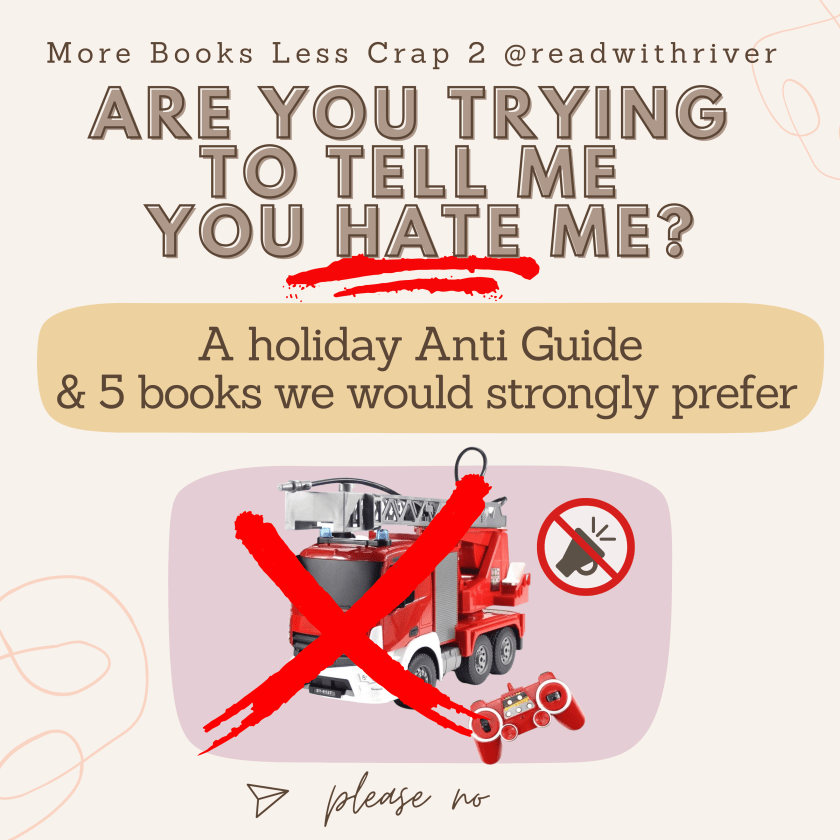
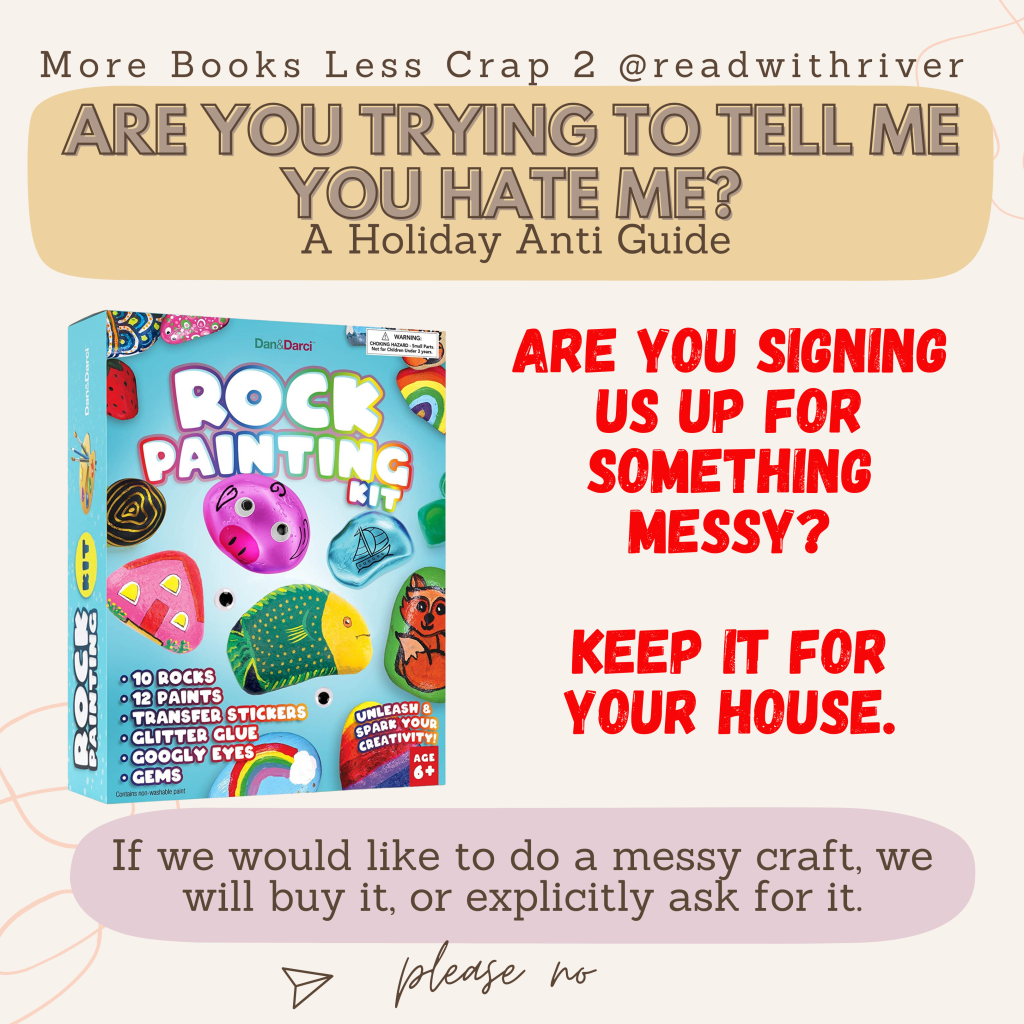
The expectation that when someone gives your kids something- when they were not asked to do so- you must pretend to be grateful, and then let it collect dust until it finally finds its way onto a donation pile or scrap heap is complete nonsense. And I object. So I’ve created a sample season’s greetings but no thank you letter for you all!
The narrative of forced gratitude for something that is actively inconvenient and wasteful is especially infuriating, to me, when the offending item was purchased for my child without considering my child as a person with preferences and feelings. (My kids are capable of talking, why doesn’t the person call them up and ask them “Hey what kinda stuff do you like?”)
Extra infuriating when it’s gigantic and noisy.
Can we please start changing the narrative that relatives and family friends need to give flashy toys to demonstrate a relationship? It’s really messed up, inconvenient, wasteful, and desperately harmful to our environment.
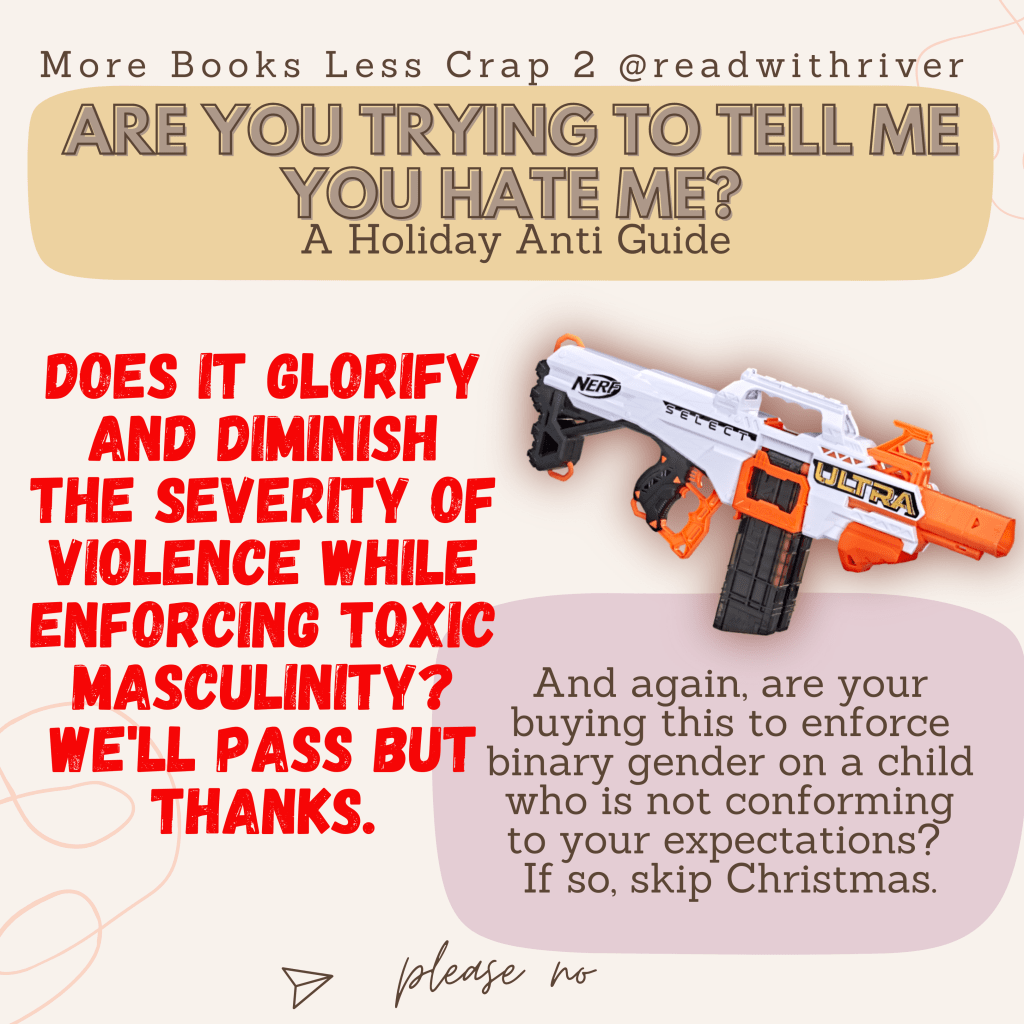
Before you say “well some people can only afford crappy plastic toys and they deserve to enjoy the gift giving time of the year” YES, they do, but can they ask first? Can they ask what the kid actually likes instead of deciding ‘that’s a boy-child and I’m gonna buy them a great big gun thing.’ Can they maybe get a ten dollar bill, go to the convenience store, have it broken into nickels, and give the kid a giant bag of coins? (My brother in law did that one year, and it was such a huge hit with my kid, and it cost him less than ten bucks.) Can they perhaps just buy some nice books, write a nice message in them, and sit down and read to the child? It’s not hard to make space for books, if they’re good books they get enjoyed way longer than a crappy plastic toy, and its an opportunity to build a relationship.
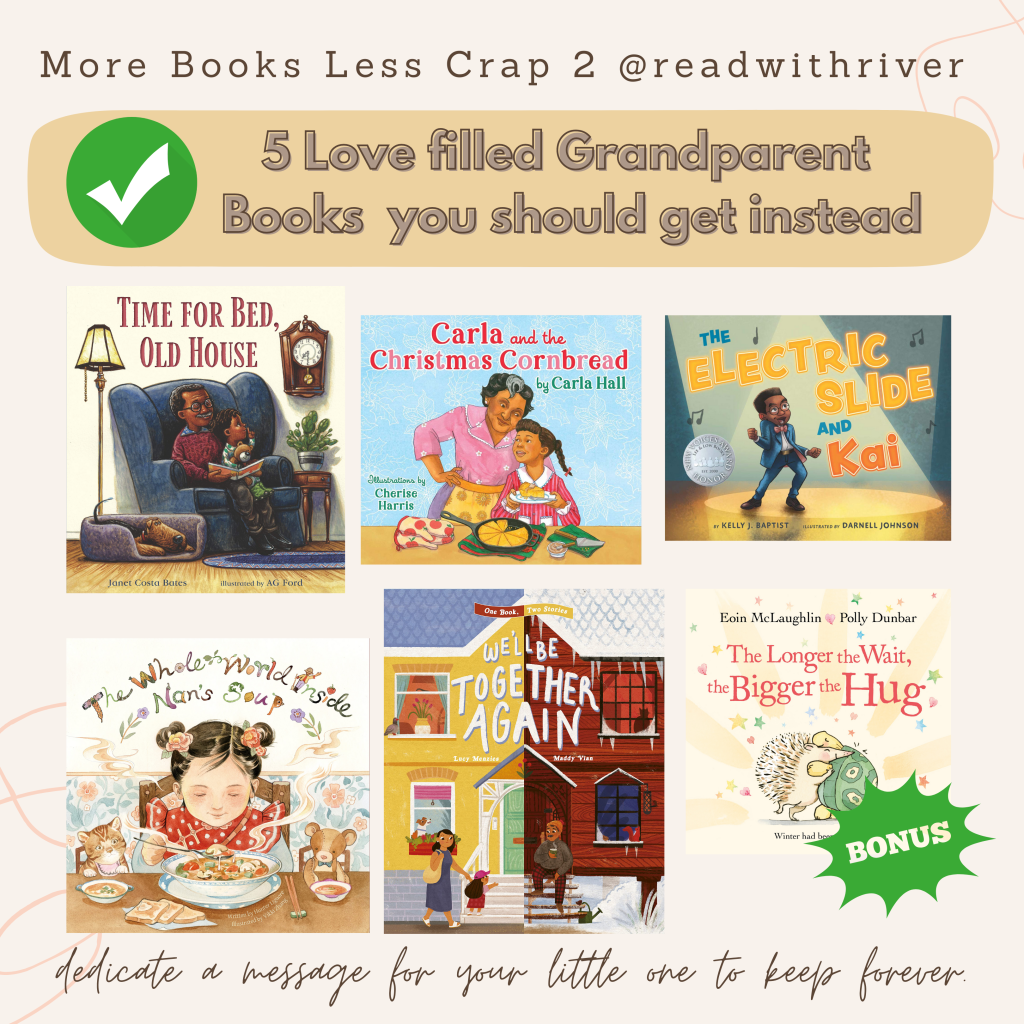
So here is a list of 5 love filled Grandparent Books I recommend Grandparents buy instead of getting random crap in the clearance section at Walmart.
TIME FOR BED, OLD HOUSE Janet Costa Bates, A.G. Ford @candlewickpress a boy’s first sleep over with his Grandpa, and it’s time to say goodnight to every part of the house.
CARLA AND THE CHRISTMAS CORNBREAD Carla Hall and Cherise Harris @simonkids a beautiful nostalgic story, with a delightful array of foods, and family traditions.
THE ELECTRIC SLIDE AND KAI Kelly J. Baptist and Darnell Johnson @leeandlowbooks One boy practices his dance moves in anticipation of finally seeing his grandpa again. A joyful happy family story.
THE WHOLE WORLD INSIDE NAN’S SOUP Hunter Liguore and Vikki Zhang Absolutely beautiful, would be nice to include your own recipe to pass down when writing a dedication into the end papers.
WE’LL BE TOGETHER AGAIN Lucy Menzies and Maddy Vian @quartokids this one is unusual, it flips open like two doors, and shows the little girl waiting to be reunited with the grandfather, who is on the otherside.
THE LONGER THE WAIT THE BIGGER THE HUG Eoin McLaughlin and Polly Dunbar @faberchildrens the third book in this charming classic series about love and affection.
These books were all submitted by the publishers for the #bookstagang _bestof2021 which is currently being judged!
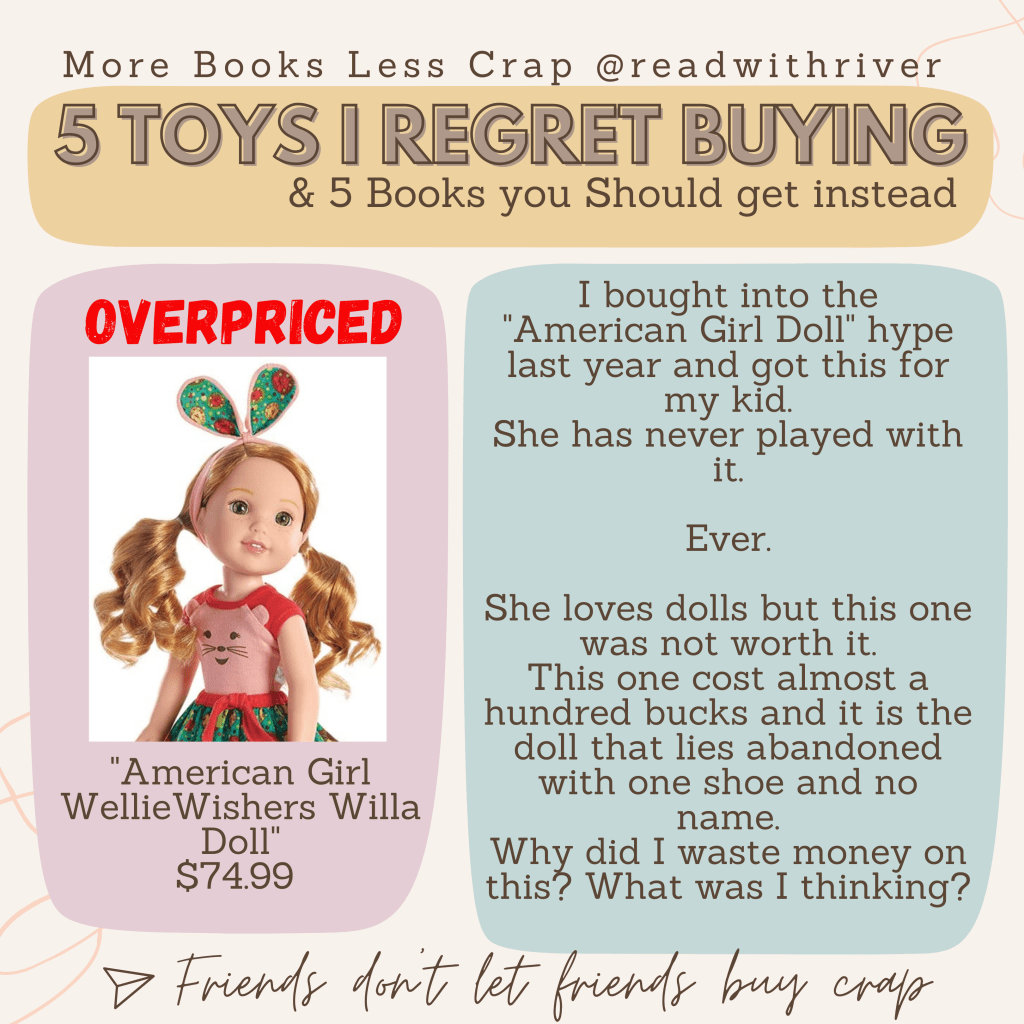
This year I’ve had it with the garbage. I’m done I tell you, finished. I’ve been burned too many times before, and not only am I going to try my best to minimize the plastic crap that comes into my house, I want to warn you all against some of my worst purchasing choices (that came highly recommended) and give you a short list of the most hilarious read aloud books from this year. So yes, I bought all of these crappy toys, please don’t make my mistakes.
These book were all gifted to me by publishers, some are submissions for the #bookstagang_bestof2021 which is being judged as we speak. I am doing NO affiliate linking. If you choose to buy any of these books, I recommend ordering them from your local independent book shop, you can call and place an order ahead of time!
“Gigantosaurus: Roar, Giganto, Roar!: A Puppet Book” by Cyber Group Studios @bigpicturepress Willow is obsessed with this dinosaur puppet book. Such a huge hit!
“When I’m Not Looking” Farren Phillips @yeehoopress hilarious, engaging, search and find element included. Absolute delight.
“The Grumpy Fairies” by Bethan Stevens, adorable, funny, beautiful.
“Here Be Dragons” Susannah Lloyd and Paddy Donnelly @quartokids this one doesn’t technically release until February in North America but if you order from Blackwell’s you can get around that in time for the holidays.
“Sloth and Squirrel in a Pickle” Cathay Ballou Mealley and Kelly Collier @kidscanpress
“Maybe…” by Chris Haughton Okay I said five but here’s a bonus book because I can’t leave it off the list! We love Haughton’s humorous books about mischievous animals and this new one about monkeys tempted by a tiger surrounded mango tree is top notch. Instant classic.
So these are the books I thought were the funniest of the year so far, they’re not the most educational, they’re not the most important or diverse. Just the funniest books my kids and I loved. If you’re looking for something more sentimental, fact filled, or looking to create a more intentionally diverse collection, check out some of my other recommended lists!
Looking for Board Books guaranteed to entertain and stand the test of time? Perfect gifts for Baby Showers, Christmas, holidays, birthdays, or just because!
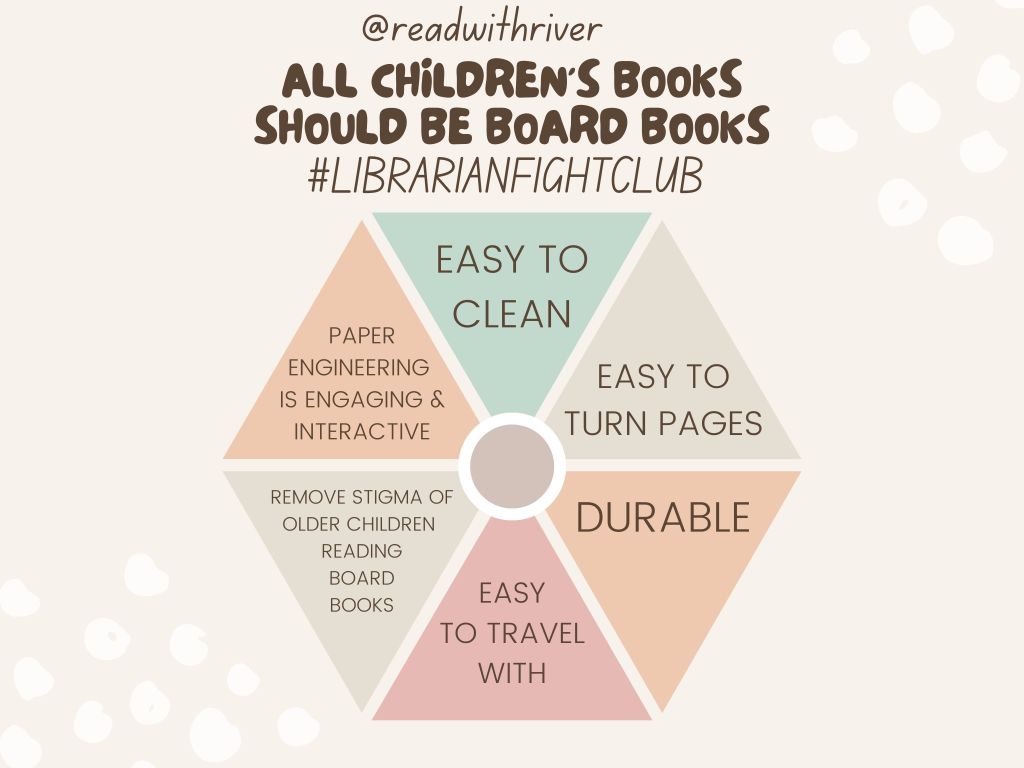
Board Books are the perfect form of children’s book, they hold up, they’re water resistent, they’re easy to travel with. Babies and toddlers can explore them independently and manipulate the pages and the features. Then of course there’s the whole new world of flaps, furs, twists, pulls, tabs, and whatever the heck pop out an artist can imagine and create! Paper Engineering adds a completely new element of STEM creation and 3D thinking otherwise unimaginable.
I LOVE BOARD BOOKS. MY KIDS LOVE BOARD BOOKS. Why do publishers bother printing stories on anything else? It just makes everything more accessible.
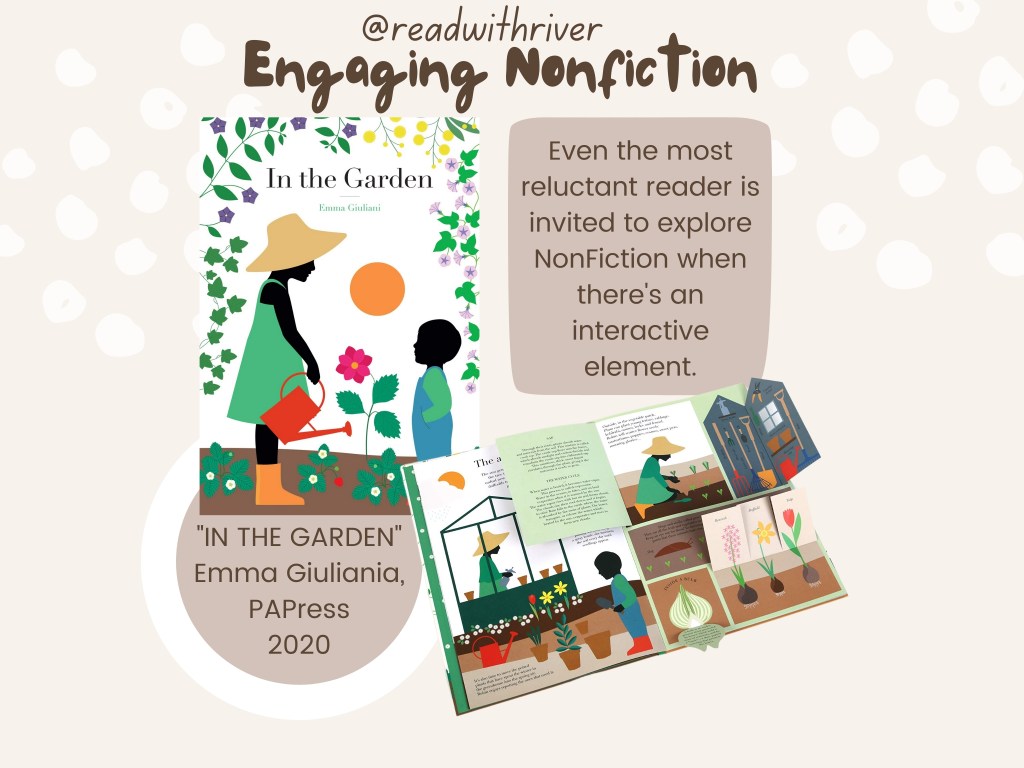
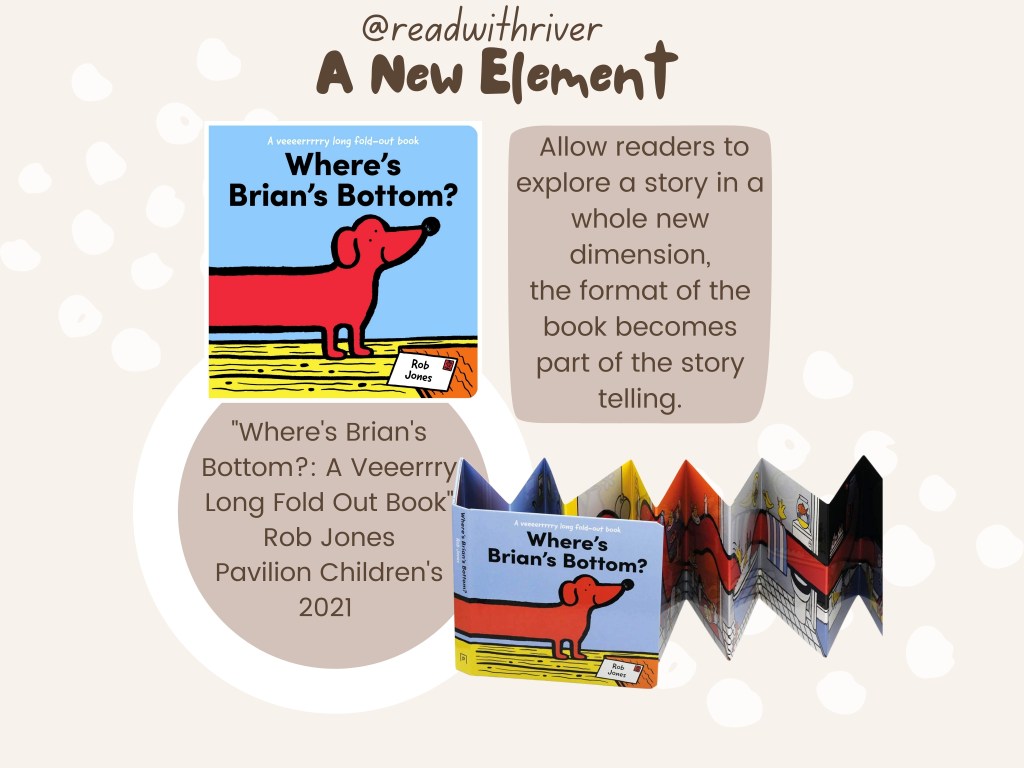
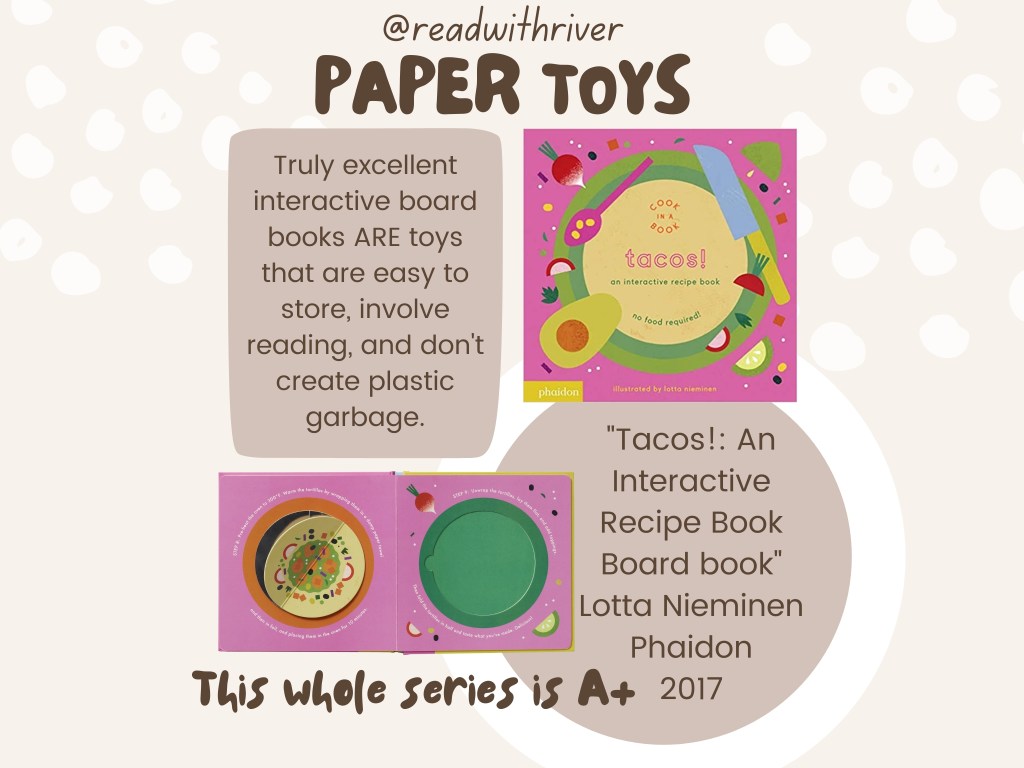
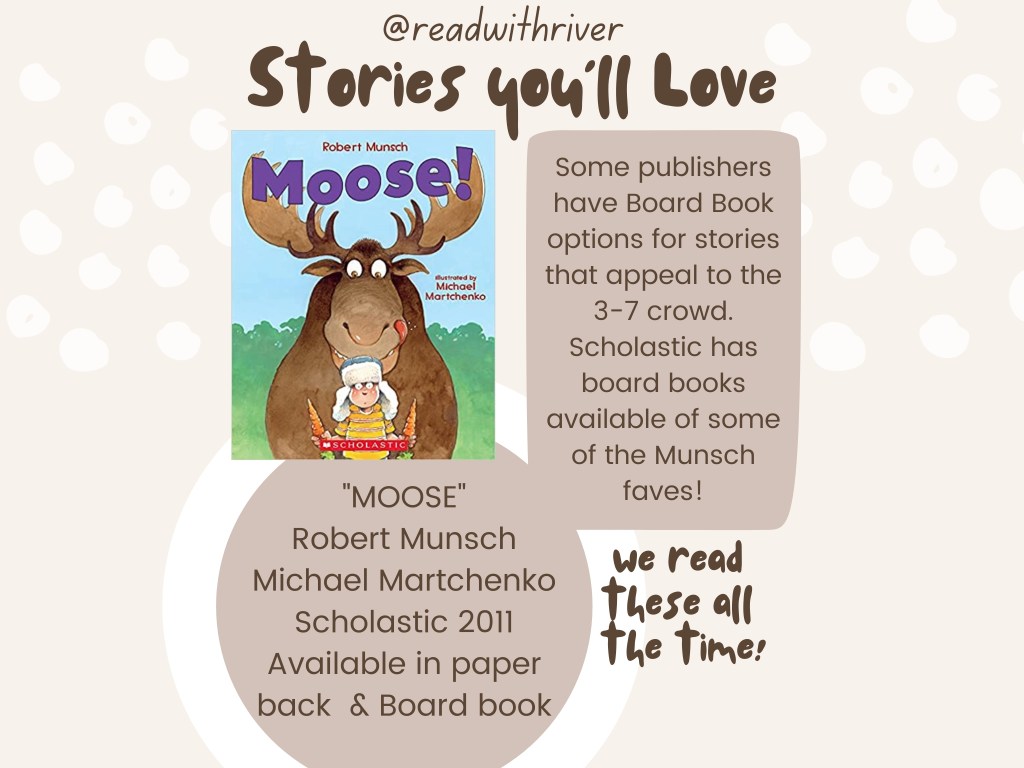
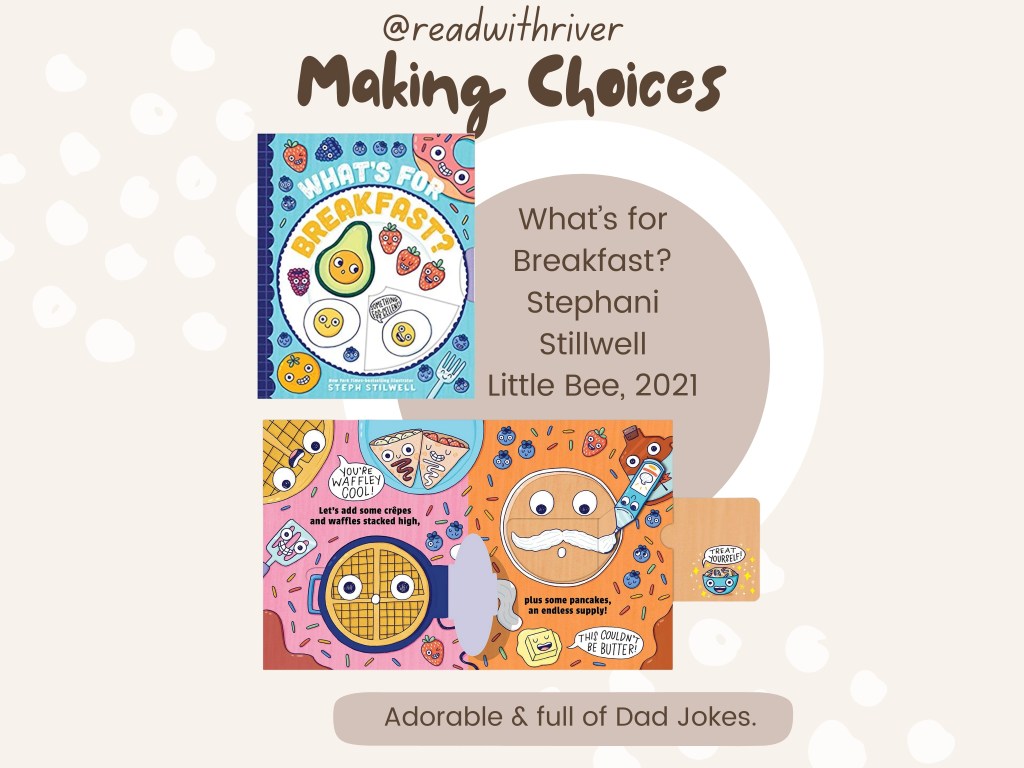
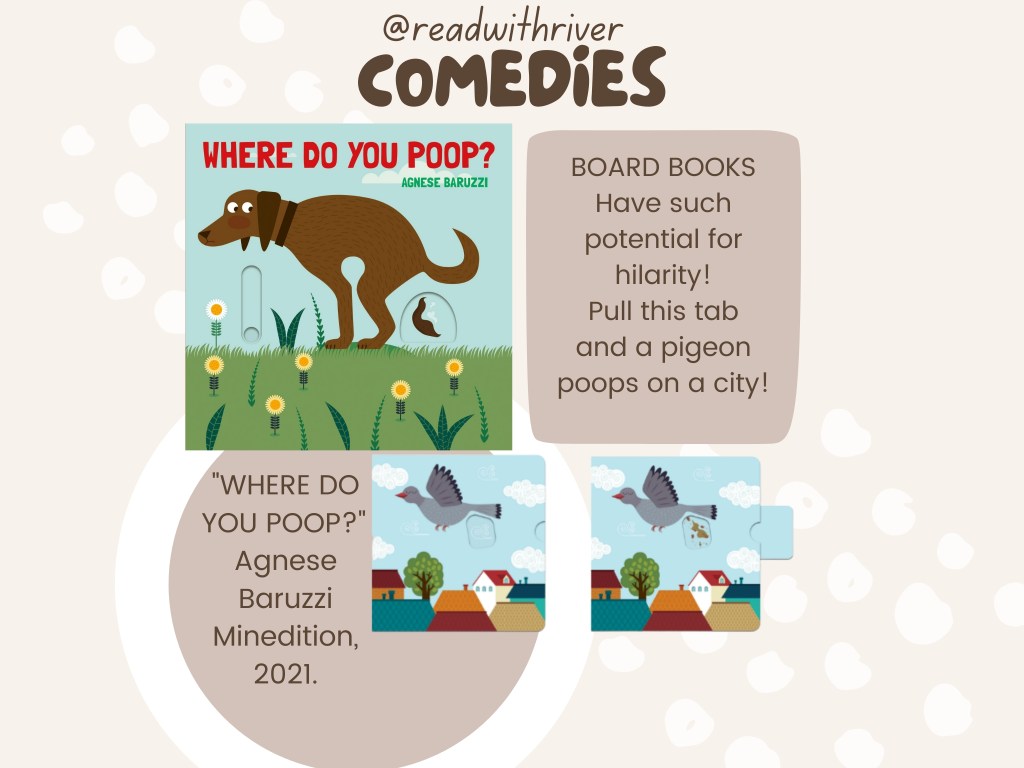
“in the Garden” by Emma Giuliani“Encyclopedia Prehistorica Dinosaurs Pop-Up” Robert Sabuda and Matthew Reinhart“Where’s Brian’s Bottom?: A VEEEEERRRYYYY LONG FOLD-OUT Book” Rob James“Unicorns and Rainbows: A Very Busy Board Book!” Rusty Finch & Ela Smietanka“Tacos!L An Interactive Recipe Book Board Book” Lotta Nieminen the whole series is fantastic.“Moose!” Robert Munsch & Michael Martchenko, Available in paperback and board book.“What’s For Breakfast?” Stephani Stillwell“Fire Truck Tales” Jack Redwing, Josh Talbot“Where Do You Poop? Agnese Baruzzi
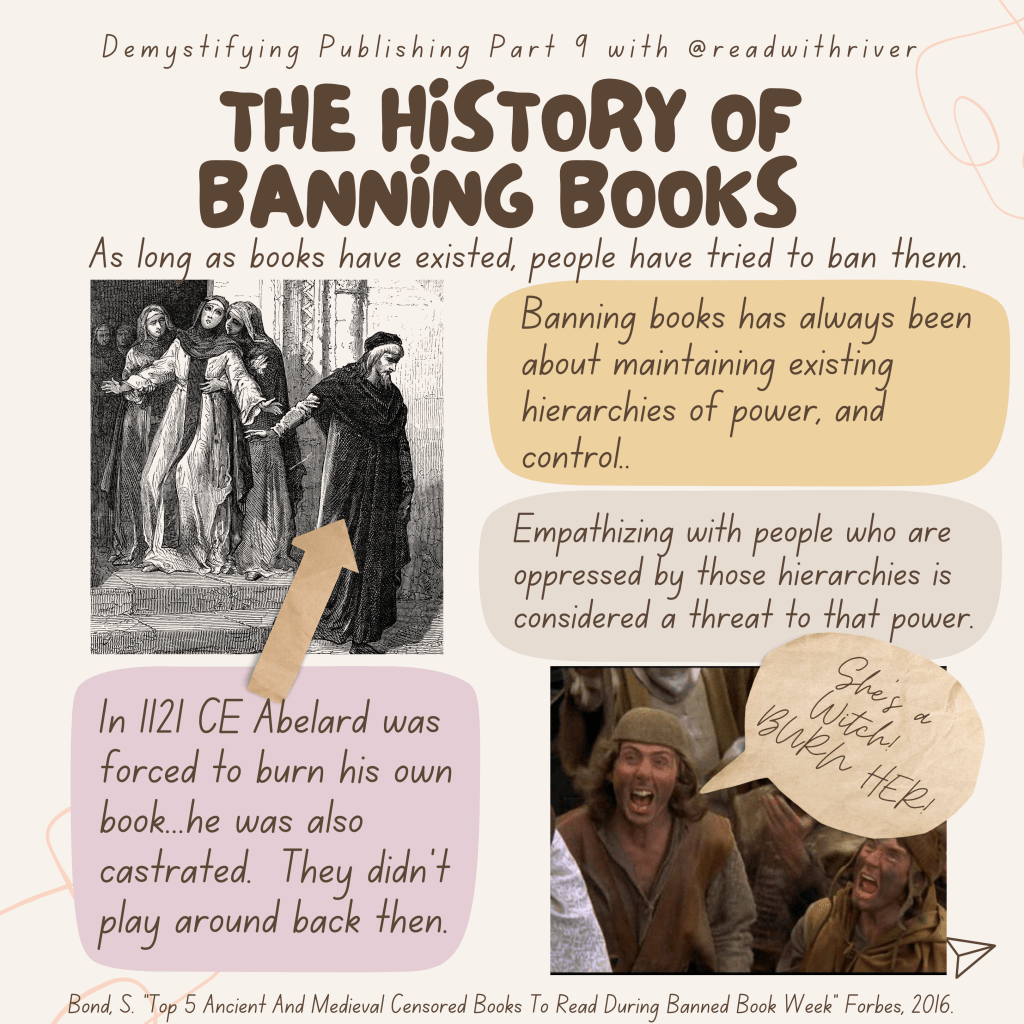
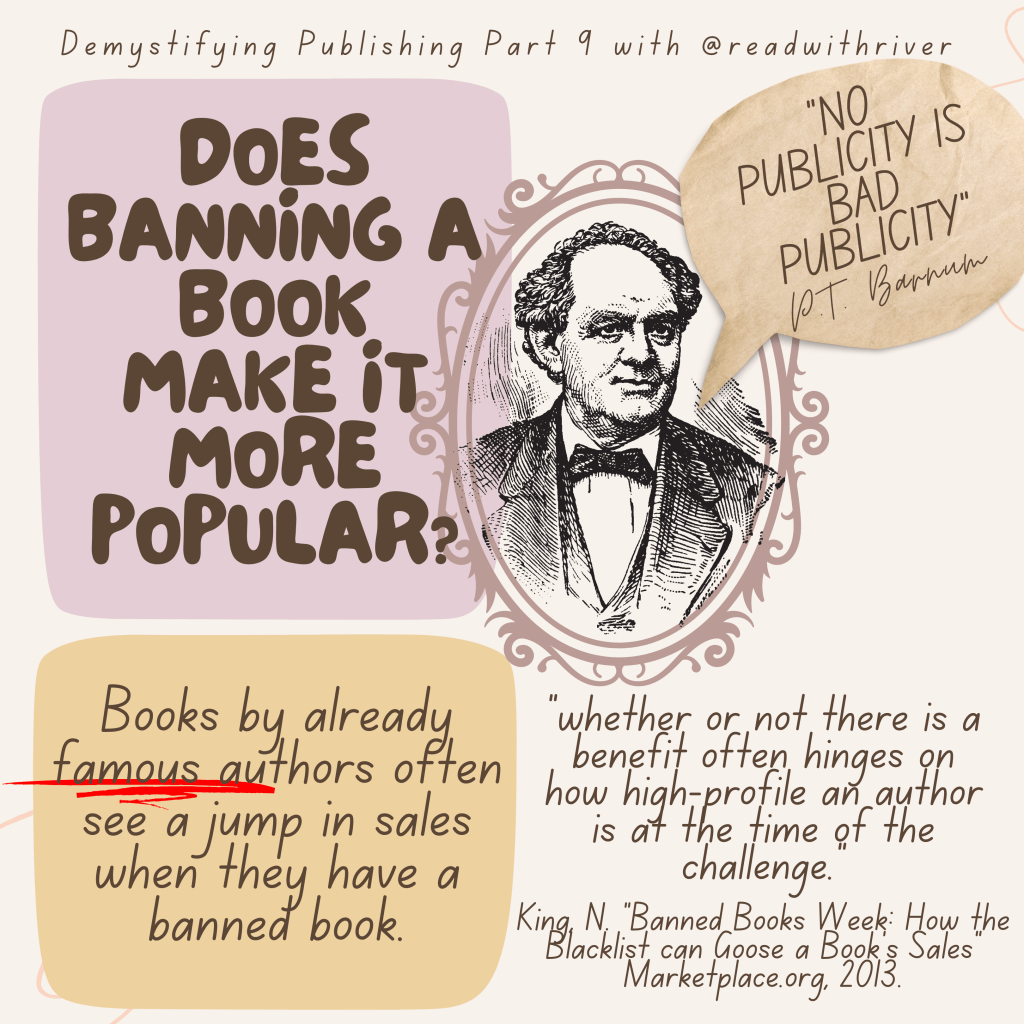
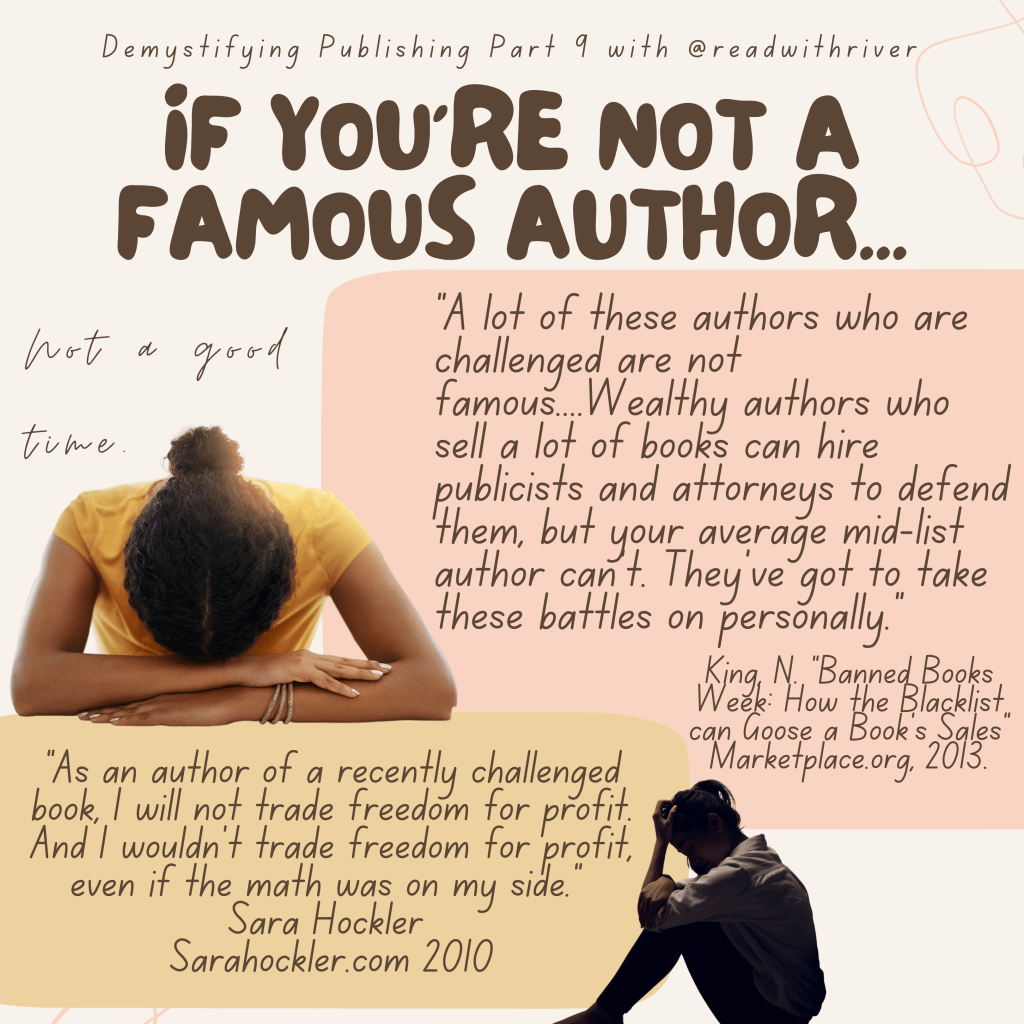
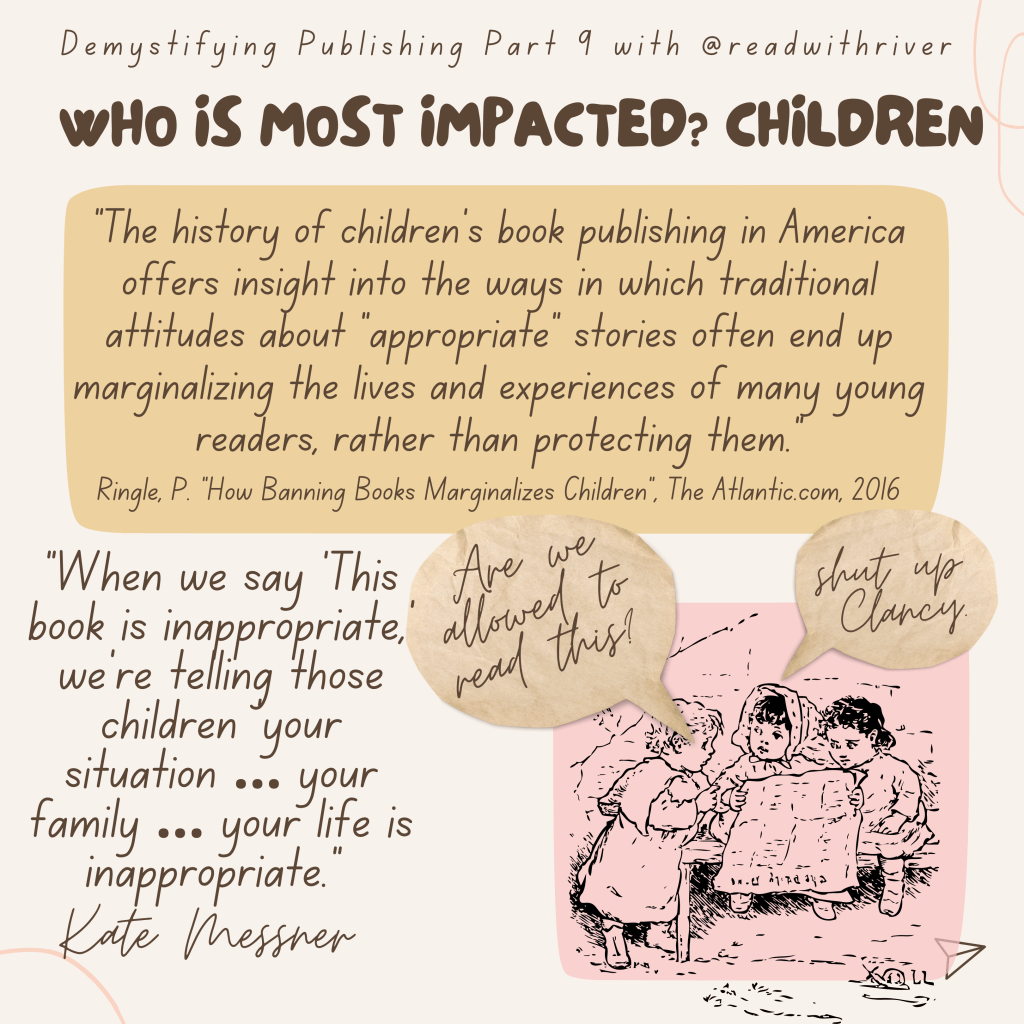
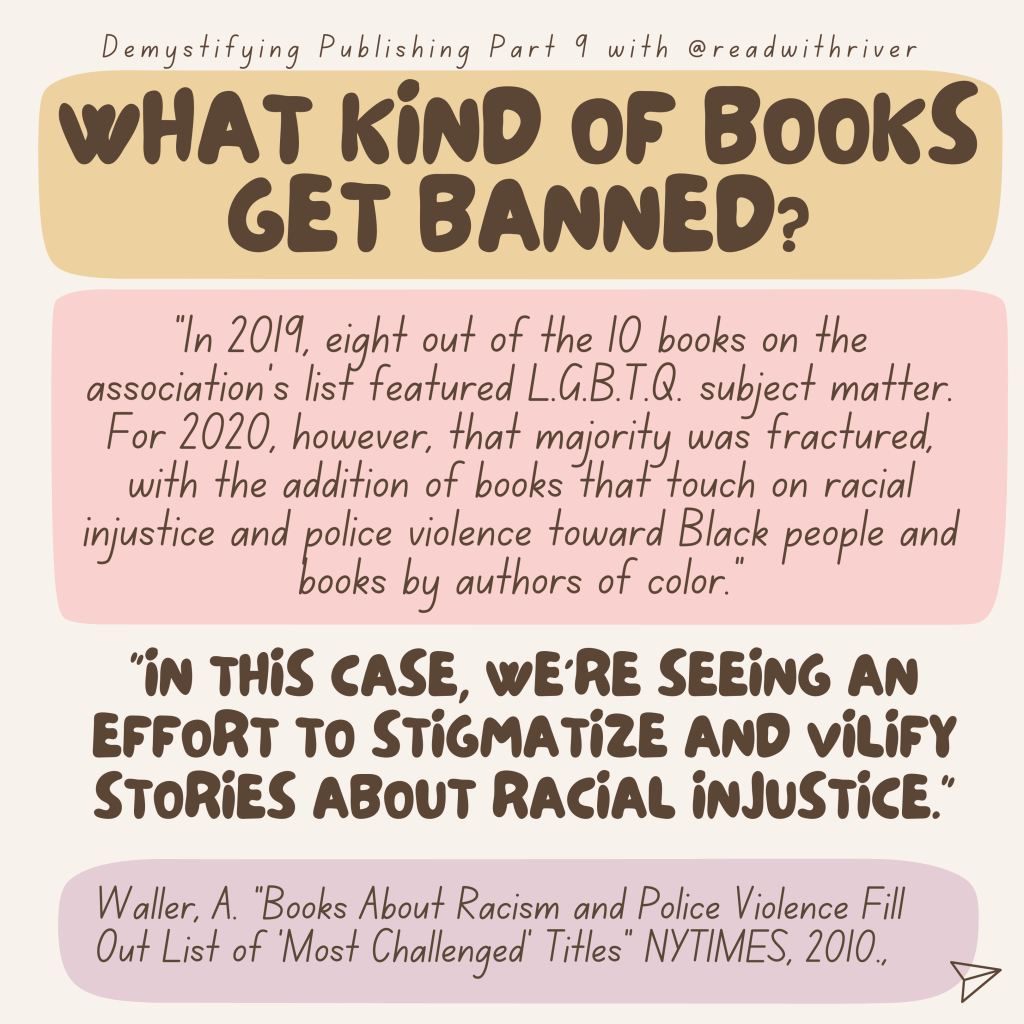
Demystifying Publishing Part 9 with @readwithriver: What happens to Banned Books? #BannedbooksweekThe History of Banning Books. As long as books have existed, people have tried to ban them. Banning books has always been about maintaining existing hierarchies of power, and control. Empathizing with people who are oppressed by those hierarchies is considered a threat to that power. In 1121 CE Abelard was forced to burn is hown book…he was also castrated. They didn’t play around back then. (Source Bond, S. ” Top 5 Ancient and Medieval Censored Books TO Read During Banned Book Week” Forbes, 2016.Banned Books Today. Are banned books illegal tools of the devil? …No…Books are banned by individual school boards, libraries, schools, etc. You can still buy them, they are often harder to find. Does banning a book make it more popular? “No Publicity is Bad Publicity”-P.T. Barnum. Books by already famous authors often see a jump in sales when they have a banned book. “Whether or not there is a benefit often hinges on how high profile an author is at the time of the challenge.” (Source King,N. “Banned Books Week: How the Blacklist can Goose a Book’s Sales” Marketplace.org, 2013.)IF You’re Not A Famous Author… not a good time. “A lot of these authors who are challenged are not famous….Wealthy authors who sell a lot of books can hire publicists and attorneys to defend them, but your average mid-list author can’t. They’ve got to take these battles on personally.” (Source. King,N. “Banned Books Week: How the Blacklist can Goose a Book’s Sales” Marketplace.org, 2013.) “As an author of a recently challenged book, I will not trade freedom for profit. And I wouldn’t trade freedom for profit, even if the math was on my side.” (Sara Hockler, Sarahockler.com, 2010) Who is most Impacted? Children. “THe history of children’s book publishing in America offers insight into the ways in which traditional attitudes about “appropriate” stories often end up marginalizing the lives and experiences of many young readers, rather than protecting them.” (Source, Ringle, P. “How Banning Books Marginalizes Children,” TheAtlantic.com, 2016.) “When we say ‘this book is inappropriate’ we’re telling those childrne your situation…your family…your life is inappropriate.”-Kate MessnerWhat kind of books get banned? “In 2019, eight out of the 10 books on the association’s list featured L.G.B.T.Q. subject matter. For 2020, however, that majority was fractured, with the addition of books that touch on racial injustice and police violence toward Black people and books by authors of color.” “In this case, we’re seeing an effort to stigmatize and vilify stories about racial injustice.”(Source, Waller, A. “Books About Racism and Police Violence Fill Out List of ‘Most Challenged Titles.” NYTIMES, 2020.)Banned Books Week Since 1982 every year in September Banned Books Week is celebrated to fight against challenges, and support books that have been banned. A Coalition of Organizations works together for banned Books Week. Check it out to learn more.
Sources
Source 1: Bond, S. ” Top 5 Ancient and Medieval Censored Books TO Read During Banned Book Week” Forbes, 2016.
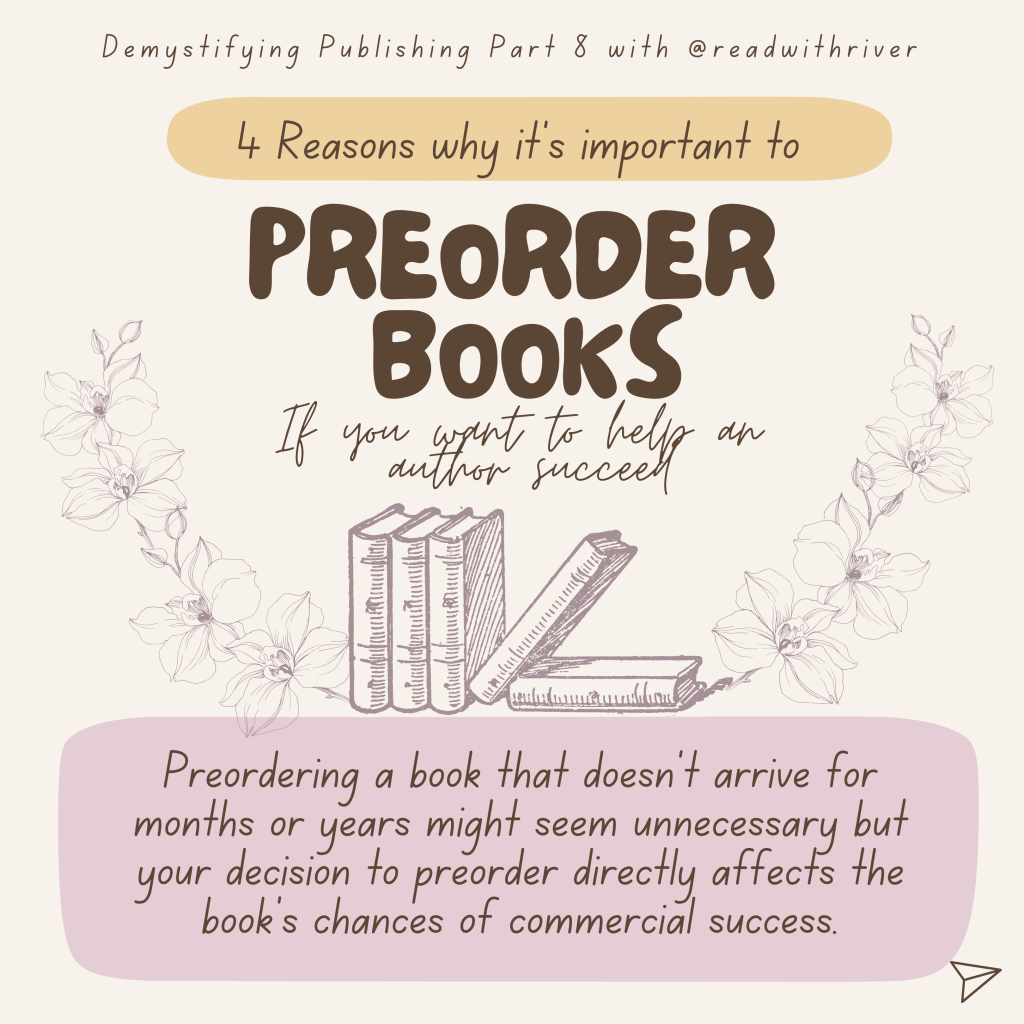
Have you ever wondered why publishers and authors are always publicizing preorder availability? There’s some very practical reasons for it!
Preordering a book that doesn’t arrive for months or years might seem unnecessary but your decision to preorder directly affects the book’s chances of commercial success. 1. Pre-release, preorders signal to publisher there will be interest, and they can adjust print runs to accurately meet demands. THe size of an initial print run announces to the world the confidence the publisher has in a book’s commercial success. The bigger the print run, the more confidence, the more buzz. Under printing can be a huge problem, because often people who cannot find a book in stock when they want it, will forget about it and not come back and buy it later.2. Preorders then build buzz and encourage larger orders from big retailers. The buzz around the book is a great sales point that gets big retailers to make larger initial orders to prepare for consumer demand. This is of course not a good thing if after the fact nobody buys them, because they’ll be returned. But having them ordered and in stock means that they are available and a book has a chance to succeed. 3. Post-release, preorders sales count as part of first week sales. These inflated numbers allow books to launch and climb the rankings onto the bestseller lists which guarantee continued sales. Being on a bestseller list is one of the best things that can happen to a book commercially. People who have never heard of it, and might have never considered buying it, will go out and buy it because it is on this list.4. Support independent Bookshops with guaranteed sale for their stock, helps mitigate risks. Independent bookshops help authors with creating readership and awareness. Preorders are guaranteed sales, and it allows retailers who operate on small profit margins and are risk averse to have a guaranteed sale on a book. Independent bookshops work hard to create opportunities for local authors and illustrators, to help them create buzz and get books out there. Supporting indie bookshops is supporting the culture of books.
Special thanks to the team at Walker Books for answering questions about this issue as well as UK Book Publisher, Editorial director at Andersen Press, Libby Hamilton @LibbyHamHam on Instagram
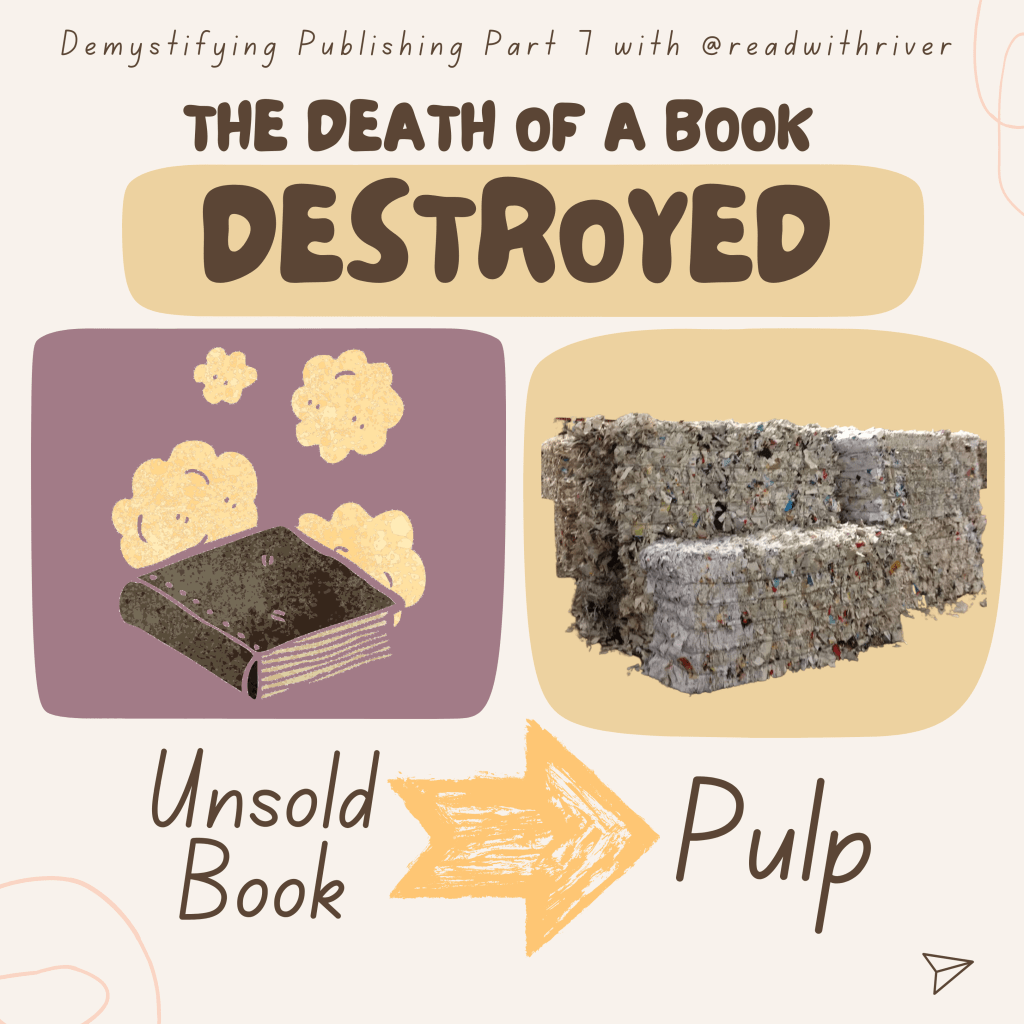
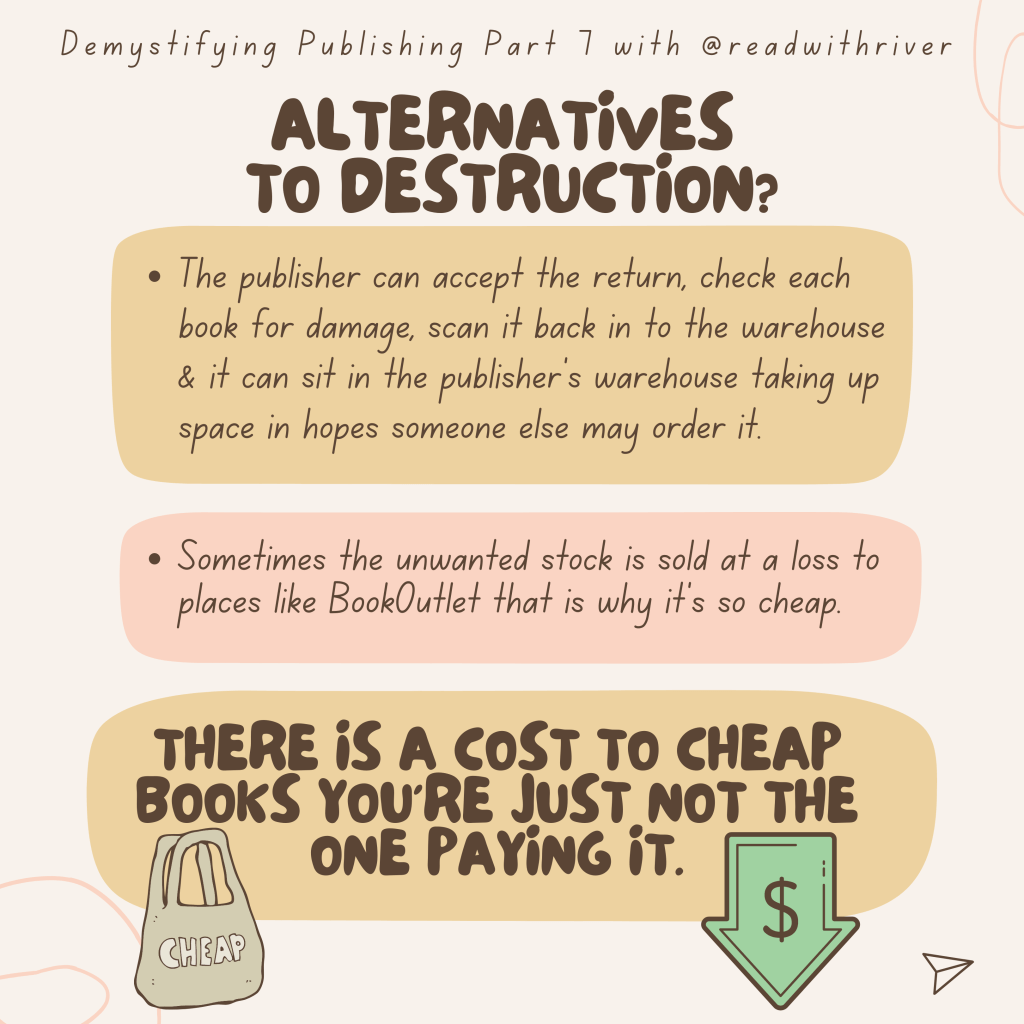
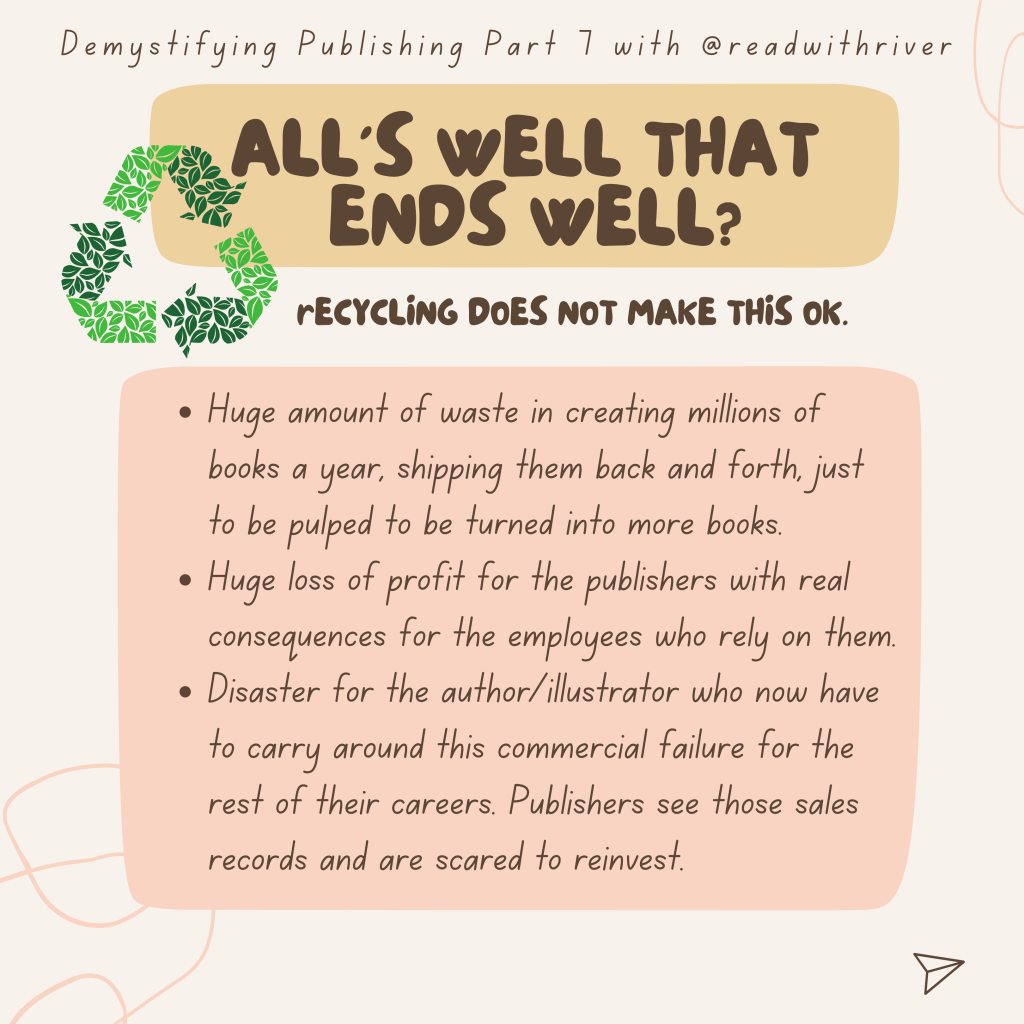
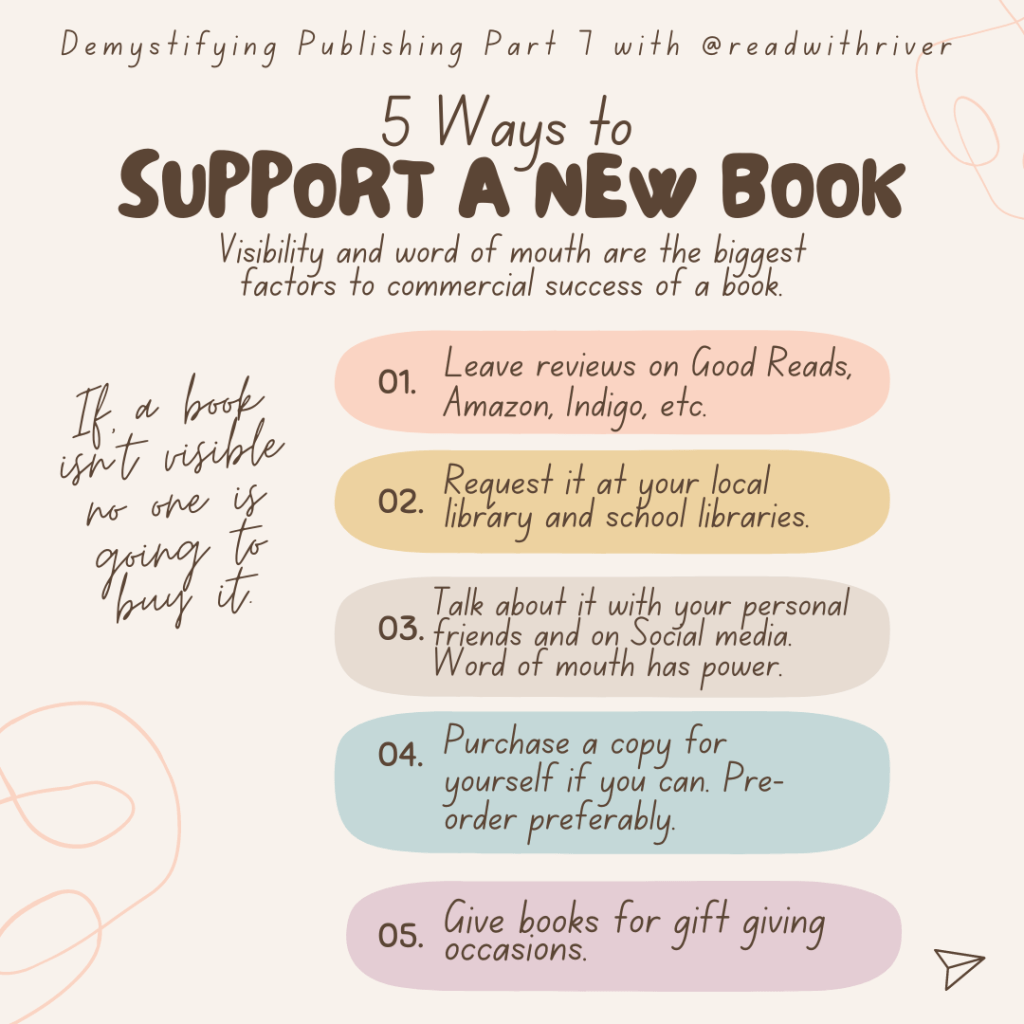
“What Happens to Books that Don’t Sell? It’s Not Good.”Books Shall Gather no Dust. A book launches. Retailers have ordered copies from publishers, the publishers are paid. But what happens if no one buys that book from the retailer? New books can be returned to publishers if they’re not purchased with approx 3-12 months after the launch (depending on the contract.) The window for success or fail is tiny! The Death of a book, Destroyed. Unsold books that are returned to the publisher, are usually immediately sent to be destroyed, turned into a liquid pulp. That pulp is then reused to make other things, most notably pulp fiction books. Alternatives to Destruction? The publisher can accept the return, check each book for damage, scan it back into the warehouse and it can sit in the publisher’s warehouse taking up space in hopes someone else may order it. But this is costly, and wasteful compared to pulping. Sometimes the unwanted stock is sold at a loss to places like BookOutlet (which is why their prices are so cheap!) There is a cost to cheap books, you the consumer however are just not the ones paying it. The publisher, author, and all of the people involved with the book are the ones to pay.The History of Pulping: A long history of returns. As early as the 17th century book publishers were ripping apart pieces of unsold books to create new books. To this day the pulp from destroyed books is used to create paper to…MAKE MORE BOOKS!All’s well that ends well? Recycling does not make this okay. Huge amounts of waste in creating millions of books a year, shipping them back and forth, just to be pulped to be turned into more books. Huge loss of profit for the publishers with real consequences for the employees who rely on them. Disaster for the author/illustrator who now have to carry around this commercial failure for the rest of their careers. Publishers see those sales records and are scared to reinvest.5 Ways to Support a New Book! Visibility and word of mouth are the biggest factors to commercial success of a book. If a book isn’t visible no one is going to buy it. 1. Leave reviews on Good Reads, Amazon, Indigo, etc. 2. Request it at your local library and school libraries. 3. Talk about it with your personal friends and on Social Media. Word of mouth has power. 4. Purchase a copy for yourself if you can, Pre-order preferably. 5. Give books for gift giving occasions.
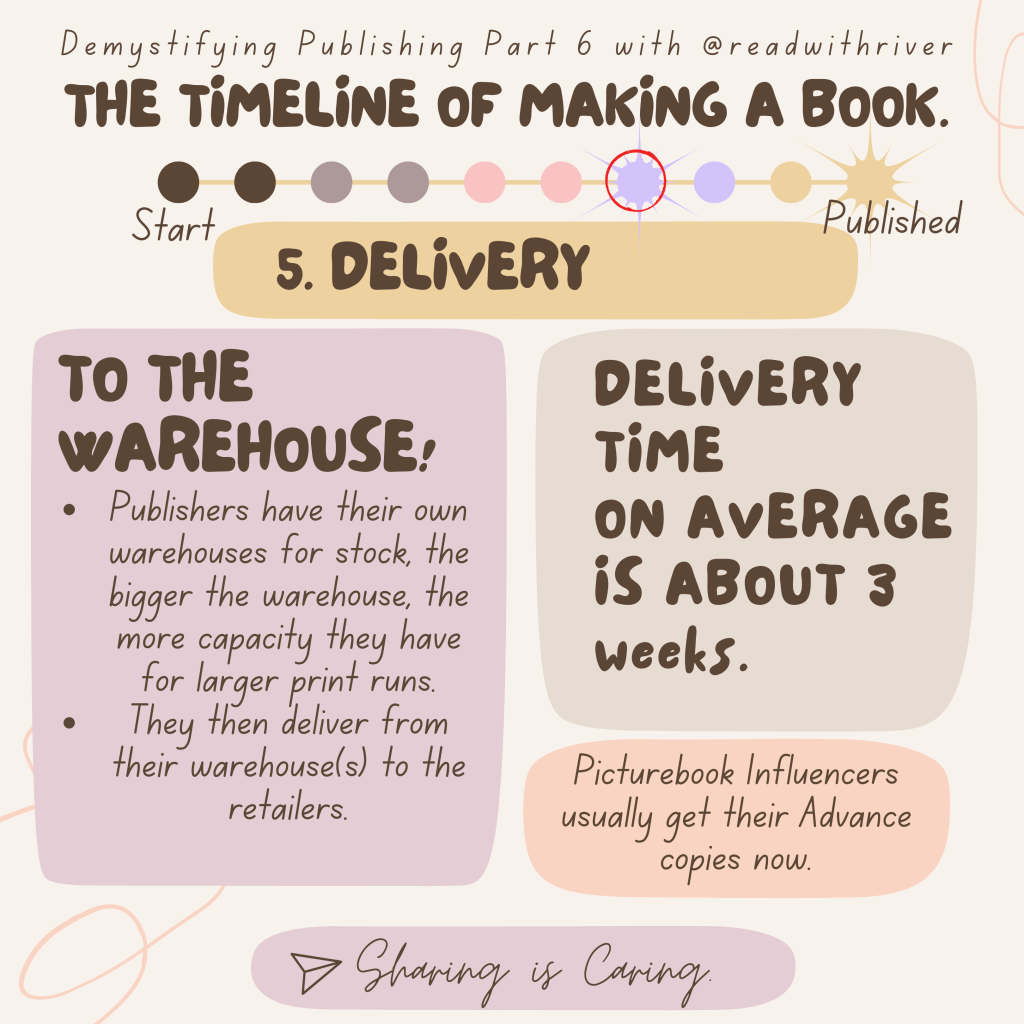
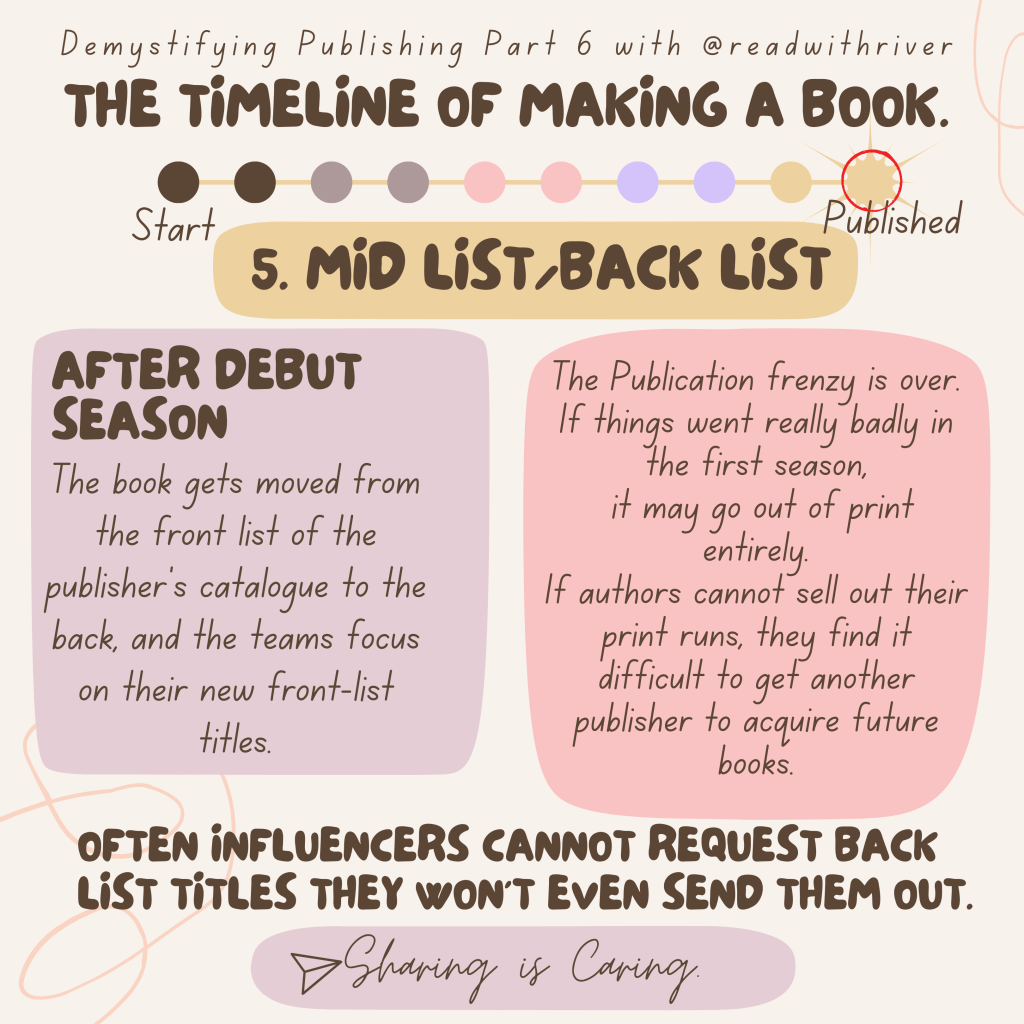
The amount of time it takes to put out a book can vary wildly in the traditional publishing industry. This is dependent on a number of factors, for example books without pictures do not require illustration and can be put out fairly quickly. Where as in some cases a book can take over two years between acquisition and actual publication.The starting point here is the acquisition of the book, so when the publisher makes the decision to purchase a text. A meeting is held of all departments and if the okay is given, then negotiations begin between the author/agent and the publisher. Eventually contracts are signed (At this point the author/agent receive part of their Advance) and announcements are made.Next comes first round of edits and design decisions. For picture books that means choosing an illustrator and them getting to work. For non picture books that means cover and text design. The illustration process can take up to a year, and some illustrations require more time consuming labour than others.MORE EDITING> While sales does the sell-in.Printing and Binding, and Sales.Delivery to warehouses, and then to retailers.Promotion, marketing, publicity, and sales.Debut!After debut season is over, the book no longer receives the same publicity and marketing push as it did in it’s debut. Unless it was highly successful
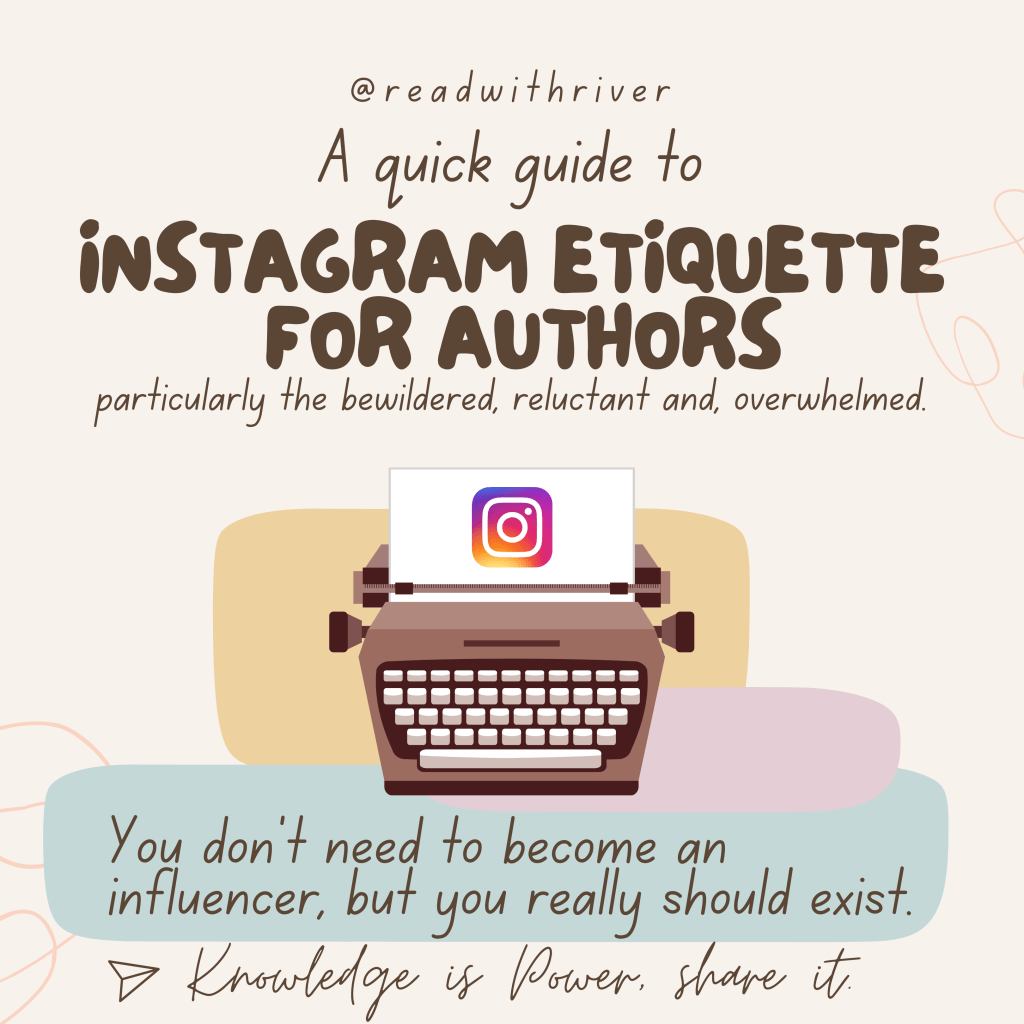
A Quick Guide to Instagram Etiquette for Authors: Particularly the bewildered, reluctant and, overwhelmed. You don’t need to become an influencer but you really should exist.
Why Instagram?
You’re an author, you’ve spent your life writing and planning for the day when your books are available to the general public, you want to hear from your readers, you want to help your book sales move along. Social media is one of the few free tools you have at your disposal to connect with your readership and your target audience easily and globally. It’s also one of the ways that readers seek to connect to the authors of books that they enjoy, the hand mailed fan letter is sadly a dying art.
Okay, but why Instagram? Why not Twitter or, Tik Tok or, Facebook or, Pinterest? That’s a great question, and each of these platforms have different advantages and appeal to different demographics. Some people manage to juggle a presence on multiple platforms but it’s a lot of work, and it’s likely you will run out of steam. So picking one platform to start out with is more of a reasonable starting goal.
When it comes to responding to a fan base and encouraging buzz and sales, the two platforms readers, reviewers and influencers will be actively looking to reach you the author of the books they’re discussing and showing off, are Twitter and Instagram. There is a healthy Book loving community on TikTok (see New York Times article about Booktok linked at the bottom) but getting on TikTok is more difficult, the demographic is exceedingly young, and the kinds of books people are discussing on TikTok tend to be romance/young adult fantasy specifically. So if you’re a picturebook writer, TikTok is not the right place for you.
It comes down to Twitter vs. Instagram
Twitter is a great place to connect with people within the publishing industry and join in the conversation. Twitter is where you’ll find editors, agents, writers, and everyone else with a stake in the game professionally. If you’ve had a book come out people may discuss it on Twitter and look for you, the author/illustrator, to tag in their tweets. So having a presence here gives you a voice in this discussion with your colleagues. But Twitter is not where you’re going to find your general target audience for the most part.
You will find far fewer publishing industry people publicly on Instagram, but what you will find are your book consumers. 1 billion people use Instagram every month (compared to Twitter’s 330 million) and 80% of those Instagram users will use the app to research products and services. Instagram is designed for showing off luxury goods, books being an enormous niche. If you actually want to help your book sales, Instagram is the app to jump on.
Instagram is a primarily visual platform, influencers/creators reach their audiences with photos and videos, text is secondary. The #Bookstagram world is where you will find the community of people devoted to spending all their time fawning over books. How do you engage with #Bookstagram in an appropriate way? Well, I’ve broken it down for you below step by step…
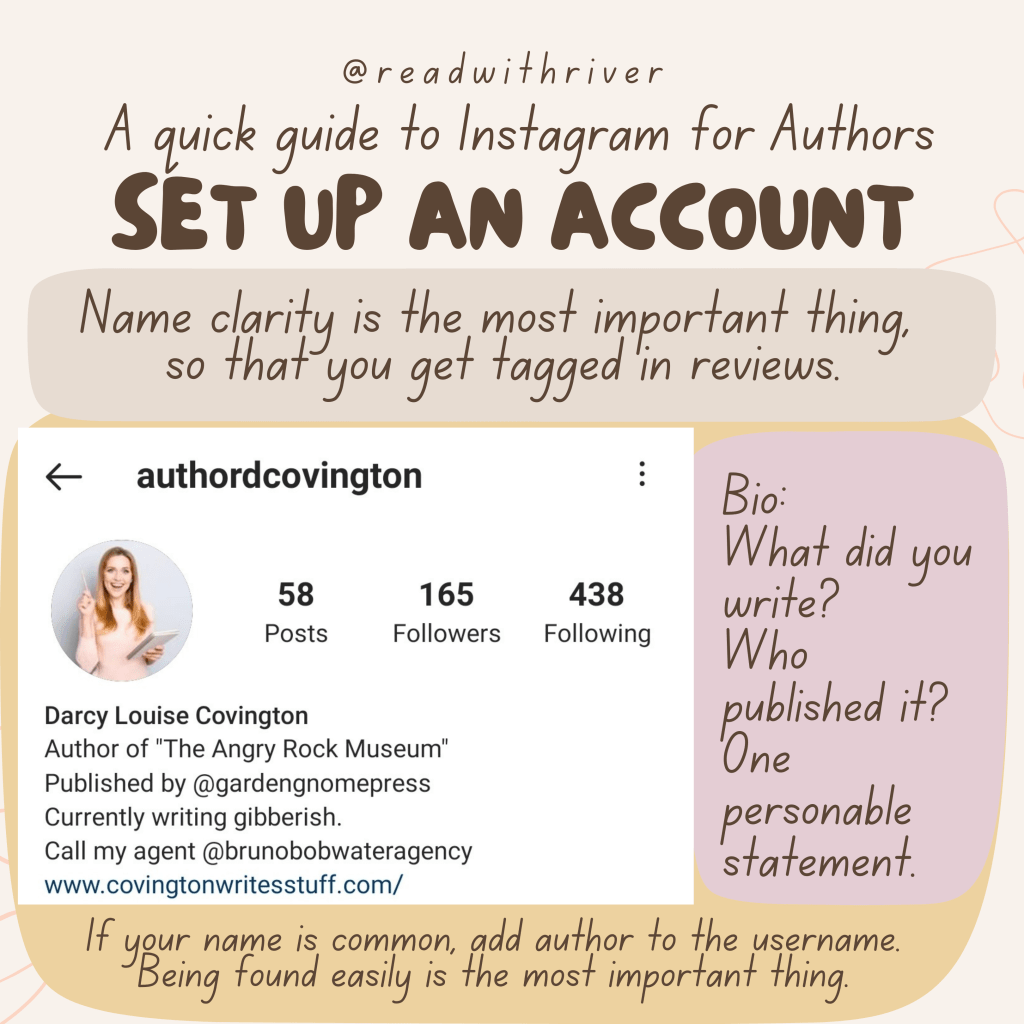
Set up an Instagram Account: Name clarity is the most important thing, so that you get tagged in reviews, if your name is common add “Author” to the user name. Being found easily is absolutely the most important thing. For your Bio, keep it simple. What did you write? Who published it? One personable statement.
When setting up your author account keep it simple, people need to be able to find you that’s the primary purpose here. If an influencer or reader is sharing your book, they’re going to try and tag you in that review, so when they type your name in it needs to pop up and be clearly you.
Profile photos: Professional headshot is excellent, if you’re a picture book author getting a portrait made of you by the illustrator of your book also works. If you want an interesting photo make sure it’s clear and you’re visible in it.
Some authors do not like to be in photos. I get it, it’s not what you’re here for. But think of this as your ID badge. It needs to look legitimate, and a picture of your garden or your dog just isn’t going to work.
What to post? Profile Grid aka Main feed: Bare minimum, you don’t need to post lots of content. Just put 6-9 photos up to show you’re a real person. You can’t leave it empty, empty is suspicious. Basic photo content: book launch photo, book signing photo, throw back photos, pleasant outdoor scene, surrounded by books, just keep it classy.
If you want to start creating content, posting photos of your life and your work regularly, by all means go for it. But if it’s not your bag, that’s okay. You just need a profile active and professional looking up to respond to your reviewers, to get that professional looking profile you do need to put up a few photos on the page. An empty profile page looks suspicious and people will think you’re a bot. So put a few photos up and call it a day.
Navigating the App: Icons
This is all pretty easy to navigate if you want to just try looking around but here is my break down if it helps you feel more comfortable:
Profile Grid: Main Feed: These are the photos/videos you see on a person’s profile screen.
Reels: Reels are short form videos, often set to music, currently very popular with Instagram.
IGTV: Instagram TV is where people put up videos longer than 1 minute.
Filters: this is if you have created a software filter program for people to edit their photos in stories, unless you’re a programmer this likely does not apply to you.
Photos you’re Tagged in: If someone puts a post up of you or your book and tags you in that photo, it will appear here. You can adjust your settings so that these require your approval, and if you don’t like the photo you can have it removed.
Home: Home takes you to your main feed screen where you’ll be shown posts by everyone you’re following, and also along the top of the screen you’ll see everyone’s daily “stories” see below for stories.
Explore: This is where you can search for people or subjects using hashtags, Instagram will also show you content it thinks you’re going to like here.
Likes, Comments, Tags: This is where you will have a log of all of the engagement on your posts, if someone likes your photo or left you a comment it will pop up here.
Profile: Back to your main page, this is where you can access logging in and out, switching accounts, and other settings.
Navigating the App: “Stories” top of home screen, stories expire after 24 hours, this is where you share posts, remember to tag the creator with @theirname. This is for more informal content, aesthetic coffee photo, selfie, funny duck.
If you put up a story of your self talking, remember to hit the captions button. There are a lot of possibilities for adding to your stories but one thing to remember is that most people view stories without sound. So make sure any messages appear in writing as well as with sound.
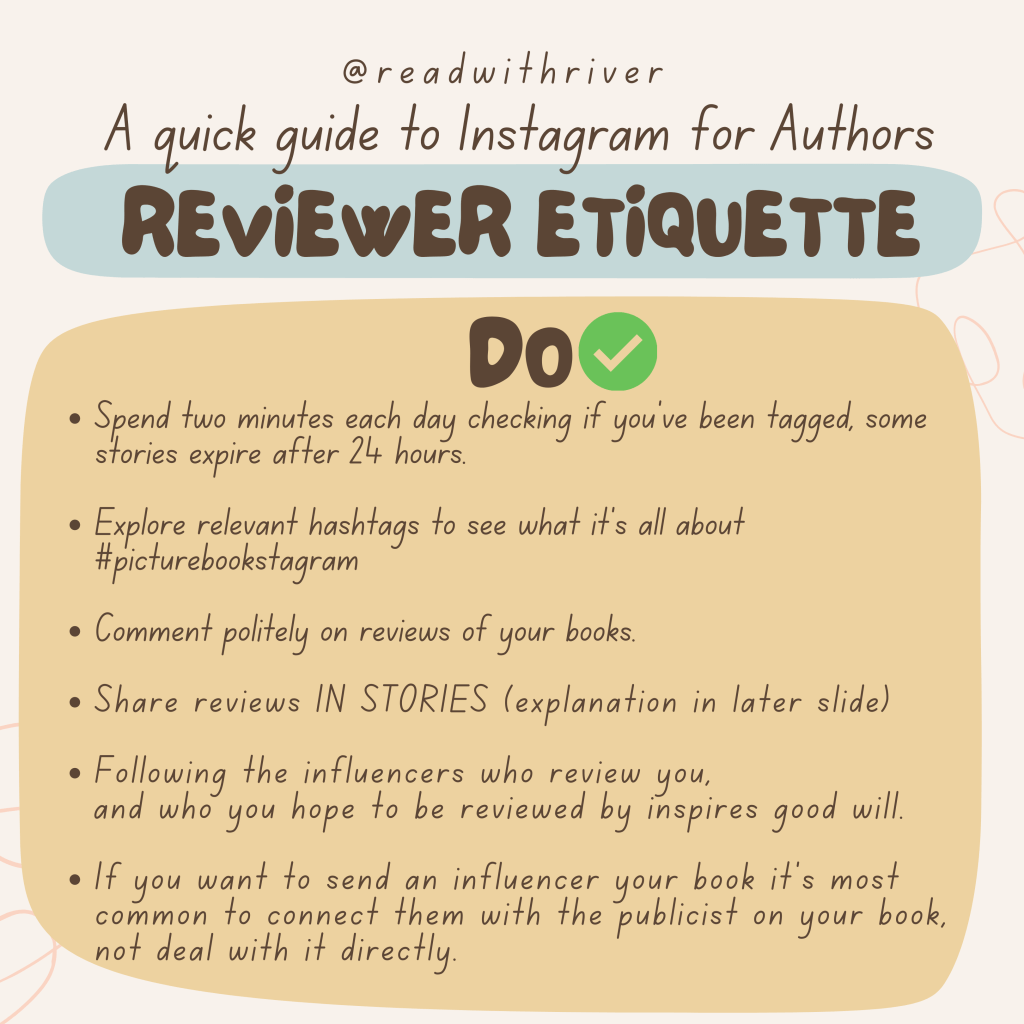
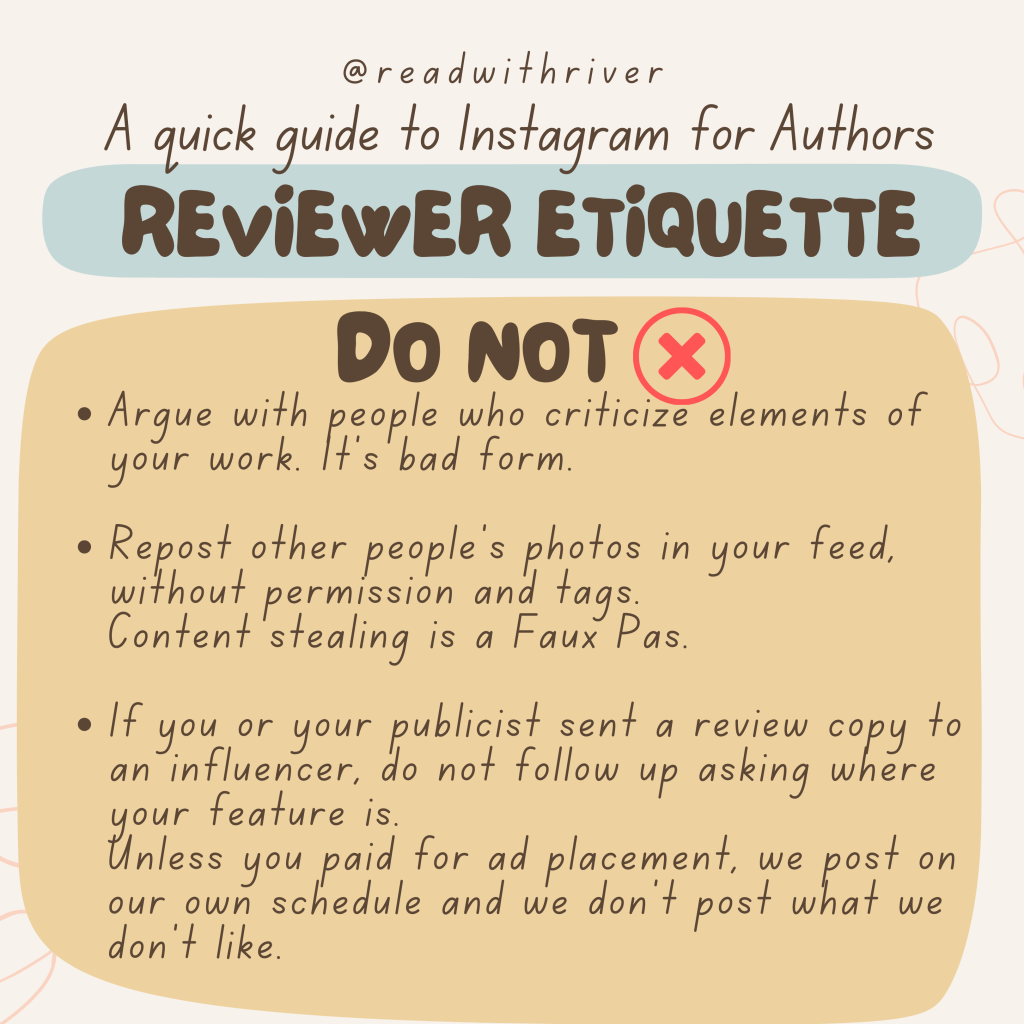
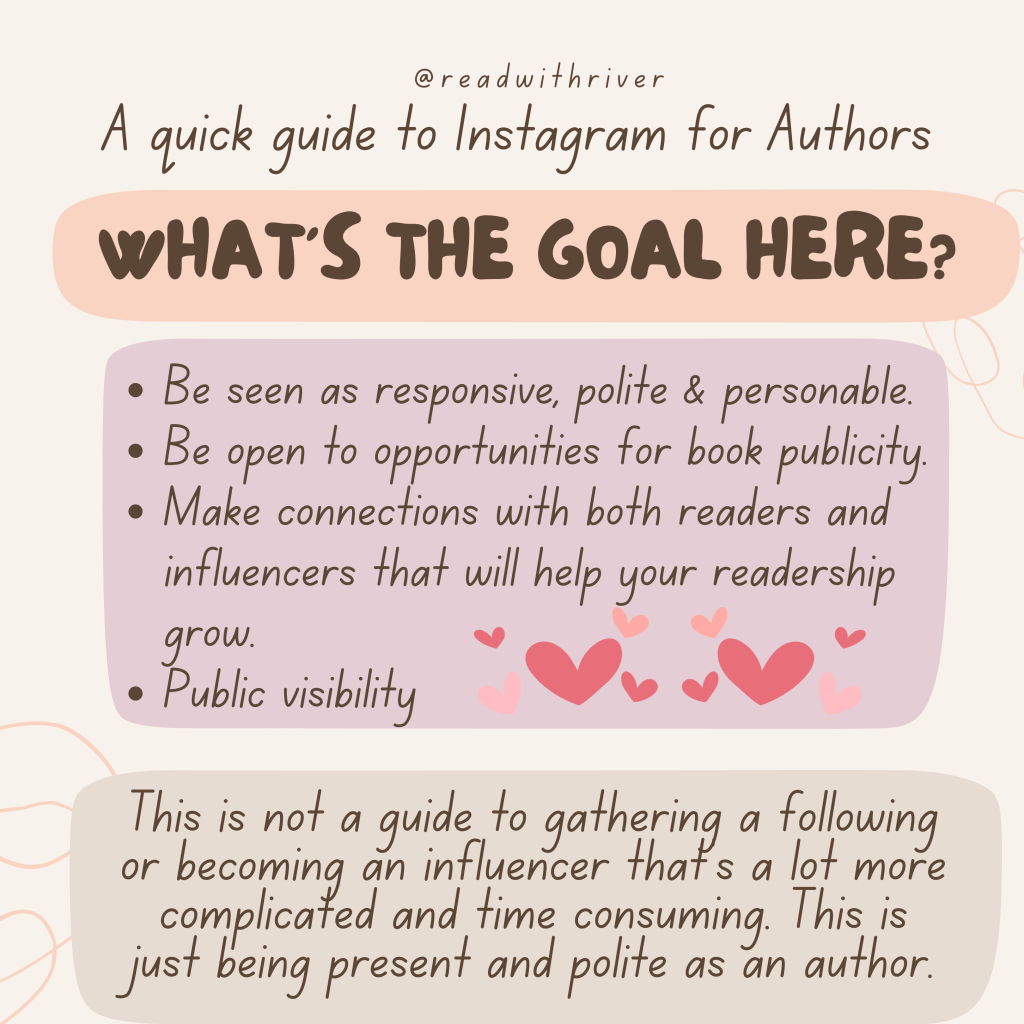
Reviewer Etiquette Reviewer EtiquetteWhat’s the goal here? Be seen as responsive, polite & personable.
Being likeable may not seem like part of your job as an author. Traditionally, it doesn’t matter whether or not people like you as long as you can write. But in the world of Social Media, authors who spend time making connections with book influencers, are more likely to get talked about. Influencers are more likely to go out of their way to find your other books, more likely to go out of their way to film more content for your books. Think of book influencers as your champions, if you win them over, they will gladly scream your name from the rooftops until you’ve sold out your print run.
Explore first!
If you’ve never opened Instagram up before and have absolutely no idea what’s happening, it’s worthwhile to take a week to just look around anonymously. It will help you get adjusted before you make a professional appearance.
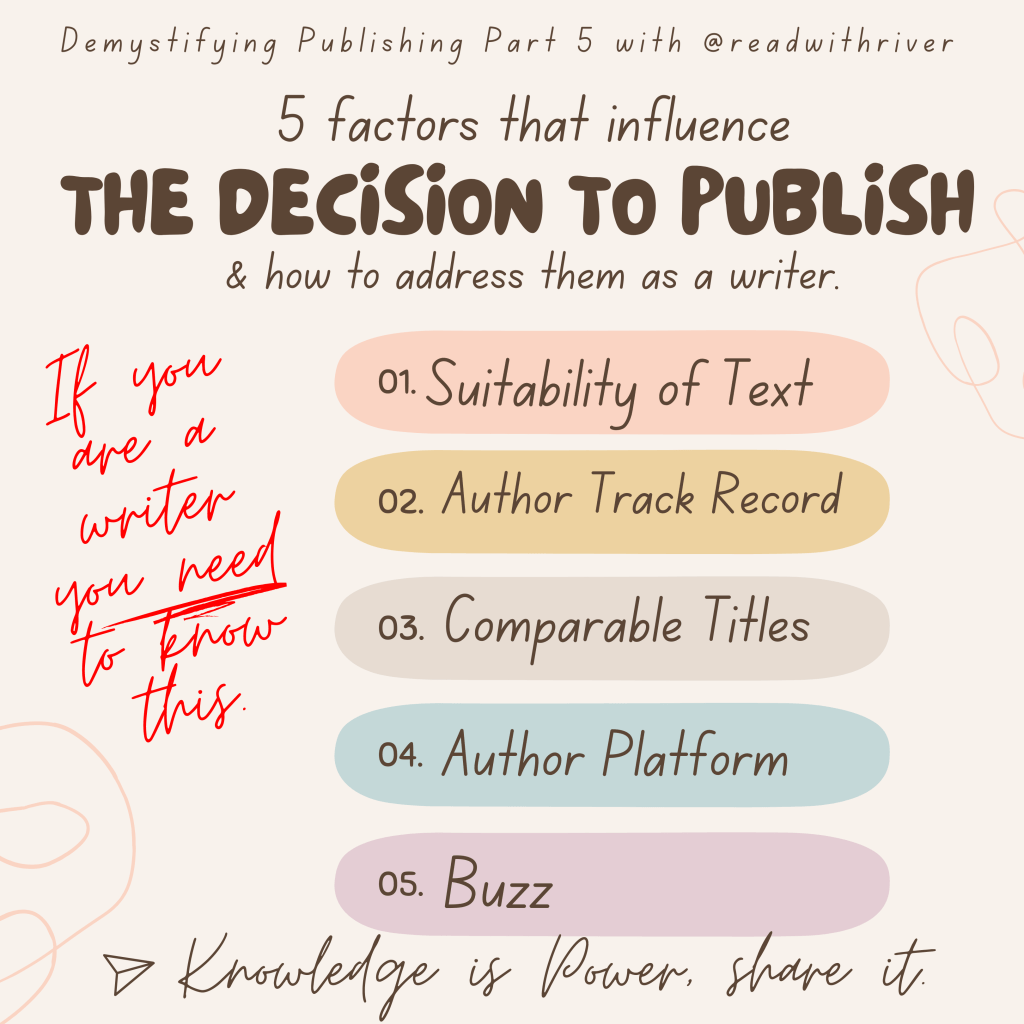
5 Factors that Influence the Decision to Publish and how to address them as a writer.
Suitability of Text
Author Track Record
Comparable Titles
Author Platform
Buzz
Profit Not Public Service: Publishers are surviving in a capitalist society, just like us.
Book Failure= Financial disaster, not just for publishing executives but everyone in the publishing industry chain.
Taking a chance on an author is a risk for the entire chain with very real consequences. So any reticence to taking on big risk should be seen as responsibility for employees, not just conservatism.
The 5 factors all contribute to creating a picture of risk vs. reward, profit vs. loss.
1. Suitability of text
this issue before in previous parts of this Demystifying publishing series, please refer to them for more details on suitability of text.
Text must be enjoyable and suits: the intended audience, publisher’s catalogue, direction of trends and, vision for future of publisher’s list.
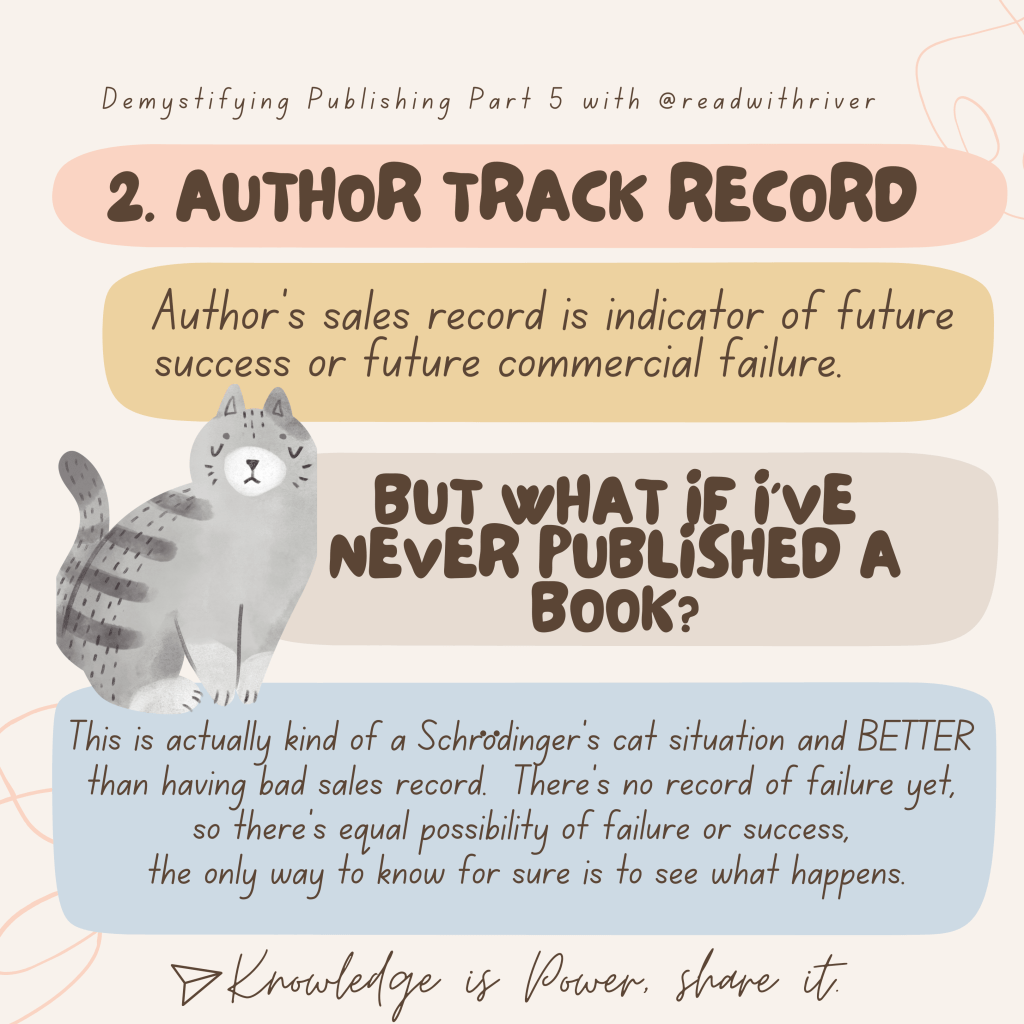
2. Author Track Record
Author’s sales record is indicator of future success or future commercial failure.
“But what if I’ve never Published a Book?”
So, fortunately for you, this is actually a Schrodinger’s cat kind of situation and BETTER than having a bad sales record. There’s no record of failure yet, so there’s equal possibility of failure or success, the only way to know for sure is to see what happens next.
3. Comparable Titles
Comparable titles are used to build a case for the financial viability of your book (MSS) Mention them in any submission to either agent or editor.
So “You Matter” “All Because You Matter” and “I Believe I Can” are titles comparable to each other because they have similar themes.
Good comparable titles must be: recent, specific and, successful.
Bonus Points if it’s from the publisher or agent who you’re submitting to.
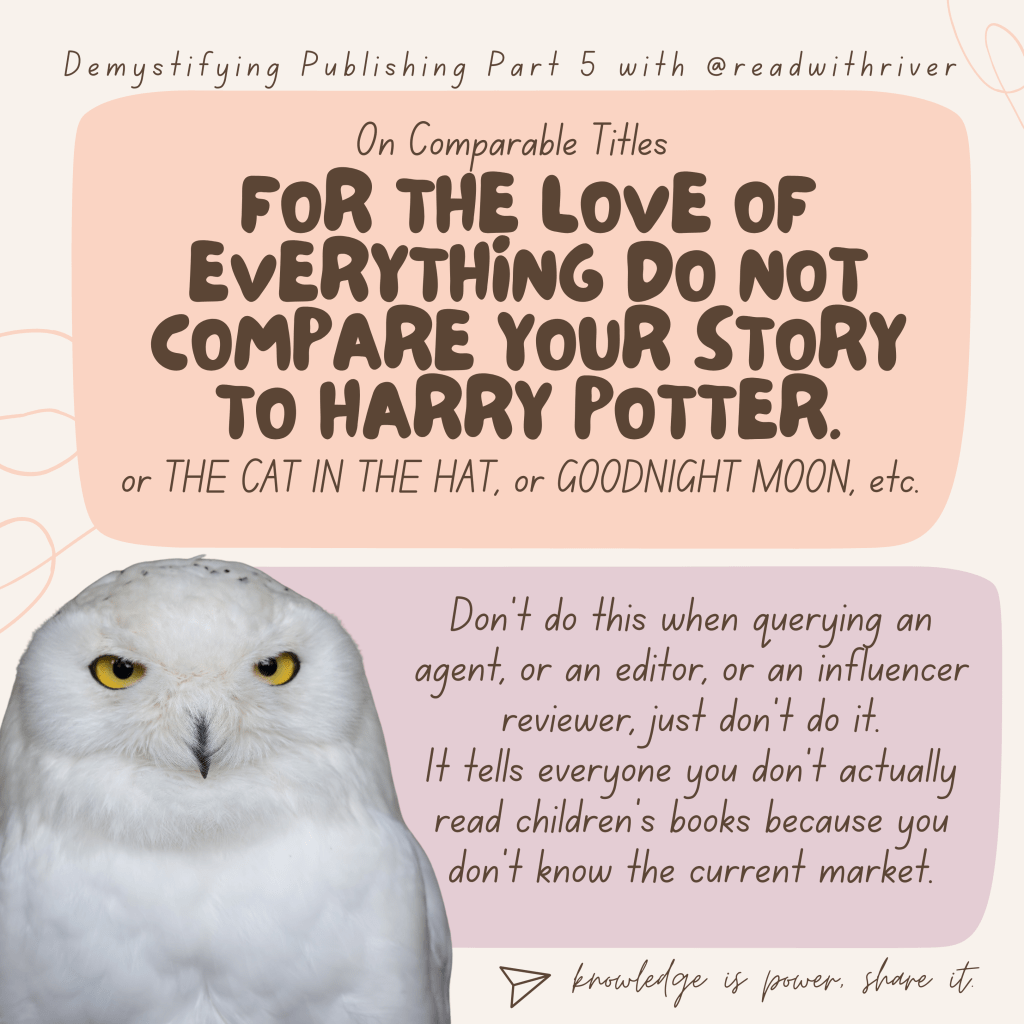
On Comparable titles
For the love of everything do not compare your story to HARRY POTTER or THE CAT IN THE HAT or, GOODNIGHT MOON, etc.
Don’t do this when querying an agent, or an editor, or an influencer reviewer, just don’t do it.
It tells everyone you don’t actually read children’s books because you don’t know the current market.
Also it kind of makes you sound like an ass.
4. AUthor Platform
Authority: Relevant credentials are key for Non-Fiction authors
Less important for fiction authors.
Relevancy is key here, if you have a PHD in Psychology, and you’re writing about Rocket Ship Engineering, that is not relevant. So, not really helpful.
Quantifiable visibility within target audience: aka do you have people who will buy your book?
“Influencers” & Author Platform
Unlike every other luxury consumer good industry (which is exactly what book publishing is,) publishers are slow to see Social Media Influence as genuine proof of money making platform.
This attitude is changing and some big publishers are now producing books by influencers.
This shift will partly be thanks to the NYT article from March of 2021 “How Crying on Tik Tok Sells Books”
Most publishers don’t know a lot about Social Media Influencing and change will continue to move slowly. But it’s happening.
5. Buzz
Are people actually in the industry talking about your work?
How can you get them talking about you? Twitter is actually a good place to start, a lot of publishing industry people are on Twitter. And if you follow me you know I’m abysmal at Twitter, I just don’t enjoy it, not enough pretty pictures, so this is a piece of advice I do not take for myself. I’d rather cry on Tik Tok.
Attending industry events, book launches, meeting people. Doing this in the pandemic might be harder but not impossible. Virtual events are hosted all the time and often you’ll find editors or other senior members of publishing houses showing up to them.
Having a well respected agent is also key for generating industry buzz, see my previous blog in this series on Literary Agents.
Profit & Loss Assessment
So when you put all of these things together, along with some other numbers for production, distribution, etc. They start to build a profit and loss statement, they will assess the commercial viability of your manuscript proposal, and from this statement they can decide whether or not to offer to acquire it and also, how much money they can offer you as an advance.
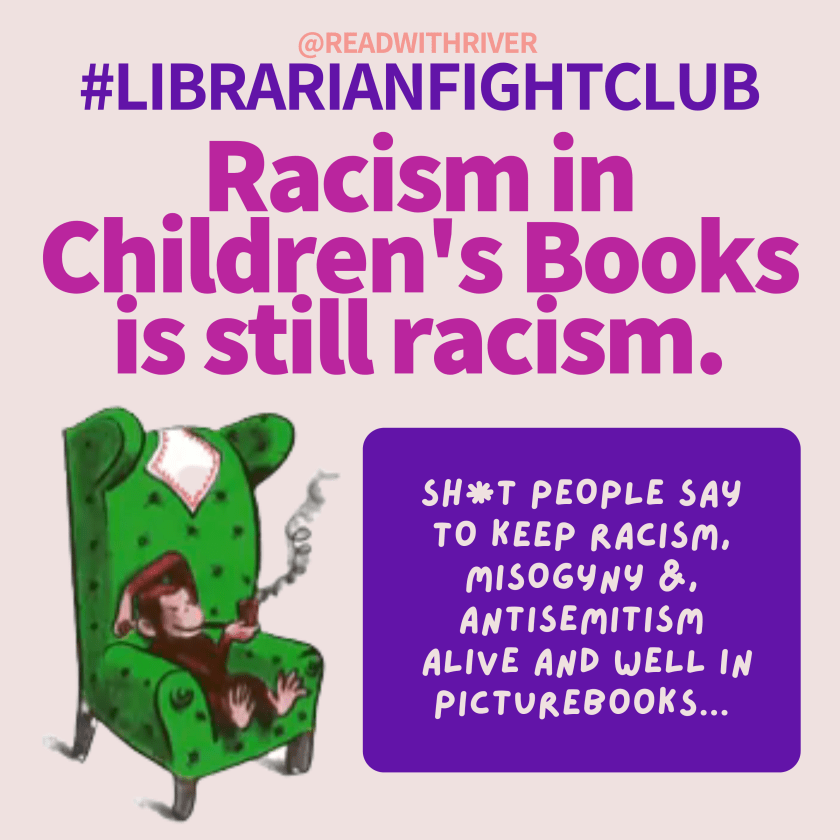
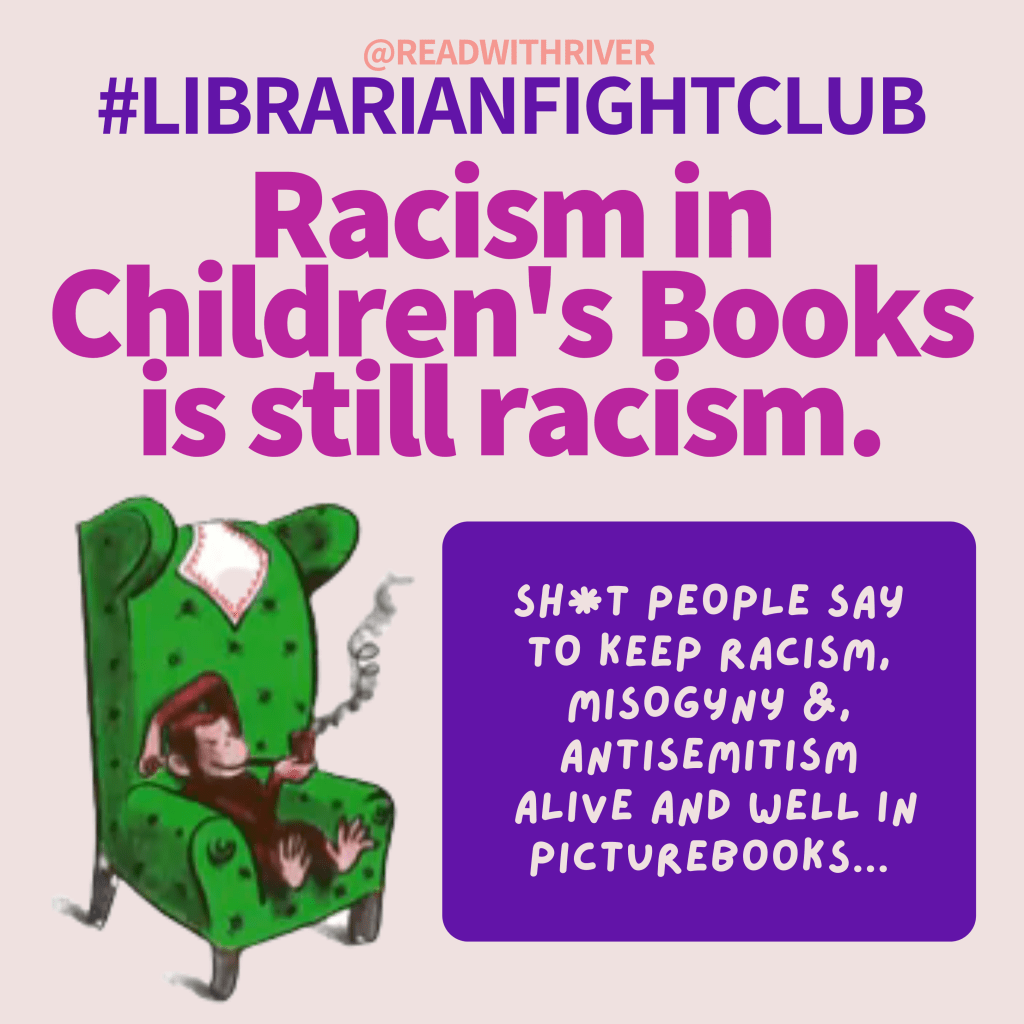
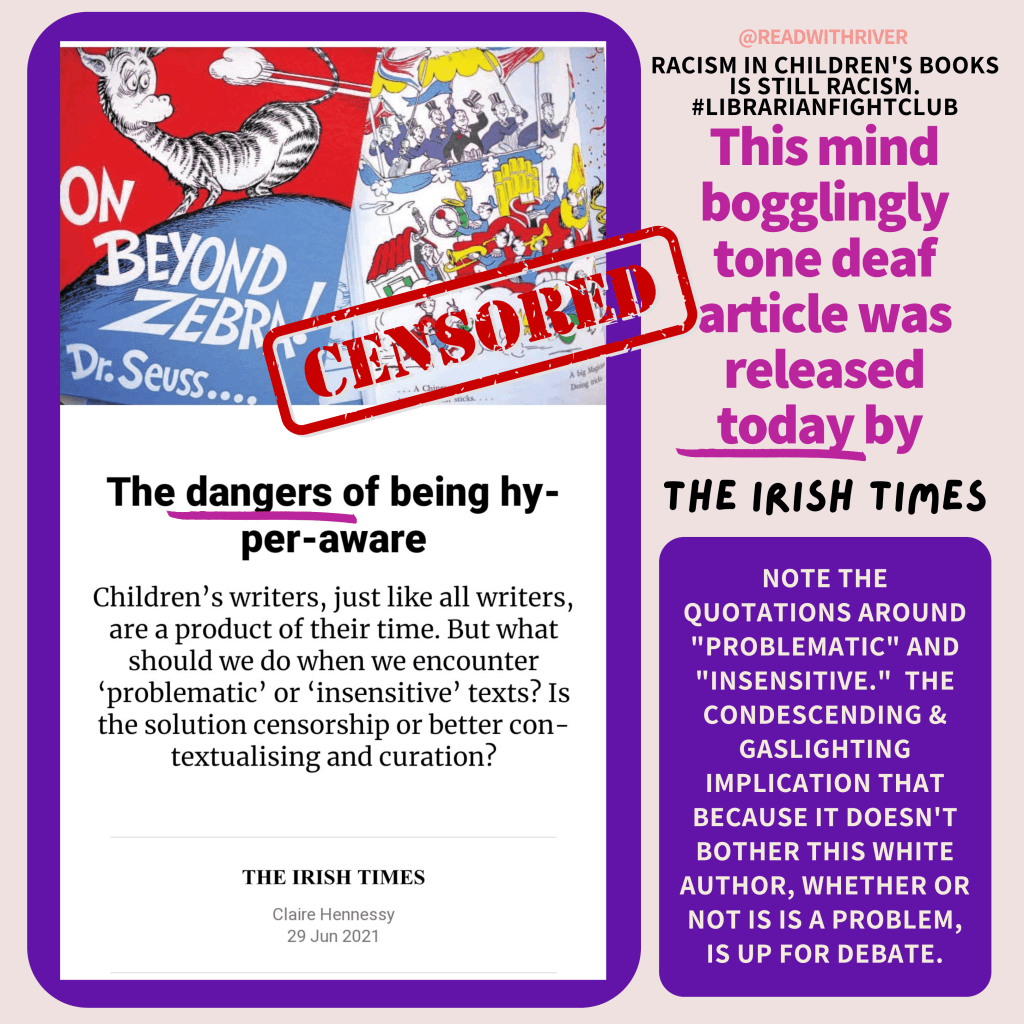
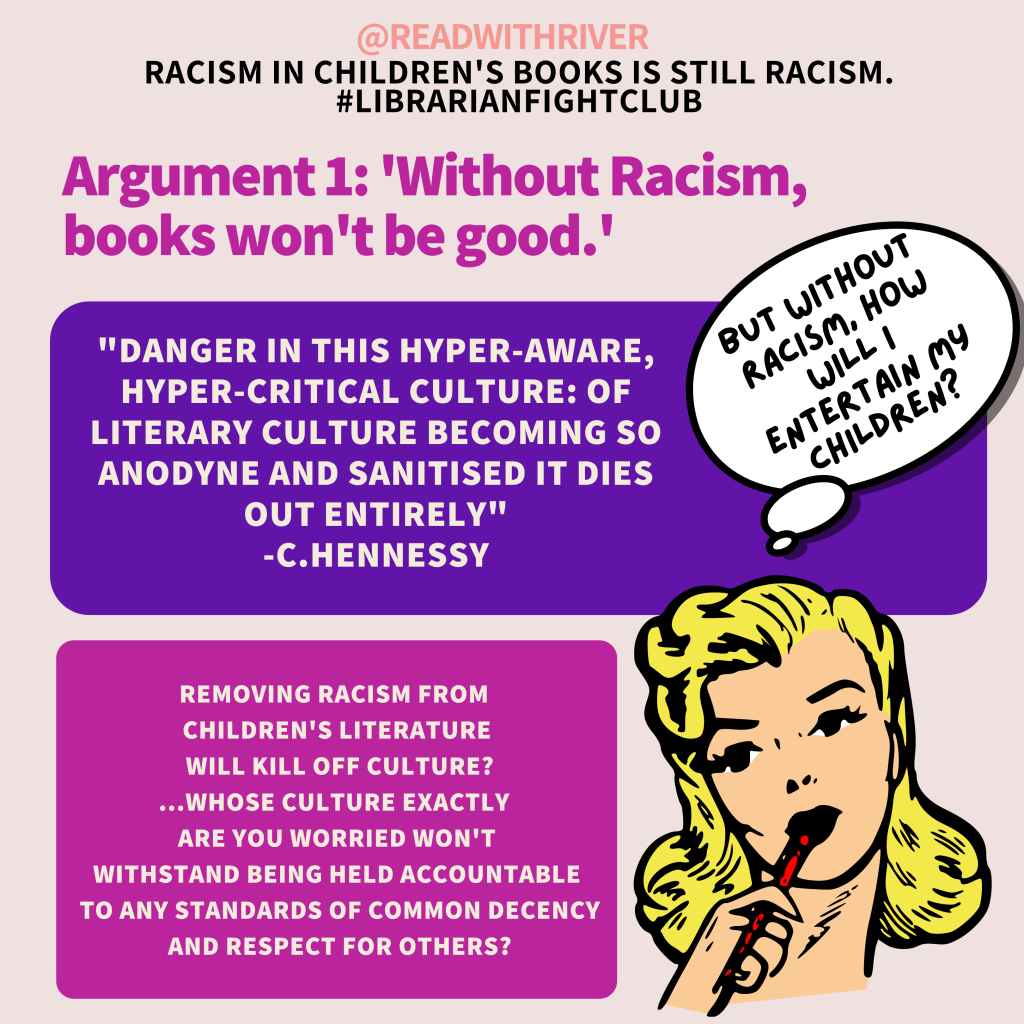
Shit People Say to Keep Racism Misogyny &, Antisemitism Alive and Well in Picturebooks…This mind bogglingly tone deaf article “The Dangers of being hyper-aware” by Claire Hennessy was released today in The Irish Times. Note the quotations around “problematic” and “insensitive.” The condescending & gaslighting implication that because it doesn’t bother this white author, whether or not it is a problem, is up for debate.The author of this article, an established member of the publishing industry as both editor and author of 12 books, makes several points that we often see in defense of problematic children’s books. In fact, it makes the rounds so it’s a perfect case study! Let’s explore some of the main points shall we?Argument 1: ‘Without Racism, books won’t be good.’ “Danger in this hyper-aware, hyper-critical culture: of literary culture becoming so anodyne and sanitised it dies out entirely”- C. Hennessy
Removing racism from children’s literature will kill of culture? …whose culture exactly are you worried won’t withstand being held accountable to any standards of common decency and respect for others?
Argument 2: ‘Just give your kids the Historical Context Disclaimer.” “Contextualizing the dodgy bits within Seuss’s overall body of work Developmentally ages-3-4 Time is a completely abstract concept. Ages 5-6 they begin to understand correlation between certain days in their daily life (holidays, birthdays, etc.) Concepts of historical time don’t develop until ages 9-11. History is valuable, discussion on literary theory is interesting but learning goals should be age appropriate. How do you teach a 5 year old historical context with any level of valuable understanding, when they do not know what Friday is?
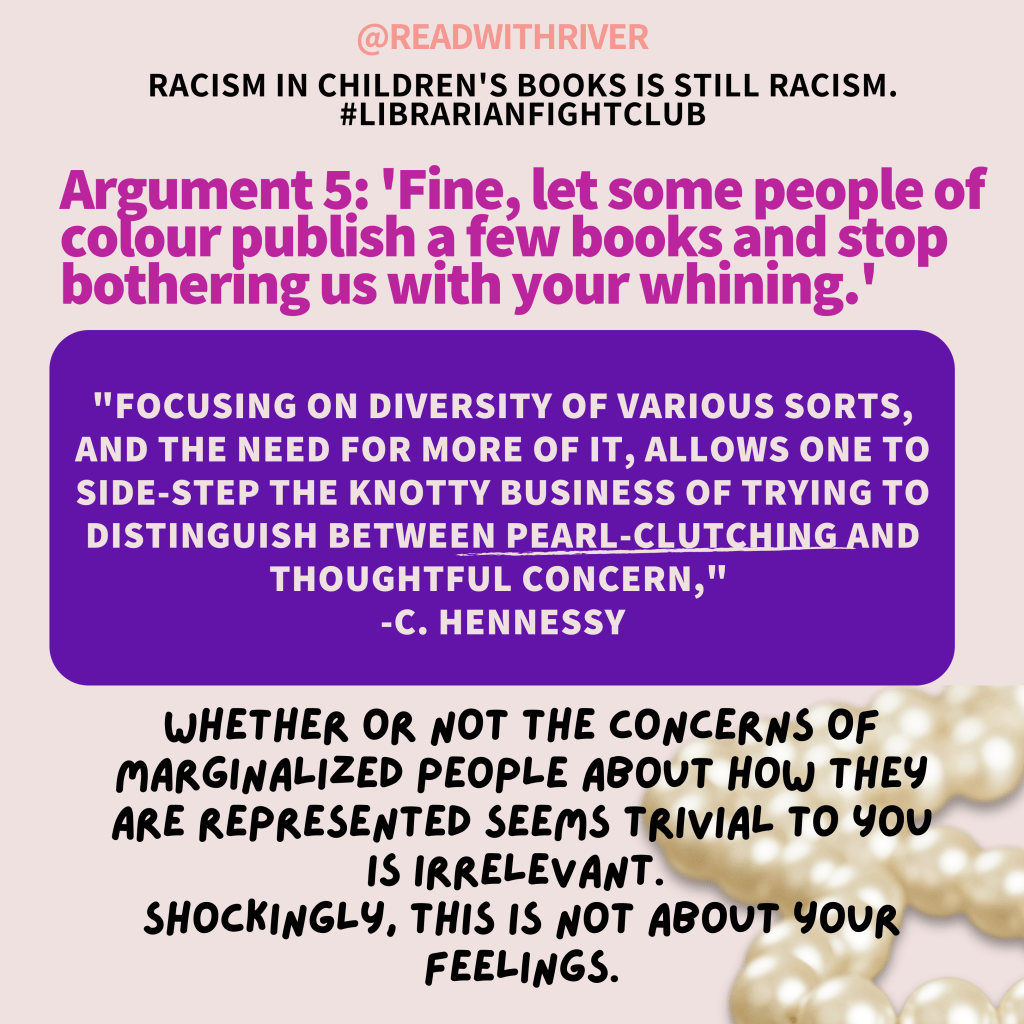
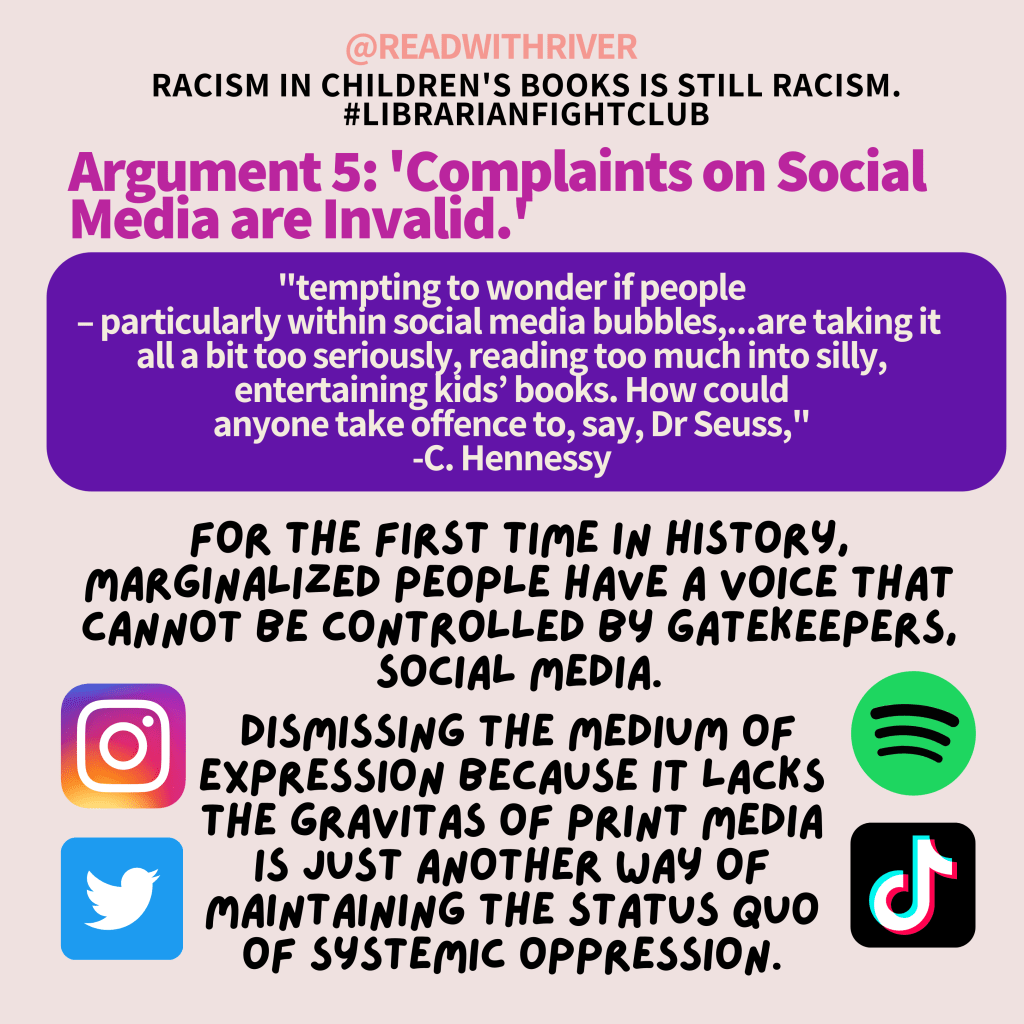
Argument 3: ‘But I liked it and it’s inconvenient you’re ruining it for me.’ “The delicious insanity of Roald Dahl’s fiction is forever tainted by his anti-Semitic comments (his family apologized in late 2020)”-C. Hennessy. Oh, his family apologized so as not to jeopardize their cash cow? Well then, that changes everything!Argument 4: “Your fave is almost certainly problematic.”- C. Hennessy. Gosh could that be because picture books are written almost exclusively by white people, to this day? Maybe the publishing industry allowed other people traditionally to write picturebooks, we wouldn’t have such a crap selection.Argument 4: ‘Fine, let some people of colour publish a few books and stop bothering us with your whining.’ “Focusing on diversity of various sorts, and the need for more of it, allows one to side-step the knotty business of trying to distinguish between pearl-clutching and thoughtful concern,”-C. Hennessy. Whether or not the concerns of marginalized people about how they are represented seem trivial to you is irrelevant. Shockingly, this is not about you.Argument 5: ‘Complaints on Social Media are Invalid.’ “tempting to wonder if people-particularly within social media bubbles…are taking it all a bit too seriously, reading too much into silly, entertaining kids’ books. How could anyone take offence to, say, Dr. Seuss,” -C. Hennessy. For the first time in history marginalized people have a voice that cannot be controlled by gatekeepers, Social media.; Dismissing the medium of expression because it lacks the gravitas of print media is just another way of maintaining the status quo and of systemic oppression.Argument 6: ‘It’s too hard to fix we better do nothing about it.’ “Hard-and-fast rules to ensure inoffensive content are impossible” -C. Hennessy. Try not starting out with stereotypes? Try researching? Try editing? Try consulting with people you’re representing? Try harder.






































 Read With River