Posted in Author Resources, Demystifying publishing

Picturebooks Wrapped: The 2024 Trend Report

After wrapping up as a judge for the Bookstagang 2024 picturebook awards and looking at my tallied list of themes that recurred in the 570 new releases that were submitted for scoring, I have serious question to ask our publishing friends.

Are you guys okay?

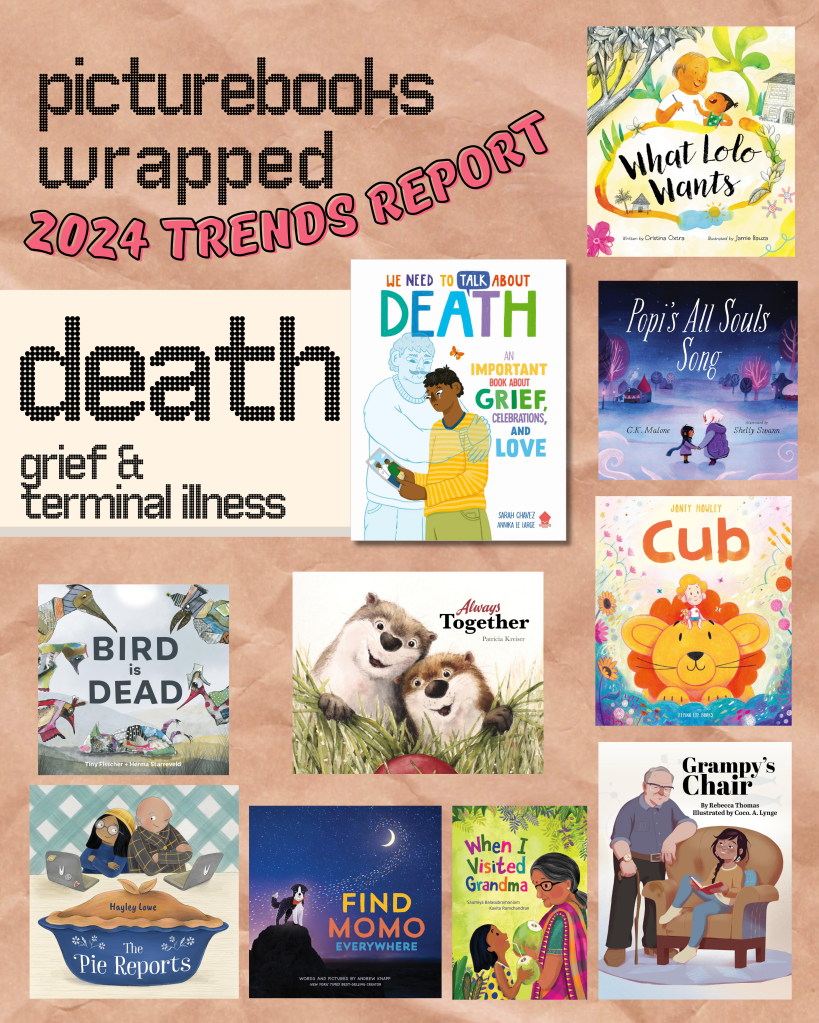
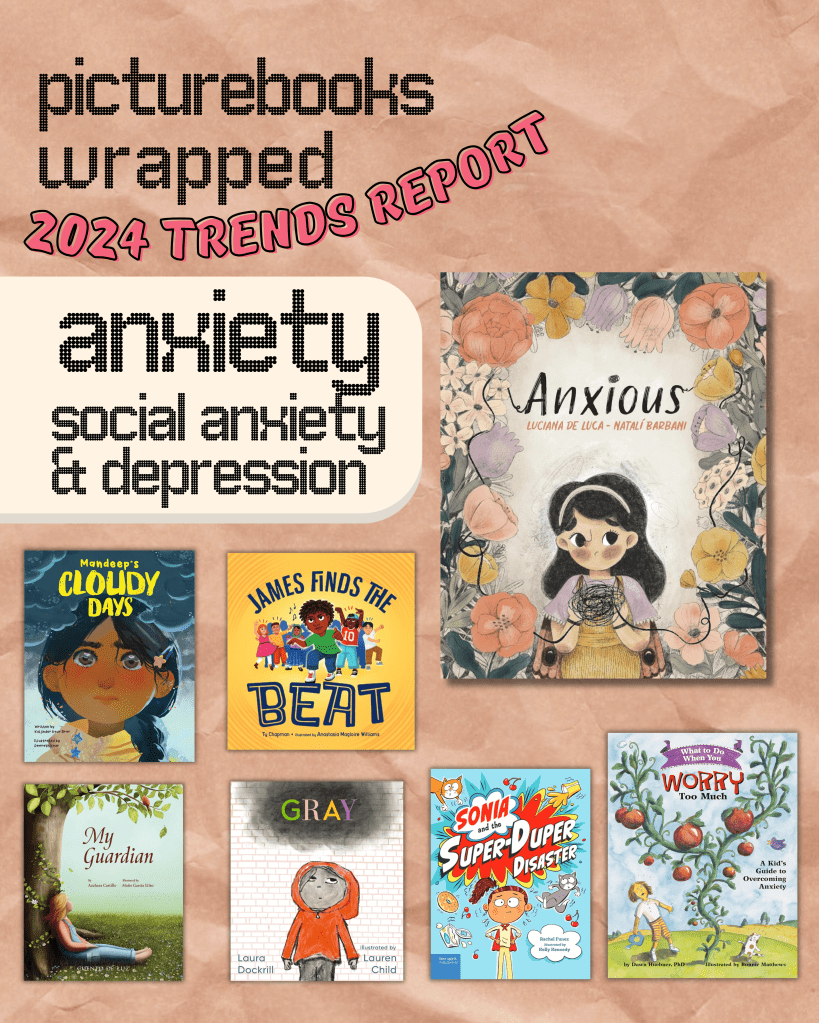
I am almost certain the answer is no, because nobody seems to be okay anymore and this year’s big trends are really driving that stake into our collective barely beating hearts. We’re seeing an unprecedented number of picturebooks about; death, depression, dementia, displacement, and a concerning dose of severe anxiety.
Little Bo Peep needing to practice therapeutic coping mechanisms to deal with the panic attacks brought on by the death of her sheep, as she wanders the moors in search of a new home would fit right in with this year’s catalogues.

Gone are the days of kindness and capybaras, oh no, now it’s dead dogs and dead otters and dead grandparents galore. Every time I saw a grandparent appear on a spread I clenched my butt hole readying myself for their inevitable and untimely demise.
It makes sense when you consider these books were acquired most likely some time in 2022. We were still in the throes of pandemic pandemonium, and had not become quite as desensitized to the ongoing onslaught of covid as it continues today. We were definitely not okay.  Was that back when there were still killer bees, or murder hornets, maybe there were the wildfires? Or was that 2023? Please someone put out a recent history book because I can’t keep track anymore and it’s still as fresh as the corpse of the dead bird in BIRD IS DEAD.

The question I have is, if this was the vibe that 2022 brought forth in picturebooks then what fresh illustrated hells will be unleashed upon us yet to come? Our global situation has moved laterally at best since 2022 and the forecast for 2025 isn’t looking sunny.

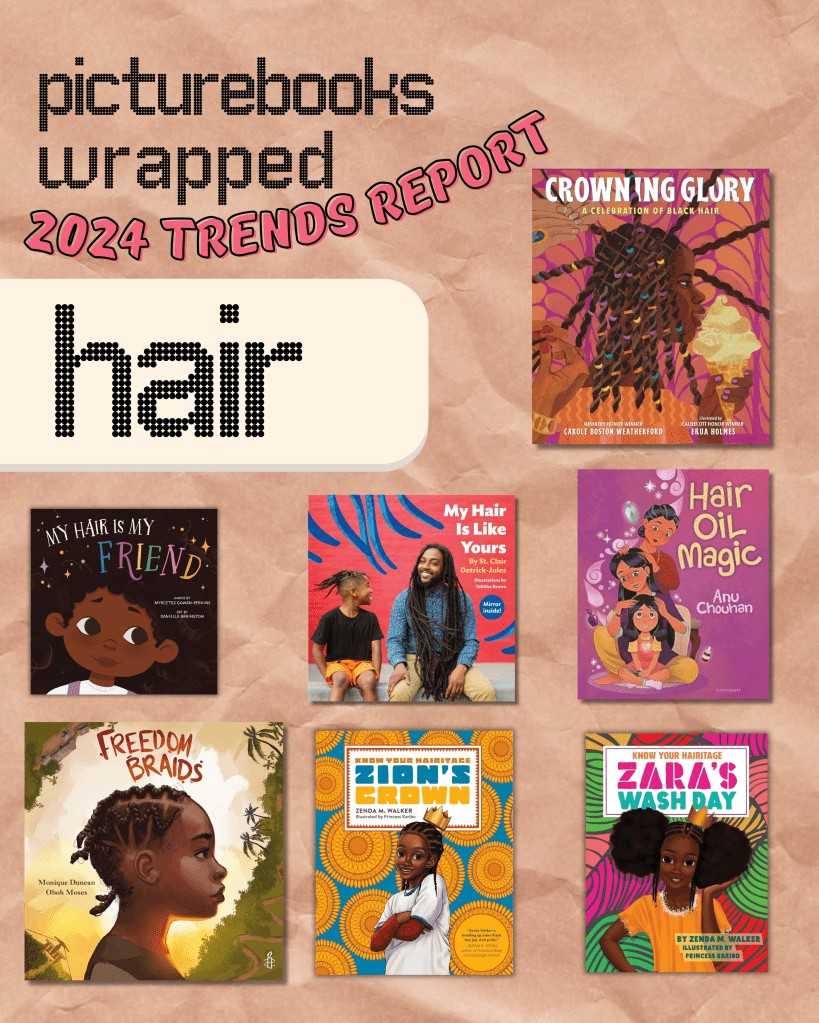
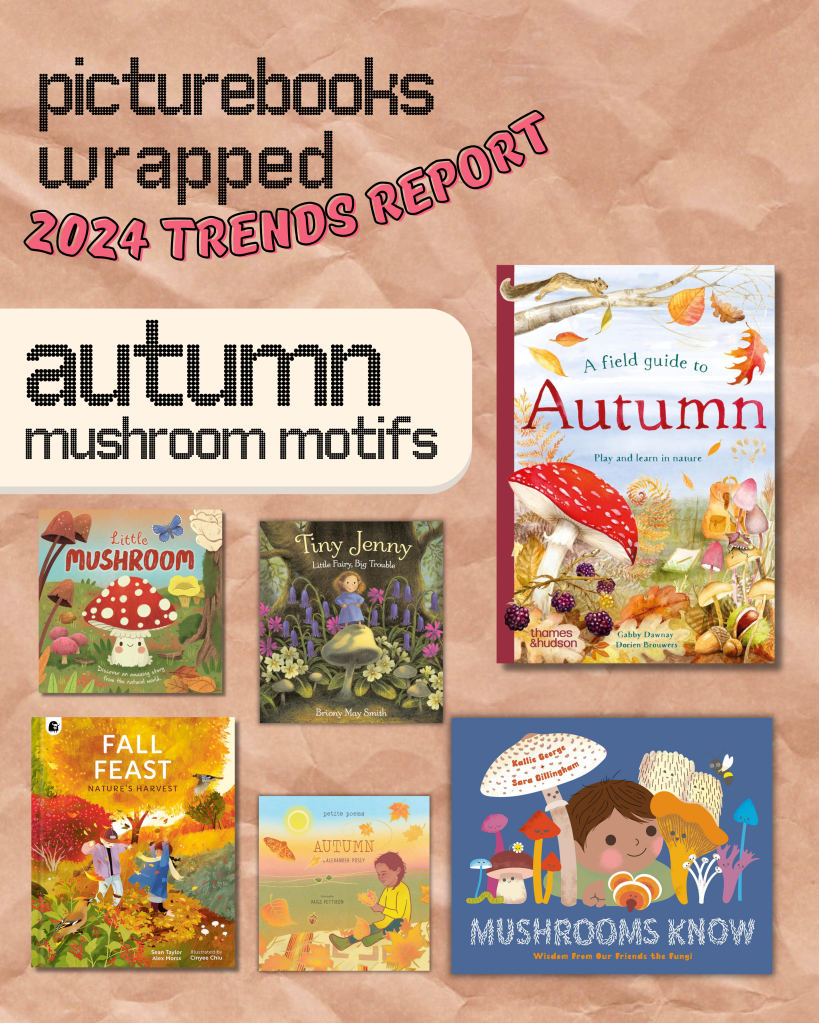
Not to worry, it’s not all doom and gloom, 2024 brought us a lot of very nice books about hair and a good number of cosy autumnal mushroom books popping up to soften the harshness of mortality in this cruel world.  So there’s that to find comfort in. 
There is a continued general movement away from the minimalism in design and efficiency of word counts that we were seeing back in 2020. The picturebook trends are flowing into full blown maximalism in almost every element except for paper printing and binding details. I’m seeing a real lack of gold foil and everyone is skipping the embossed covers (expensive paper engineering and print details are no longer in the budget it seems). 

Word counts are way up, testing and stretching the boundaries of this screen fed generation. It’s no longer a Hemingway-esque test of economy to see how much meaning you can jam into a paragraph shorter than a haiku and I for one am relieved. The scripts are getting downright flowery, poetry is seeping into every genre, both verse and prose. We’re even seeing poetry appearing in our non-fiction new releases. This is a nice extrapolation of the emergence of narrative non-fiction that has been really growing in the last few years.  
This year saw a real variety of artistic styles, and I love to see it. The boundaries of what qualifies as an appropriate illustration for a children’s book are being explored. A number of deep richly coloured hyper realistic painted books have come out.The overall palettes are natural and warm. We’re seeing lots of details being included all over the place. The possibilities are endless it seems and I can’t wait to see how things continue next year at this rate. 

I know the question everyone actually wants answered is are we really seeing a decline in diverse representation? After the recently released Guardian article citing a serious drop in diverse representation as tracked by the research from CLPE from 2022-2023 in UK published children’s there is real concern.

The CLPE data showed increase in the rise of background characters that were racially minoritized and a drop of racially minoritized main characters. Although picturebooks had the highest proportion of racially minoritized characters with a 3% increase from 2017. 

“Whilst this is disappointing, we have always expressed cautious optimism regarding the increased output of recent years,” writes Farrah Serroukh, CLPE research and development director, in the report’s foreword. “Historical patterns would indicate that gains regarding inclusion are susceptible to being constrained by the cyclical nature of publishing trends.”

Do those numbers hold up for North American publishing? According to the statistics put out by the CCBC, no. 2022-2023 did not see a decline. However there wasn’t a significant increase either. The market seems to have plateaued on how much diversity it’s willing to float. Furthermore the North American statistics indicated that the representation increase that did occur was localized to the representation of minorities by authors who did not share those identities, there was no significant increase in representation written by those minorities.  

So what did that mean for the books we received in 2024? The data from these organizations, the CLPE and CCBC respectively, does not exist yet for 2024. Admittedly the sample size we have here in the Bookstagang of 570 books is much smaller than the 4-5,000 that the CLPE and CCBC have for their studies, but it is an immediate look at what’s happening right now in 2024 and a more localized look at the kind of stories that are being told.

As someone who has judged this particular list for 5 of the past 6 years, I would say that I am noticing a general trend away from diverse narratives but not away from diverse representation. 

It seems to me that ‘diverse stories’ are more than ever being slotted into a category of books that don’t really need to have a narrative arc and I am concerned about how tenable that is for the continuation of the diversification of children’s literature. If diversity continues to be relegated to books that do not have storylines, then ‘diversity’ may very well prove itself to be a trend that doesn’t work under capitalism, instead of a genuine move to a more just system within children’s publishing. There are only so many books that people can buy that are catalogues of what different children look like accompanied by lists or poems. I am uncertain the market will be able to carry them. Only time will tell.

Forecast for the next few years:

Now, I’m no oracle, but here’s what I think we’re going to see in the next couple of years.

I think we will probably see a continuation for a little while at least of the exceptionally heavy topics, because it’s probably the beginning of the wave and then I suspect it will get very silly (which I’m looking forward to.)

I think we will see a continuation of the trend of maximalism, and I think that there will be a continued preference for the cosy and the comforting. I think we can expect more warm palettes and frogs making stew wearing little jackets. I think that it’s a reaction to these uncertain times and that it will continue for a while.

Given the uncertain political climate, I do wonder if we are going to see a decline in efforts to continue to diversify children’s publishing at least for the next five years. Certainly I think a lot more publishers who have been open to representing LGBTQ+ stories and racially minoritized stories may feel discouraged at the risk of losing money. We will have to see how that pans out, and I think that there are a lot of fights to be had in the coming times.

If I could make one request of publishers, for any who are listening, please stop killing dogs unexpectedly. We can’t take it anymore.

A.
Posted in Author Resources, Demystifying publishing

Advice to Self Publishers from @ReadWithRiver

So you want to launch a self-published book. Common Problems
to Avoid &
Boundaries with Influencers
You Need to Respect.
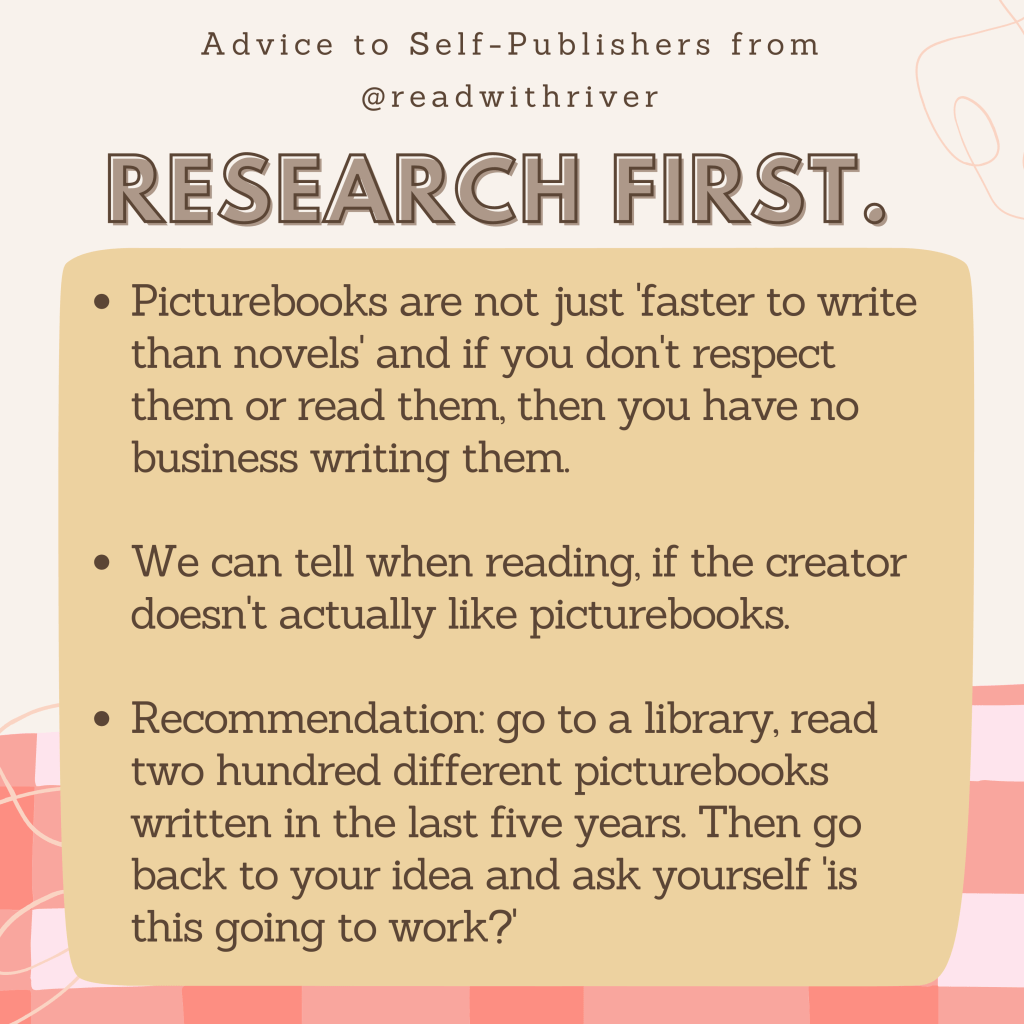
Research First: Picturebooks are not just ‘faster to write than novels’ and if you don’t respect them or read them, then you have no business writing them.

We can tell when reading, if the creator doesn’t actually like picturebooks.

Recommendation: go to a library, read two hundred different picturebooks written in the last five years. Then go back to your idea and ask yourself ‘is this going to work?’
Get it Edited: Your computer spell check program is not adequate for editing a book.
You need more than one editor, who you are not related to. by blood or marriage.
They should be looking at things like structure, logical consistency, dialogue believability, if it’s in verse is the meter good?
If you’re including marginalized groups you are not a part of you need to hire a Diversity and Inclusion consultant/sensitivity reader.
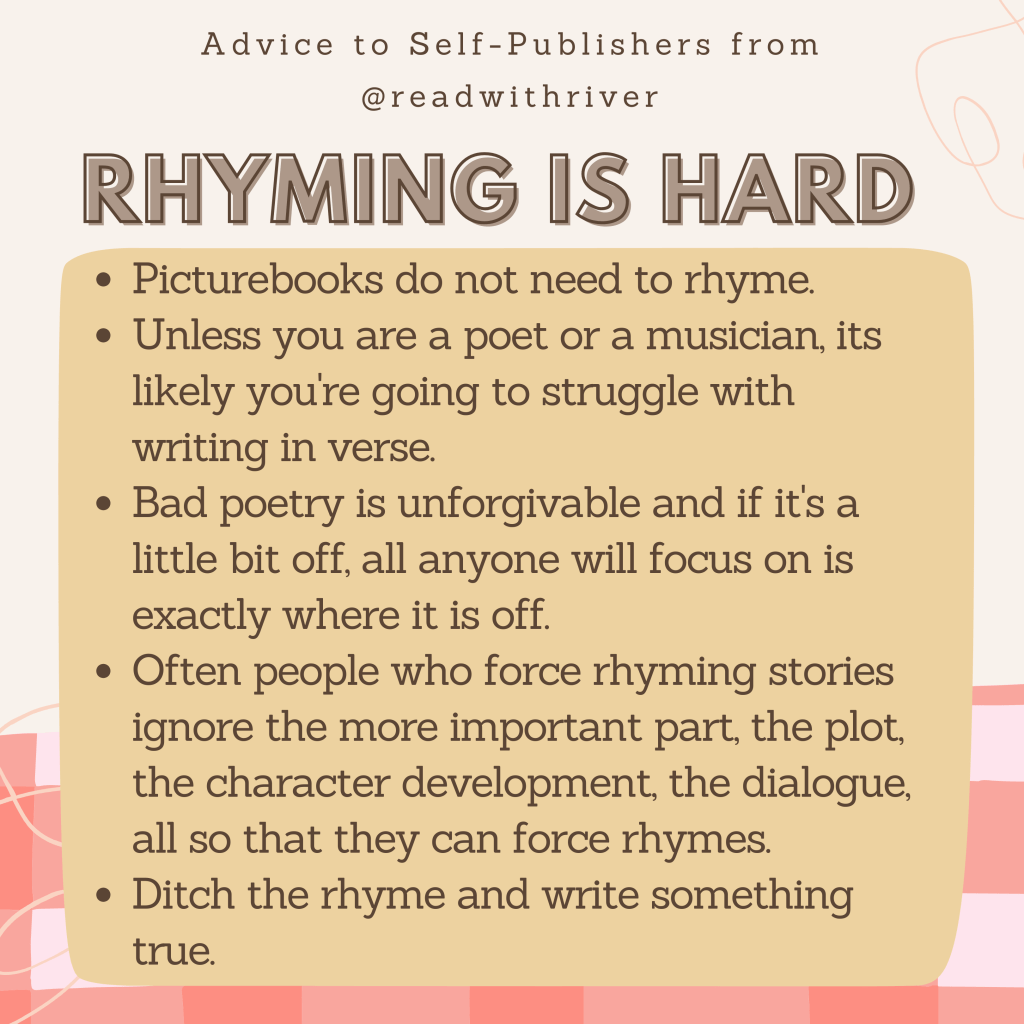
Rhyming is hard : Picturebooks do not need to rhyme.
Unless you are a poet or a musician, its likely you’re going to struggle with writing in verse.
Bad poetry is unforgivable and if it’s a little bit off, all anyone will focus on is exactly where it is off.
Often people who force rhyming stories ignore the more important part, the plot, the character development, the dialogue, all so that they can force rhymes.
Ditch the rhyme and write something true.
The Picture in Picturebook is Key: The illustrations of a picturebook are arguably more important than the text. People can forgive a boring story if the pictures are beautiful. There’s no forgiving an ugly picturebook.
You need a real artist, who knows how to do picturebooks.
You also need someone who can do Cover Design, and text lay out (which the illustrator may not know how to do.)
For the love of Jon Klassen do not use a weird font or comic sans, just don’t.
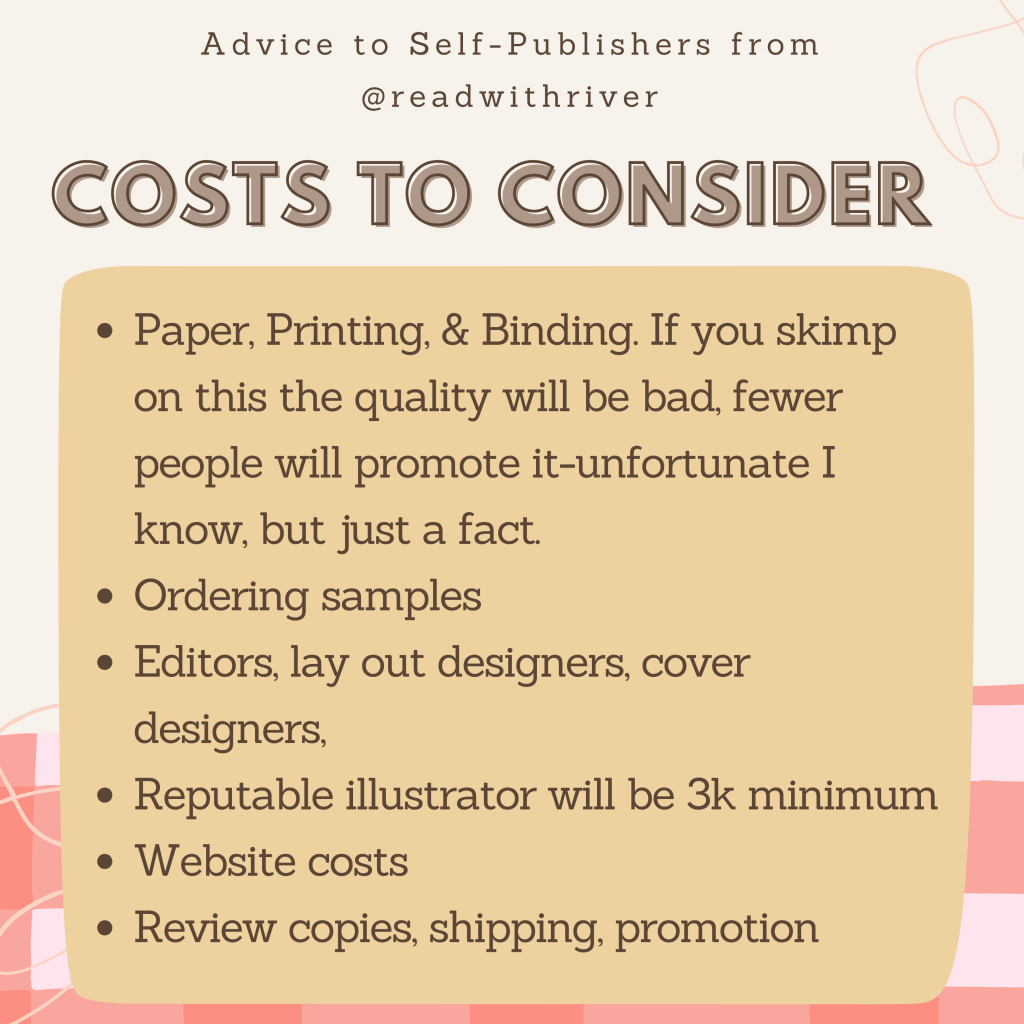
Costs to consider: Paper, Printing, & Binding. If you skimp on this the quality will be bad, fewer people will promote it-unfortunate I know, but just a fact.
Ordering samples
Editors, lay out designers, cover designers,
Reputable illustrator will be 3k minimum
Website costs
Review copies, shipping, promotion
Setting up social: If you open up your Instagram/Twitter/Tiktok account three days before you launch nothing is going to happen for you.

If you’re just opening up your social accounts right now with the intetion of selling a book for Christmas you have missed the boat by six months.

All of the reputable influencers have their content planned until Christmas, most traditional publicists get out all the stuff they want featured in December out by August-October.
There must be some way to get immediate promotion: You can pay people. (Not me, do not ask me..) But you can approach people and be upfront that it’s a paid ad opportunity.
Influencer standard is $10 per a thousand followers so do the math before asking, some people may ask for more if you want it done quickly.
Kirkus also has an expedited review program for self pub but it’s gonna cost you about $400 USD.
I only want free publicity: You can pay people. (Not me, do not ask me..) But you can approach people and be upfront that it’s a paid ad opportunity.
Influencer standard is $10 per a thousand followers so do the math before asking, some people may ask for more if you want it done quickly.
Kirkus also has an expedited review program for self pub but it’s gonna cost you about $400 USD.
Book influencers are friends. Behave Accordingly. We tell each other about self published authors who are difficult, audacious, rude or threatening.
We share screenshots of your spam messages.
No means no, do not keep badgering someone, do not investigate them or show up at their place of work, do not do it.
If people are refusing to respond to your messages, ask yourself, did I have a bad interaction with an influencer? Because if you did, that’s why noone is answering.

Posted in Author Resources

A Quick Guide to Instagram Etiquette For Authors: Particularly the bewildered, reluctant and, overwhelmed

A Quick Guide to Instagram Etiquette for Authors: Particularly the bewildered, reluctant and, overwhelmed. You don’t need to become an influencer but you really should exist.

Why Instagram?

You’re an author, you’ve spent your life writing and planning for the day when your books are available to the general public, you want to hear from your readers, you want to help your book sales move along. Social media is one of the few free tools you have at your disposal to connect with your readership and your target audience easily and globally. It’s also one of the ways that readers seek to connect to the authors of books that they enjoy, the hand mailed fan letter is sadly a dying art.

Okay, but why Instagram? Why not Twitter or, Tik Tok or, Facebook or, Pinterest? That’s a great question, and each of these platforms have different advantages and appeal to different demographics. Some people manage to juggle a presence on multiple platforms but it’s a lot of work, and it’s likely you will run out of steam. So picking one platform to start out with is more of a reasonable starting goal.

When it comes to responding to a fan base and encouraging buzz and sales, the two platforms readers, reviewers and influencers will be actively looking to reach you the author of the books they’re discussing and showing off, are Twitter and Instagram. There is a healthy Book loving community on TikTok (see New York Times article about Booktok linked at the bottom) but getting on TikTok is more difficult, the demographic is exceedingly young, and the kinds of books people are discussing on TikTok tend to be romance/young adult fantasy specifically. So if you’re a picturebook writer, TikTok is not the right place for you.

It comes down to Twitter vs. Instagram

Twitter is a great place to connect with people within the publishing industry and join in the conversation. Twitter is where you’ll find editors, agents, writers, and everyone else with a stake in the game professionally. If you’ve had a book come out people may discuss it on Twitter and look for you, the author/illustrator, to tag in their tweets. So having a presence here gives you a voice in this discussion with your colleagues. But Twitter is not where you’re going to find your general target audience for the most part.

You will find far fewer publishing industry people publicly on Instagram, but what you will find are your book consumers. 1 billion people use Instagram every month (compared to Twitter’s 330 million) and 80% of those Instagram users will use the app to research products and services. Instagram is designed for showing off luxury goods, books being an enormous niche. If you actually want to help your book sales, Instagram is the app to jump on.

Instagram is a primarily visual platform, influencers/creators reach their audiences with photos and videos, text is secondary. The #Bookstagram world is where you will find the community of people devoted to spending all their time fawning over books. How do you engage with #Bookstagram in an appropriate way? Well, I’ve broken it down for you below step by step…

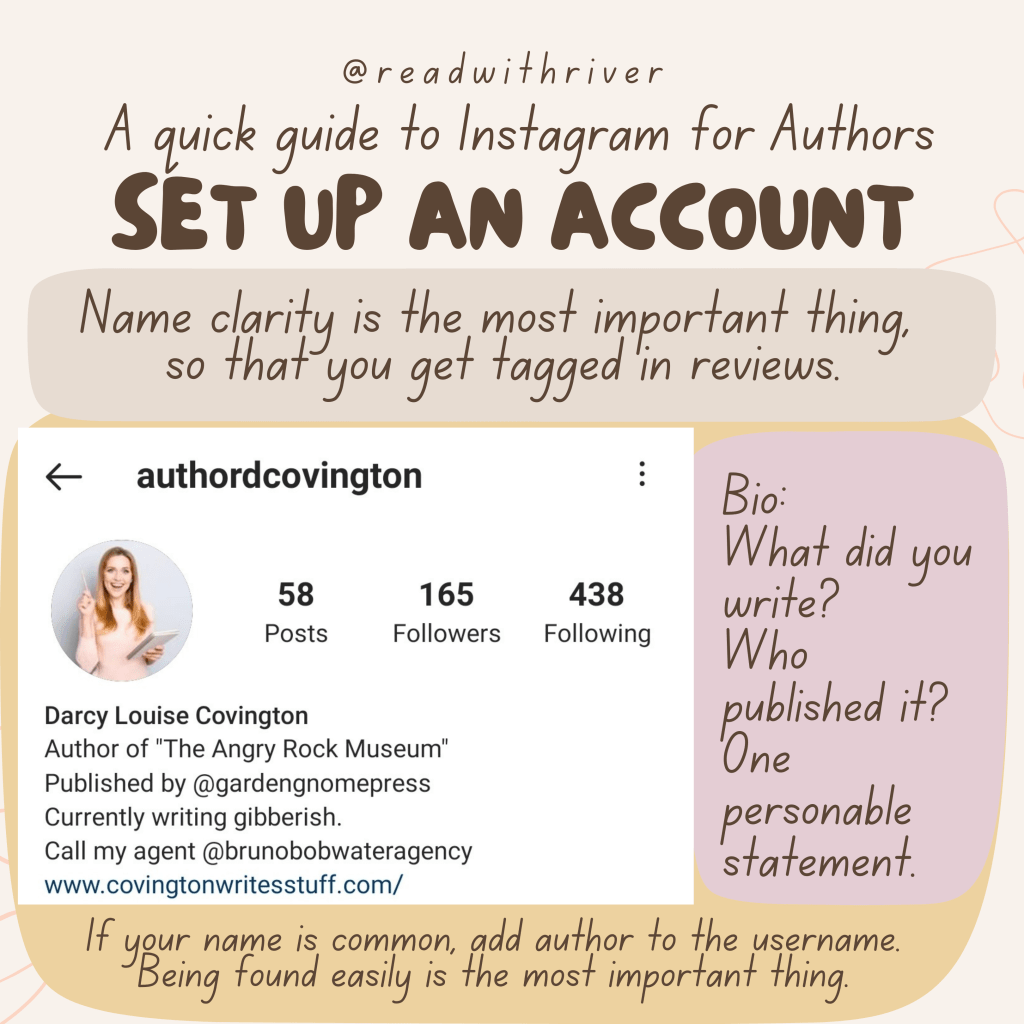
Set up an Instagram Account: Name clarity is the most important thing, so that you get tagged in reviews, if your name is common add “Author” to the user name. Being found easily is absolutely the most important thing. For your Bio, keep it simple. What did you write? Who published it? One personable statement.

When setting up your author account keep it simple, people need to be able to find you that’s the primary purpose here. If an influencer or reader is sharing your book, they’re going to try and tag you in that review, so when they type your name in it needs to pop up and be clearly you.

Profile photos: Professional headshot is excellent, if you’re a picture book author getting a portrait made of you by the illustrator of your book also works. If you want an interesting photo make sure it’s clear and you’re visible in it.

Some authors do not like to be in photos. I get it, it’s not what you’re here for. But think of this as your ID badge. It needs to look legitimate, and a picture of your garden or your dog just isn’t going to work.

What to post? Profile Grid aka Main feed: Bare minimum, you don’t need to post lots of content. Just put 6-9 photos up to show you’re a real person. You can’t leave it empty, empty is suspicious. Basic photo content: book launch photo, book signing photo, throw back photos, pleasant outdoor scene, surrounded by books, just keep it classy.

If you want to start creating content, posting photos of your life and your work regularly, by all means go for it. But if it’s not your bag, that’s okay. You just need a profile active and professional looking up to respond to your reviewers, to get that professional looking profile you do need to put up a few photos on the page. An empty profile page looks suspicious and people will think you’re a bot. So put a few photos up and call it a day.

Navigating the App: Icons

This is all pretty easy to navigate if you want to just try looking around but here is my break down if it helps you feel more comfortable:

Profile Grid: Main Feed: These are the photos/videos you see on a person’s profile screen.

Reels: Reels are short form videos, often set to music, currently very popular with Instagram.

IGTV: Instagram TV is where people put up videos longer than 1 minute.

Filters: this is if you have created a software filter program for people to edit their photos in stories, unless you’re a programmer this likely does not apply to you.

Photos you’re Tagged in: If someone puts a post up of you or your book and tags you in that photo, it will appear here. You can adjust your settings so that these require your approval, and if you don’t like the photo you can have it removed.

Home: Home takes you to your main feed screen where you’ll be shown posts by everyone you’re following, and also along the top of the screen you’ll see everyone’s daily “stories” see below for stories.

Explore: This is where you can search for people or subjects using hashtags, Instagram will also show you content it thinks you’re going to like here.

Likes, Comments, Tags: This is where you will have a log of all of the engagement on your posts, if someone likes your photo or left you a comment it will pop up here.

Profile: Back to your main page, this is where you can access logging in and out, switching accounts, and other settings.

Navigating the App: “Stories” top of home screen, stories expire after 24 hours, this is where you share posts, remember to tag the creator with @theirname. This is for more informal content, aesthetic coffee photo, selfie, funny duck.

If you put up a story of your self talking, remember to hit the captions button. There are a lot of possibilities for adding to your stories but one thing to remember is that most people view stories without sound. So make sure any messages appear in writing as well as with sound.

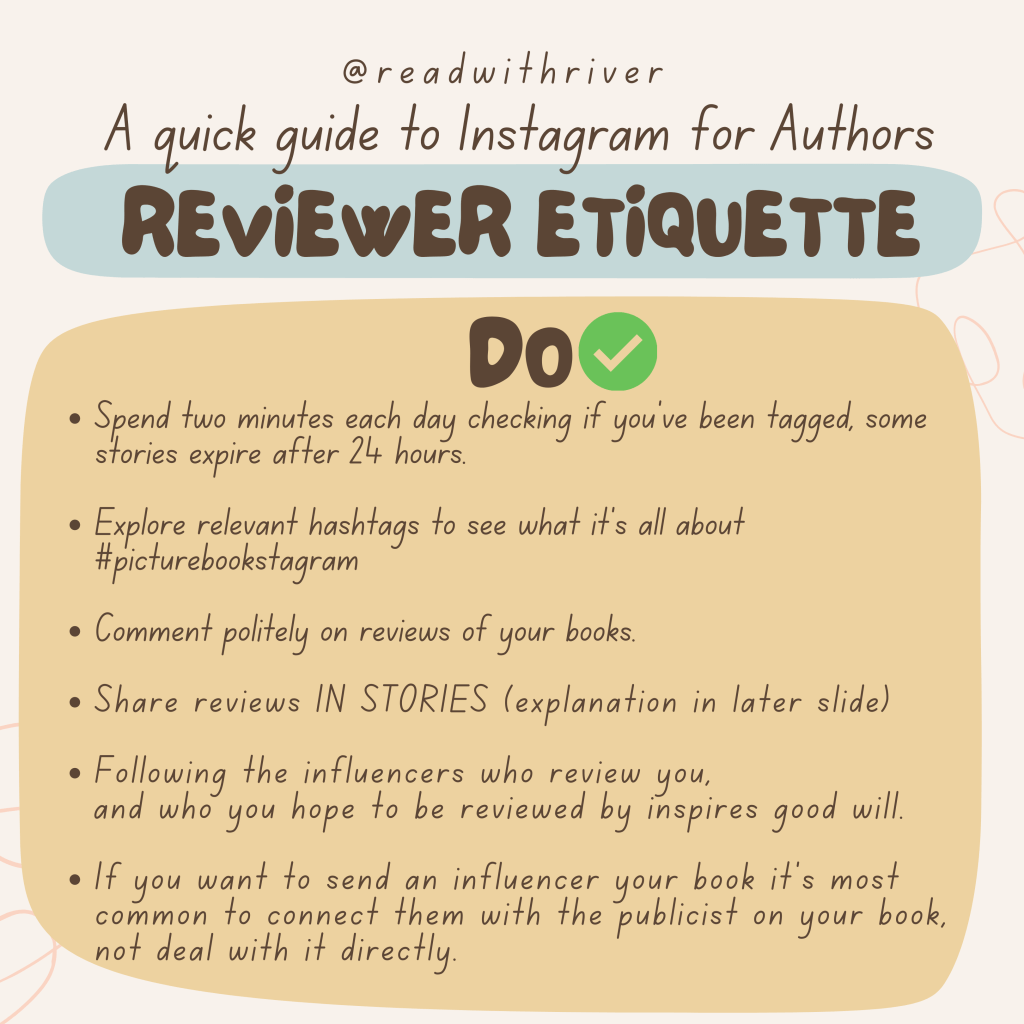
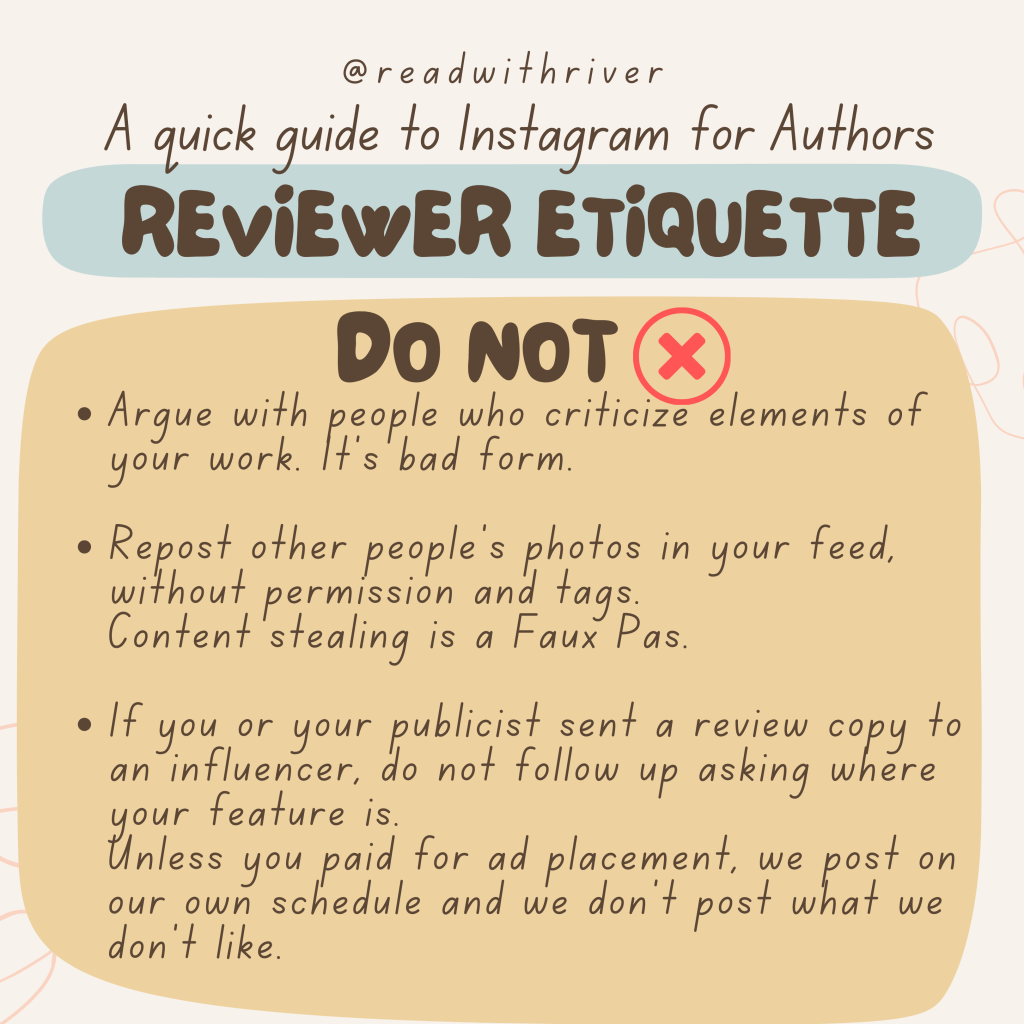
Reviewer Etiquette
Reviewer Etiquette
What’s the goal here? Be seen as responsive, polite & personable.

Being likeable may not seem like part of your job as an author. Traditionally, it doesn’t matter whether or not people like you as long as you can write. But in the world of Social Media, authors who spend time making connections with book influencers, are more likely to get talked about. Influencers are more likely to go out of their way to find your other books, more likely to go out of their way to film more content for your books. Think of book influencers as your champions, if you win them over, they will gladly scream your name from the rooftops until you’ve sold out your print run.

Explore first!

If you’ve never opened Instagram up before and have absolutely no idea what’s happening, it’s worthwhile to take a week to just look around anonymously. It will help you get adjusted before you make a professional appearance.

References:

Twitter Vs. Instagram the stats: https://sproutsocial.com/insights/twitter-vs-instagram/