Posted in Uncategorized

Reconsidering the Schism Between Process Based and Product based Early Art Education.

An example of Process Based painting made by River (4yo) and myself (32yo)

In the world of Early Years education there is a great divide, between educators who emphasize the process of art creation vs those who put the importance on the resulting product.

   This might not seem like a big deal, but between you and me, the resulting two sides can get quite judgemental of one another.  Especially if you happen to be working together with a partner who is of the opposite camp.  It can make for a heated planning session between teacher and ECE partner!

   Critics of product based art education deem the carefully coordinated and uniform projects to be void of any actual creativity or student voice.  Resulting in row upon row of identical cotton ball snowmen or cloned egg carton flower bunches. 

   Whereas those who oppose process based free form art wrinkle their noses at what they see as the inevitable muddy dishwater that child led activities produce.  Where is the learning in a big swirl of paint that resembles the contents of my stomach?  Who wants to frame that?

   I should start by admitting my bias, I have always been a Process based art teacher with an emphasis on Inquiry led projects.  I have a background in Fine Art, I attended Western university for painting, I have a minor in Art history from the University of Toronto and my original teaching subject qualification is Intermediate/Senior (high school) Visual Arts.  But my work experience has always been in Full Day Kindergarten as both ECE and Teacher, specializing in music teaching.  

   Coming from this background and a handful of years of teaching I want to question some of the basic ideas at the core of early art education.  And I want to suggest the need for a shift in the way we consider a holistic approach to early art exploration that can incorporate both process and product driven ideas.

  The major rule I want to question, that exists on both sides of the spectrum, is that a teacher or adult should not interfere in the execution of the student’s work.  Each child should be wholly and independently responsible for what you see on the page or creation.  Teachers should not write on the work, they should not even help label directly on a journal page but instead scribe on the back. 

With process work this means the students just go to town with the materials with some verbal guidance to try and observe and reflect on what they are creating.  With product work this means a carefully directed and controlled procedure that is directed by the adult and carried out by the student, then assessed.

  This dogmatic emphasis on a child creating totally independently is for two reasons. First and foremost, for assessment purposes.  At the heart of all school based projects is the directive to document, and assess for reporting purposes.  Everything a child does is ultimately evidence of their individual growth (or lack of growth to put it bluntly) to be written up on and filed away.  The second reason stems from the idea that if you interfere with a child’s work, you are telling them, they are incapable of doing it themselves.   Which supposedly has emotional and long term psychological ramifications (I strongly question this assumption.) 

What I am proposing is that we challenge this idea that art must always be an individual effort, (which is such a modern idea.) Instead look at art production as a community effort, a joint product and a way to share and cooperate.  For example when we teach music we use a community approach rather than individualist, teachers accompany on piano or guitar, children all sing or play together.  I think we should take this communal creation approach and apply it to visual arts.

An artist’s apprentice three hundred years ago would have worked with direct support, an artist’s workshop would have worked together to complete commissions.  At some point the view of visual art production as a group effort shifted from cooperation to individual genius.  And I don’t think this shift did anybody any favours.

So what would this mean for practical application?  What I am saying is that I believe it should be acceptable for adults to assist with the execution of some art projects not as a way to erase the student’s work but as a cooperative effort.  That students should work together on paintings and sculptures, that it shouldn’t matter if it is impossible to document and assess who did what exactly. There is so much more that you can get out of these sort of partnerships.

A shift away from individualism and instead a focus on exploration and social connection during art projects would have a huge impact on both of the existing approaches to art creation in the classroom.  It would mean that process work would have more of an aesthetically pleasing product and product work could have a little more complexity and depth.

Being able to intervene and work with a student during a process based piece for example would mean you don’t get that muddy dishwater effect. For example you could help them with some elements of painting, you could have a discussion about the pitfalls of overworking a painting, you could demonstrate technique and model right on the work.  Over all I find that working together also encourages students to take on larger products because they feel like they’re better supported. It also just looks better.  

In terms of doing product based craft work with adult and group support more complicated things can be accomplished. This allows for products that are a little more interesting and varied.  Allowing more than one student to work on a craft also means that your classroom bulletin board will have one or a smaller number of pieces on display but that they won’t look like a line up of tin soldiers.  

Will you still be able to assess? Yes. We manage to assess in music class while everyone is working on projects together so I don’t see how support and communal work would be impossible to assess in visual arts.  The only real difference is that it would make sending pieces home for each child a little harder to divide.  But, does anyone really keep every single macaroni decoupage?  No. So I think we can relax a little.
Posted in #Librarian Fight Club

Insidious Oatmeal: The Hidden Dogma of “The Berenstain Bears”

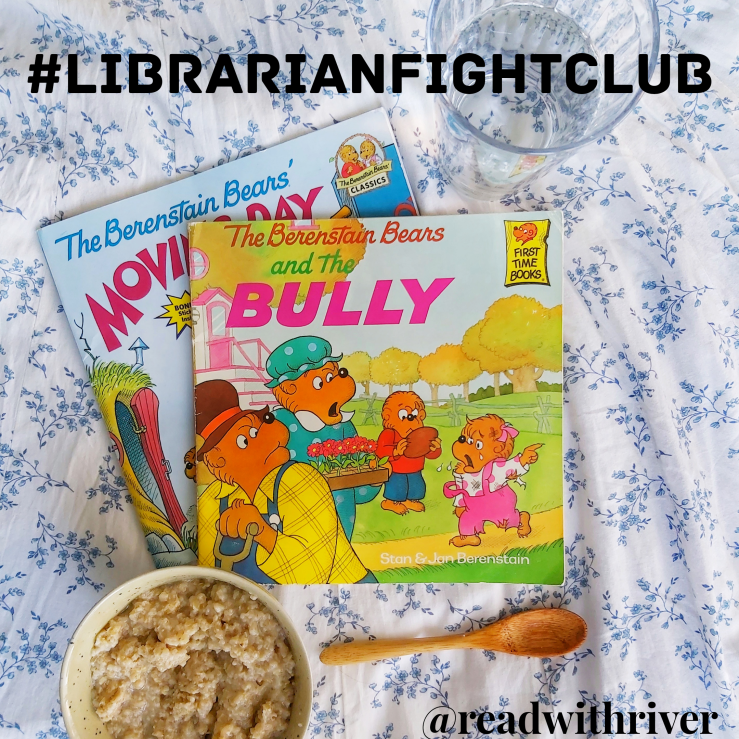
“The Berenstein Bears and the Bully” and “The Berenstein Bears’ Moving Day” by Stan and Jan Berenstain

As a child of the ’90’s and an avid reader, I owned a behemouth stack of “The Berenstain Bears” Books. I found them calming, honestly. I always liked the treehouse where they lived, with the little windows. Things never seemed that bad in their world. They are the literary equivalent of plain oatmeal and a glass of tepid water. But as an adult, I see what lurks beneath, and it makes me deeply uncomfortable.

Obviously I am not the only person who enjoyed these books, given the enormous popularity of the series over the last sixty years. However, when my daughter asked me to read one of the old books that I had the other day, “The Bully” it didn’t quite sit right and it took me some thinking to figure out exactly why.

“The Berenstain Bears and the Bully” By Stan and Jan Berenstain

In the book, Sister bear gets beat up by a bully. She runs home crying to her family, and Brother Bear, incensed, rushes over to the playground before she can finish talking. He is going to fight that bully. When he arrives, he is absolutely completely and totally flabbergasted that the bully is a girl, and obviously he can’t fight a girl. They really do play up the absolute almost impossibility that a girl could ever behave that way. So he does the next obvious thing, he teaches his sister how to fight because, clearly that’s the only way to solve this problem?

“The Berenstain Bears and the Bully” by Stan and Jan Berenstain

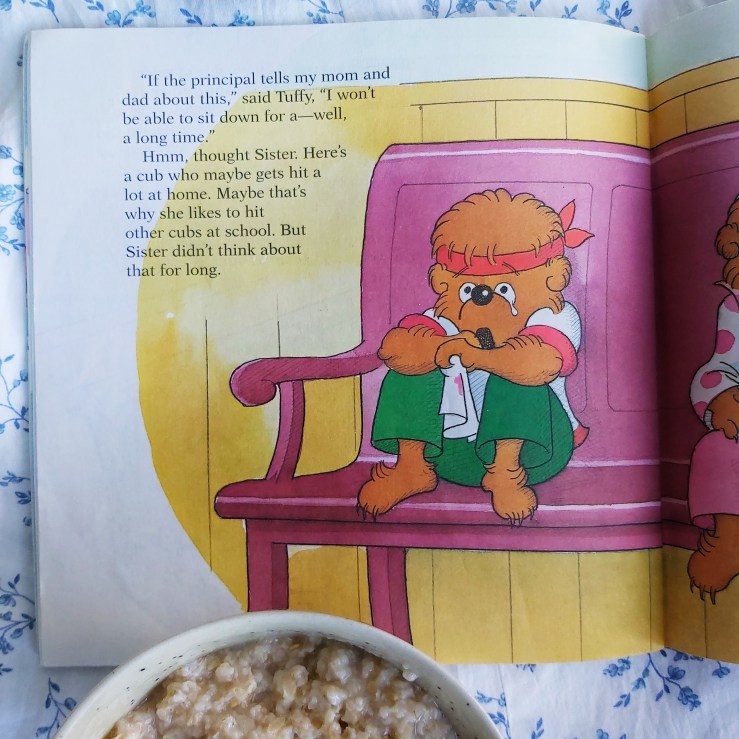
Sister Bear fights the bully and they both get hauled in to see the Principal. The Bully, Tuffy (what an original name), divulges she is frightened of being hit at home. Sister bear gives her a sidelong look, realizing her behaviour is due to abuse and quickly moves on because thinking about that messy family is not her problem.

The End.

So, a lot just happened right there. First of all, the implicit heteronormative 1940’s gender role assumptions are rampant, as they are in every single Berenstain Bears books. Mama Bear is the house maid and cook and wanders around trying to be perfect, while Papa Bear gives out orders with certainty and goes out into the world to provide. We could tear all of the books apart and you will see this but who has the time?

Aside from the horrific gender role assumptions, this whole issue of how to deal with a Bully is problematic on another level. First, there doesn’t seem to be any kind of attempt to talk directly with this Tuffy girl. The parental unit tells her to ignore, but it glamorizes Sister’s Karate Kid transformation. After the two are sent to the principal office, her home situation is given as a blanket backstory for all aggressive behaviour on the playground, and in the end Tuffy has to spend time with the school psychologist and, Sister Bear moves on with her life never having to think of this unsavoury character again. What?

Berenstain Bears books are at their core, vaguely veiled Self Help Books in sit com format. Created in 1962 by Berenstains and their editor Theodore Geisel aka Dr. Seuss. The advice given with such absolute concrete certainty harks from a different age. Apparently this was intentional, Stan Berenstein admitted in interview that the Berenstein Bears were written as existing an an older, pre war, a better time. They use out of date slang on purpose to set themselves apart from the hustle and bustle and confusion of the modern world.

What is even more shocking to me is the Universal nondenominational spirit of the series has veered off completely since 2006 when Mike Berenstain took over writing the series from his parents (who had passed away.) Stan and Jan Berenstein were not religious, Stan actually came from a Jewish family. But their son and current writer Mike, became deeply religious as an adult. When he took over the books he began adding titles such as
“The Berenstain Bears God Loves You,” The Berenstain Bears Say Their Prayers,” “The Berenstain Bears and The Big Question,” and a huge collection of more religiously dogmatic titles. The Christian centered titles have been selling exceptionally well, especially among homeschooling moms.

I always thought throwing some Berenstain Bears books in a collection, was just harmless bland filler. But it seems to me, that underneath the sunny and plain facade, lurks an intention to create internalized dogmatic and patriarchal values in every child. I am not here for it.

Check out the article below if you want to learn more about the story of the Berenstein Bears.

Posted in Uncategorized

The Curious Case of George: What is really Going on in “Curious George?”

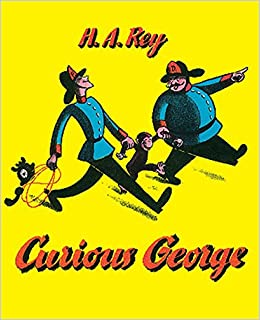
#Librarianfightclub

“Curious George” (1941) M. & H. RAY

Hold on to your hats people because this is going to get complicated.  I want to preface this with saying that as a child I was very fond of Curious George, I had the original books and a large stuffed monkey who sat on a rocking chair in a little walk in closet where I had tea parties.  Despite that Nostalgia, I think we need to look at this critically.

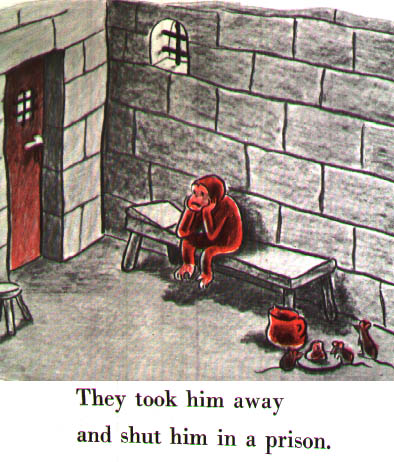
  “Curious George” (1941) by Margaret Ray and H. Ray is about a monkey (with no tail) named George who is kidnapped from his home in Africa by a white man in a yellow hat.  He is told he must be a good little monkey and accept his fate and promptly jumps off the ship, almost drowns and is fished back in.  Once they get to the man’s home, George accidentally calls the fire department and is thrown in jail.  He escapes and eventually is “saved” by the man in the yellow hat and then promptly thrown in the zoo.

“Curious George” (1941) M. & H. RAY

   So this seems like an open and shut case of some seriously messed up allegory of racial power dynamics, pro colonialist imperialist bull crap.  Right? The white man is the saviour who must impose his values and will on George, and George is expected to not only be complicit and obedient but to love and be thankful for the man. Awful right? Just bloody grotesque.

“Curious George” (1941) M. & H. Ray

   Okay but here is where it gets a little more complicated.  The authors, the Rays were a married Jewish couple who wrote “Curious George” while fleeing the Nazis.  They fled Paris on bicycles with nothing but the drawings and a few belongings.  They went to New York where they, like George, had to navigate a frightening new world having been forced by a threat of racist, antisemitic evil to abandon their home. On top of all of this, they had no children, but instead owned pet monkeys. Does this negate our initial assessment? Or does it simply complicate it?

    So how do we untangle this? June Cummins in her compelling article, you can find the link to below, argues that despite their experiences, the Rays are writing with the voice of authority. They are functioning as The Man in the Yellow Hat, who they have portrayed as a force of goodness and rightness. But who is George in all of this?  

     George, symbolizes a human child, the decision to depict him with no tail is a pretty big indicator of that. They owned monkeys, they would have been aware that monkeys have tails. Given their relationship with monkeys it seems natural that they would select a monkey as the animal symbol for a cheeky human child in their story.

    So what about the racial connection, was it intentional? They clearly had their own personal reasons to choose a monkey. But, the Ray’s would have been aware of the plethora of pre-existing media that drew comparisons between Black people and monkeys. That was a pretty commonly used symbol by this time. Add to that the entire narrative of the white man in the colonial safari outfit kidnapping and enslaving George (who is representing a human child) from Africa, this is not something we can dismiss.  The level of intention on the part of the author in making a statement about race is unclear.  However, I don’t think it is possible to fully remove the story of Curious George from its ties to the enslavement narrative and colonialist values.

       At the end of the day, does it matter if they intended it?  Curious George is certainly a book that supports unjust power dynamics, obedience in the face of subjugation, and kidnapping. It also exists in the context of a time when art, writing, propaganda had been making these symbolic connections between Race and monkeys/apes. You cannot remove a piece of art from the context it was created even though yes, clearly there are many layers here.

   No, It isn’t as clear cut as I had initially thought when I began researching this but I do not think that the personal experiences and trials of the authors can erase the obvious context and implications that Curious George and his captivity has in terms of messaging about racial power dynamics, and pro colonial attitudes. 

I do not think “Curious George” belongs on a child’s bookshelf after having researched it and it’s context and implications. However I encourage you to do the research yourself, and consider it. I have linked some articles below for your consideration. 

SOURCES

Cummins, June. “The Resisting Monkey: ‘Curious George,’ Slave Captivity Narratives, and the  Postcolonial Condition.” A Review of International English Literature 28.1 (1997): 69–83. ARIEL. Web. 12 April 2015.

“The Unexpected Profundity of Curious George” Galchen, Rivka.  The New Yorker.  June 3, 2019.

https://www.newyorker.com/books/page-turner/the-unexpected-profundity-of-curious-george

“A Good Little Monkey: Curious George’s Undercurrent of White Dominance and the Series’ Continued Popularity” Terhune, Maya. Boston University WR: Journal of the CAS Writing program