Posted in Demystifying publishing

How Do I Get My Book Published? Should I Self-Publish?

How does a person get their book published? Well there are a lot of different options actually, and though at times that may seem overwhelming to a writer just trying to find their way, we are lucky to be writing in this world with all of the various avenues available to us. If you’re feeling uncertain of what is right for you, and where to begin, let me break it down for you.

First of all you have two main choices, and then within that there are a lot of variables: Traditional vs. Self-Publishing.

Traditional Publishing

Traditional publishing is when a publishing house acquires a manuscript from a writer in exchange for an advance (money). The publishing house then takes that manuscript and it goes through several stages of development at the publisher’s expense, to bring it to it’s final form on the shelves in a bookstore. There are dedicated departments for each element of creating, selling, and publicizing the book: editing, design, layout, binding & printing, shipping, sales, marketing, and publicity. After the book is published, the author begins to receive royalty payments on book sales after the number of sales exceeds the advance that the author was paid upfront.

Variations in Traditional Publishing Houses

There is a huge variety within the realm of traditional publishing. Some publishing houses are enormous, and buy out smaller ones (such as Penguin Random house, Simon Schuster and, Hachette.) These houses publish and distribute thousands/millions of books each year world wide. Meanwhile other publishing houses (indie publishers) are tiny, a handful of people each doing three departments each and publishing only a few new titles each year with potentially very small print runs of a few thousand or less. The quality and vibe of each of these houses is entirely different and there are relative benefits to working with a big house vs. an indie.

Big House Benefits:

-Bigger budgets for every department mean a lot more is possible

-More money for marketing

-Access to more opportunities for your book to be carried in different stores worldwide

Indie House Benefits

-Each person working on your book is passionate and committed to its success.

-More likely to take risks in terms of edgy content, new and up and coming illustrators, etc.

-Authors have more contact with their publisher, and potentially more say in decisions made about their book.

Independent publishers and self-sublishing are NOT the same thing. Although often people might label a self-published book as coming from an independent publishe when it is not. There are key differences between an independent small publisher and self-publishing.

What is Self-Publishing?

Self-Publishing is when a writer produces their own book and personally sells it. There is no submission process, no gatekeepers deciding whether or not a manuscript becomes a book. There are no outside factors in the decision to publish, it is undertaken at the author’s expense. There are different ways to self-publish, some are more expensive and time consuming than others.

The easiest and fastest way to self-publish a book is using Amazon KDP. All you have to do is upload a pdf of your manuscript and within seventy two hours it will be available for purchase in much of the world via Amazon. The most difficult part of this process is getting the formatting of your pdf correct, that can be a bit finicky and annoying. Allowing for tech difficulties in pdf formatting it will still only take you a couple of days to complete. Amazon then gives you a percentage of those sales directly deposited to your bank account, and you can control the price of the book. Amazon will take most of the profit.

Some people go to great lengths and invest huge amounts of money to take their manuscript and have it produced more like a traditionally published book than the Amazon route, this is still at their own expense. I have heard of some people doing Kickstarters to help cover the costs of self-publishing like this. There are services that offer to do much of this for a price of a few thousand dollars, but some people go all out and pay for high end editing services, layout and design, the best printing and binding, marketing assistance. This can run a writer up $15,000 or more.

Which option is right for you?

Well that really depends on you and what your needs and goals are. It also kind of depends on your personality, entering into the traditional publishing world can be quite grueling and cruel and it’s not for everybody.

Let’s compare based on a case study of my own books.

The Books in Question
Self-Pub:

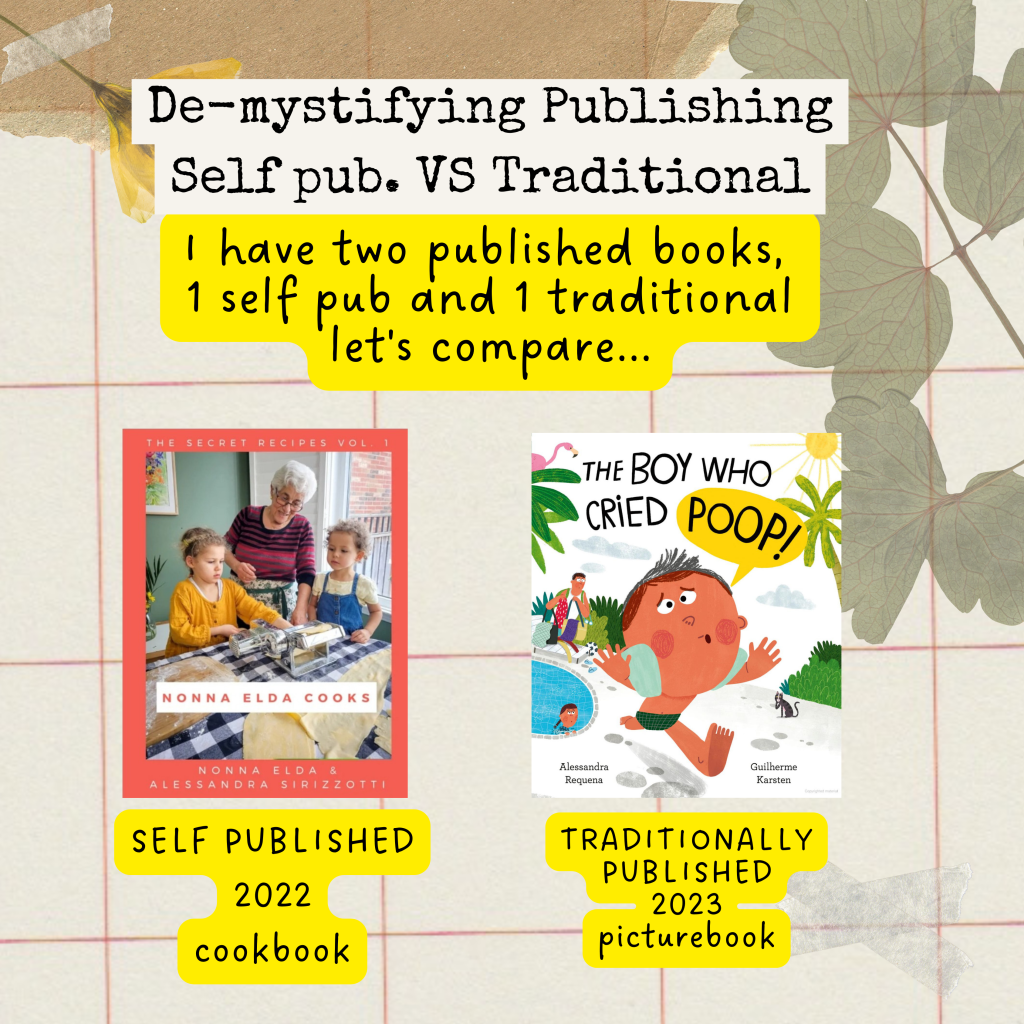
I have three self-published cookbooks available on Amazon in print form (they are also now available as pdf downloads on www.nonnaeldacooks.com for anyone who doesn’t wanna pay Jeffy). I made these cookbooks from my grandmother’s recipes, we run a social media channel where we make her recipes @nonna.elda.cooks with almost 700K followers across all of our platforms (IG/TT/FB). I made each of the three cookbooks using Canva pro, each book took me a few weeks to put together, I made them alone, no outside editors or layout designers were involved. The artistic quality is mid at best, I made it on Canva from cell phone photos what the heck do you expect? However it does the job of giving you the absolutely phenomenal secret family recipes you can’t get anywhere else and I have a large built in audience to sell it to. Today we will look at the first cookbook which was published in August of 2022 for our comparison.

Traditional Pub:

I have one traditionally published picturebook currently out “The Boy Who Cried Poop!” (about the time my brother took a dump in a pool in 1992 which I think is hilarious, he thinks it’s less hilarious). It’s out with the publisher Frances Lincoln, an imprint of a larger publisher called Quarto. The picturebook was released in June of 2023, and it is currently available in 7 languages worldwide. We will be using this book for comparison, and the numbers statements included will be from the first six months (because the publisher only issues us statements once every six months, which is annoying.)
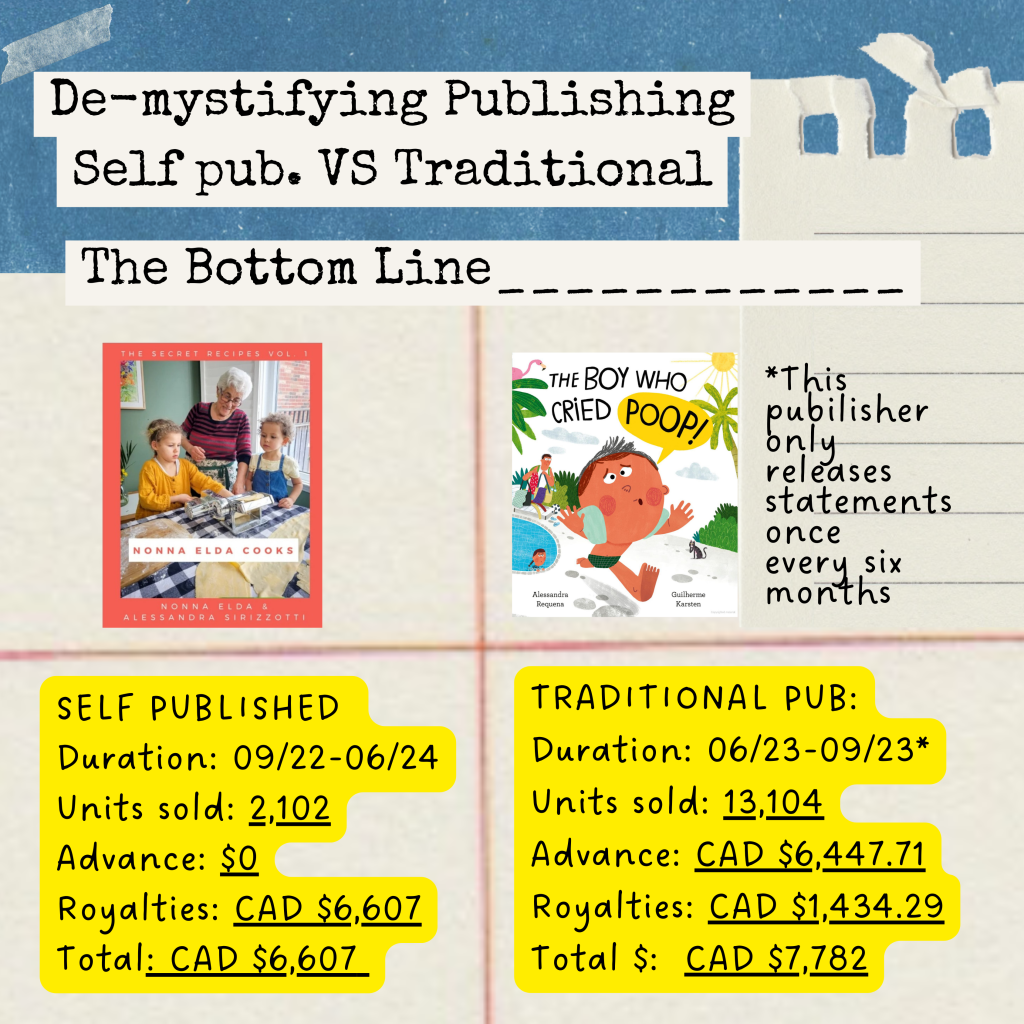
Let’s look at the bottom line numbers here of how the two books compared on the big items.

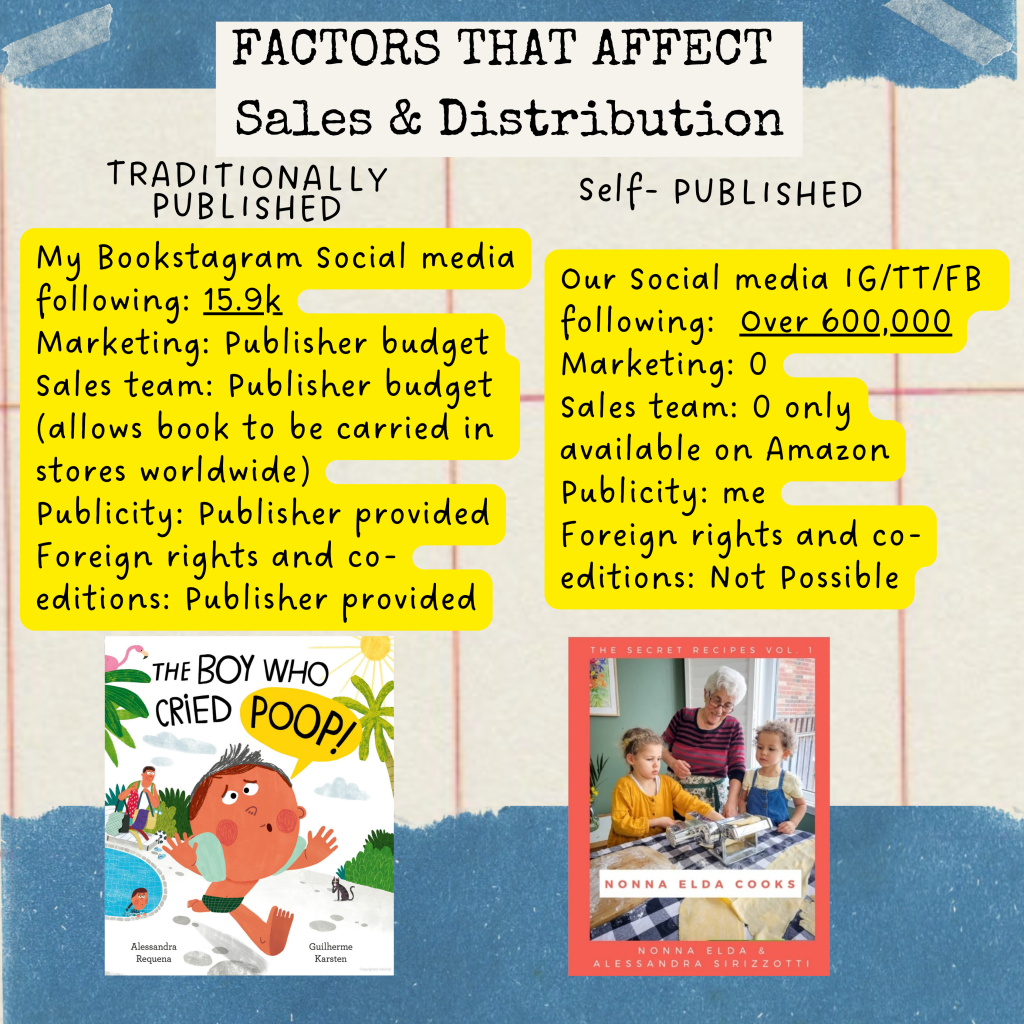
Units Sold, Selfie 2,102 vs. Trad 13,104.

Traditional publishing destroyed this competition which was actually kind of a surprise to me because we have such an enormous following backing us up on Nonna Elda Cooks. A lot of influencers who approach me asking for advice because they want to do self-publishing often say “well selling the book won’t be a problem because I have X number of followers” the reality is only a small fraction of your following will actually click through and purchase something like a book 90% are only there for free content. (It’s much easier to get a follower to switch brands, especially for a product that they feel they need than it is to get them to purchase a recipe book especially when they can view your recipes for free.) So if you have a following behind you and think you can rely on them to purchase, you might need to readjust your expectations. Of the over 650,000 followers we have on Instagram, Tiktok, and Facebook, only 2,102 people went and purchased the book even with constant reminders. We also have a tip jar available on our blog where we share free recipe downloads with over 50,000 visitors in the last six months, not a single person has ever tipped us when taking one of the free downloads. People will absolutely not give you money on the internet unless it’s completely and totally necessary.

Traditional publishing was definitely more successful in getting a much larger volume of books out. “The Boy Who Cried Poop!” book was sold into bookstores worldwide, and translated into seven languages. Despite being available for a much shorter period than the cookbook, 6 months vs. the 1.5 years, it was purchased by way more people.

Why is traditional publishing better at selling a larger volume of books?

It comes down to resources and connections and the reason why people are purchasing the book. The self-published book is only available in one place, admittedly it’s Amazon so that means people can access it all over the world but that is still only one language and one bookseller. The people purchasing it are making that choice because they know who we are and want our recipes. They’re not buying it for its artistic integrity. People buy the picturebook because it’s beautiful and they just think their kid will like it so I don’t need to create a connection with every single buyer of the picturebook.

The traditionally published book is available in many places where books are sold, as well as libraries. The publishing house has an entire network of connections to big bookstores as well as other kinds of stores that sell a selection of books such as Walmart, Costco or pharmacies. The sales team are dedicated to going out and convincing the buyers for all of these different places to stock their books. This has so many possibilities and so much potential for reaching people in all kinds of places.

The traditional publishing house also sells the rights to the books worldwide to other publishers. For example my picturebook is published by Quarto (Frances Lincoln mprint) in Britain and the United States but in Canada its distribution rights have been sold to Manda group, in Australia those rights have been sold to Thames and Hudson. Translation rights have been sold to various publishers around the world and each of those publishers have the book translated (Korean, Danish, French, several different kinds of Spanish) and they sell the books in those countries. Those publishers each have their own connections and sales teams to get the books into stores in those countries. Multiple print runs have been ordered and sold in Korea for example. This is just not a possibility for a self-published book. This is the reason that traditional publishing will always have the ability to sell bigger numbers worldwide.

Then of course actual money is spent on the marketing of these books, so that people see the book in a variety of contexts, it’s not just being shown to my followers on social media. There are so many different reasons that the book is more readily available, and more heavily marketed with traditional publishing.

MONEY

Per book sold self-publishing put more money in my pocket. My cookbooks brought in $3.14 CAD per book direct to my account, versus the traditional publishing where between my advance and royalties each book sold brought me $0.36 CAD.

You might be yelling “36 CENTS? WHAT? WHY EVEN ASK US TO BUY IT?” To which I say, “Yeah I know! That seems really little doesn’t it!” When you consider how many people work on the book and the costs associated with it, it makes a lot of sense. So if the book is retailing for CAD $27 and they are giving me CAD $0.36 cents, the other CAD$26 bucks have to pay not just the illustrator but all the other people working at the publishing house, the paper printing and binding costs of making the book, the rent fees of housing the stock of books in warehouses, the delivery truck drivers who take it to the store, the cost of any returns of said book. A certain amount of the purchase of each book also goes towards marketing that title in future. Publishers do not turn a huge profit, the margins on selling books in a publishing house is around or less than 10%, and any profits made are being put into making offers on new book acquisitions. The CAD$27 has to do a lot of heavy lifting to support a whole industry of people who barely make a living wage and that’s why authors make almost nothing per book. It’s also why every book sale is essential to keeping the publishing house going, and also to ensuring that an author gets future book deals.

On the other hand when you’re selling with Amazon you make a higher profit per book but the rest of that cost is getting eaten up by Amazon. So each book was listed at CAD$15, I made CAD$3. Something like CAD$4 of it went to paper printing and binding costs and the remainder went to Jeff Bezos. So Jeff makes like $9 on my work, and I make $3. I have to say I don’t love that. I’d rather know my work is helping to support my editor and his wife, and the layout designer and their girlfriend, and the marketing dude and his dog, my agent who is an angel on earth and really should have all the dresses she wants off of Son de Flor. I hope I sell a million books, and my agent gets some really ridiculously extravagant dresses one day.

At the end of the day I still made more money traditionally publishing than self-publishing even though the take home per book is much higher with Amazon KDP because of the volume of the sales and distribution that a traditional publisher can support.
Time and Labour

Self-Publishing

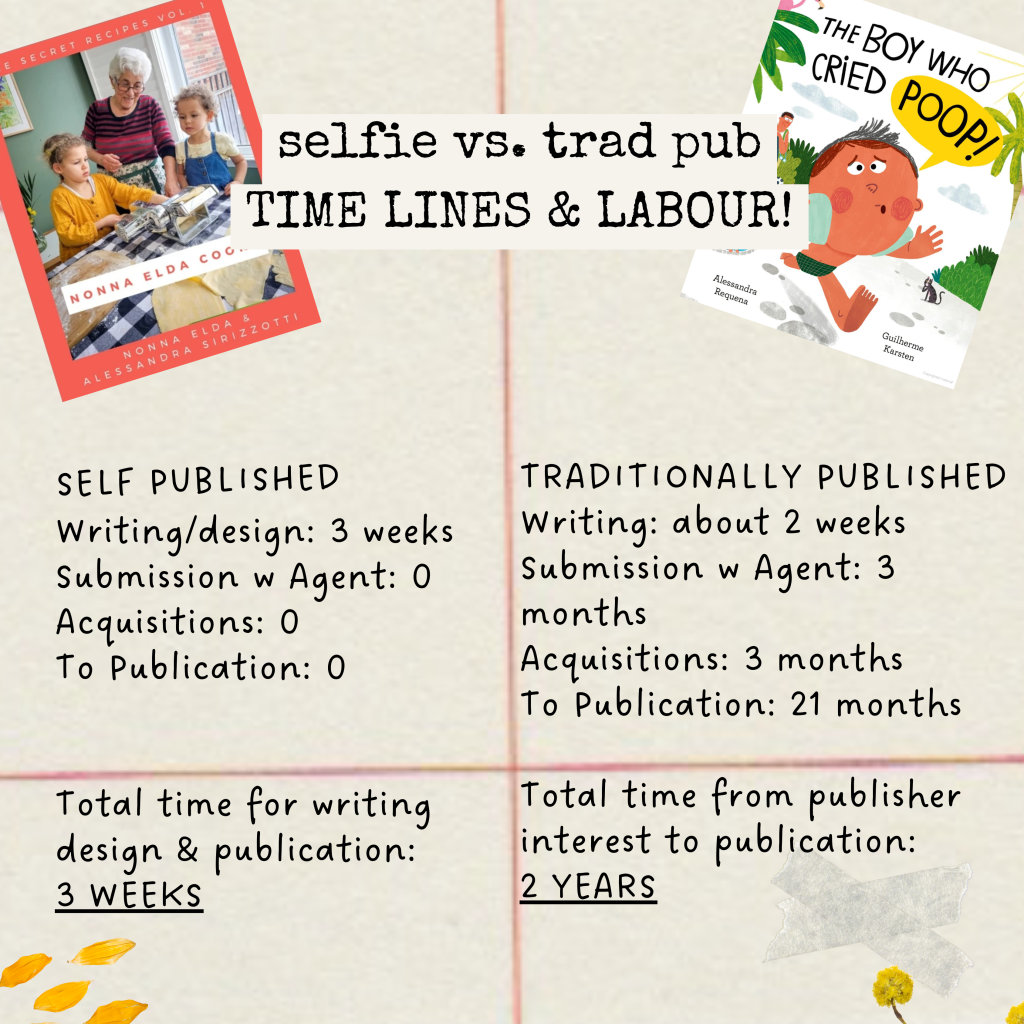
I had to do everything for the publication of the cookbooks myself, writing, editing, photography, photo edits, lay out, design, setting up the Amazon landing site, doing all the copy and SEO. Then driving traffic to the book and getting people to purchase it was again all me (and my grandmother who appears in our videos.) When you self-publish you need to find your audience and convince them to purchase your book, so that meant months of creating and putting out content on social media. Every sale made was from our own publicity we had zero dollars in marketing.

So in one way, the time it took to make the actual cookbook and push it out into the world was a lot less. It was about three weeks for me to put the actual book together and hit the publish button on KDP. But creating the audience base, making the recipes and photographing them as content, everything took months. Any ongoing sales we continue to have is because of basically a full time job creating content driving traffic. There is a lot of time and labour that goes into not just making a self-published book and then having it available for purchase, but in getting people to buy it.

Traditional Publishing

So this is a picturebook and the actual writing of the story didn’t take that long, it was maybe a two week period of thinking and editing it with my agent. My agent then took the story and did all of the work of submitting it to editors (he makes a 12% cut of all my advances and royalties, which is actually a little less than standard 15%.) I think this took a few months.

Once we had an interested publisher, between them expressing interest and us signing the book deal it was another three months or so. Then after that it was a full year and a half where the publisher was going through the process of turning it into a book. I did a few light edits with my editor Pete after the illustrator had been brought on board but that was it until the book was released.

After the release and during the lead up I did a little bit of promotion, I have a bookstagram account @readwithriver where I did some posts there. The majority of my marketing and publicity was arranged and paid for by the publisher however.

Over all I would say the traditional book was less work and labour on my part after the initial writing was done. However the time spent waiting was enormous.
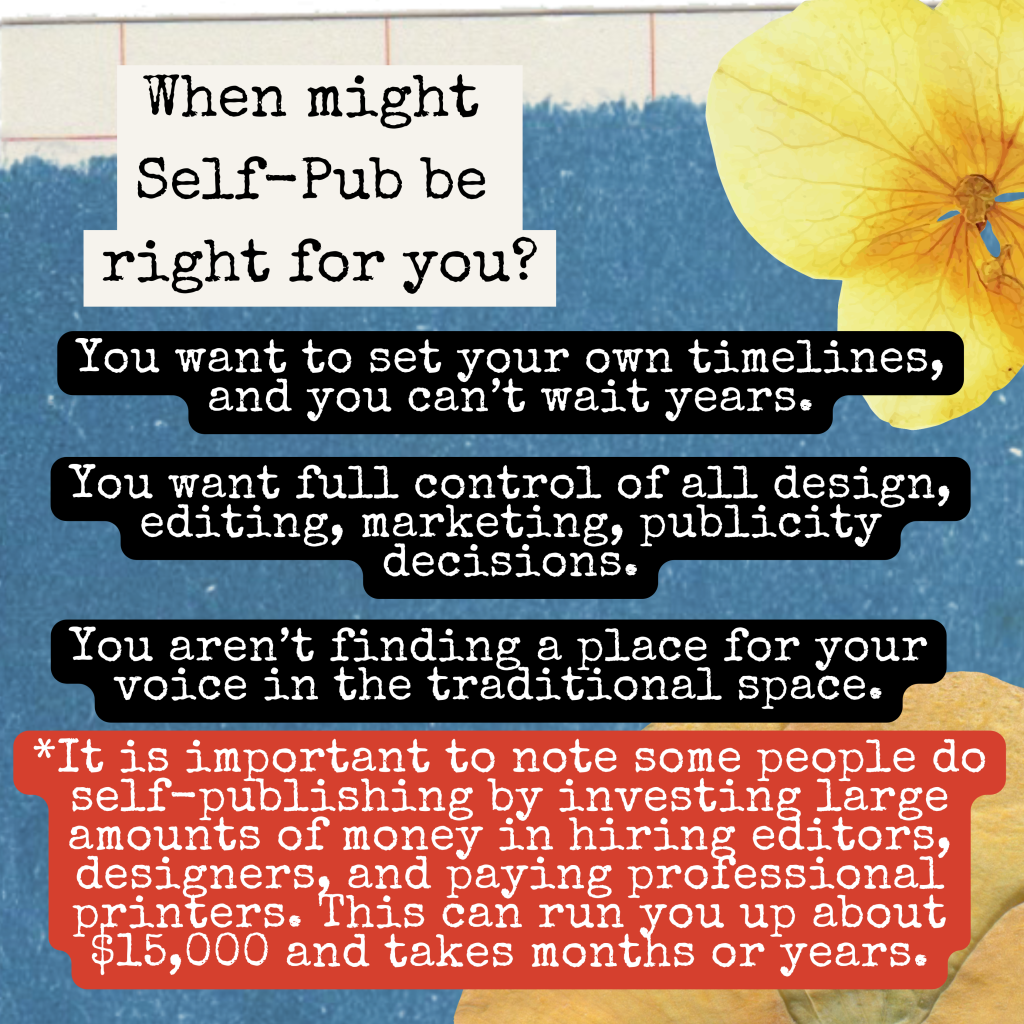
From my own experiences I have to say I think self-publishing has a lot of advantages and based on your needs, goals, and particular situation might be the right choice. Try writing down what your goals are and why, to help you figure out if it’s in line with what you can get from self-publishing.

I would and will use self-publishing again. In my particular circumstance with this book I needed to have a way to monetize my social media channels to pay for the time and items needed to run the channel. I just did not have the time to shop the cookbook around extensively. We actually did pitch the cookbook to several publishers, and despite the social media following we were rejected. I didn’t have the time to approach it from another angle, and then go through the years of waiting to release it. So for us, self-publishing the cookbooks just made sense.

Additionally the cookbooks didn’t need to be art in the same way as a picturebook has to be art. Yes most traditionally published expensive cookbooks are coffee table books that double as art, but that’s not what we needed to make. The cookbooks we provide are meant to provide a written recipe and directions for our followers to use, who need to see the words written out for the dishes we make in our videos. We are capable of providing that in a simple pdf with our photos without all the bells and whistles.

For us it was a no brainer self-publishing was the only real option for us to get what we needed for these cookbooks. I think it was the right choice, and I would use this avenue again in future for a purpose like this. It’s a great tool, with no overhead costs.
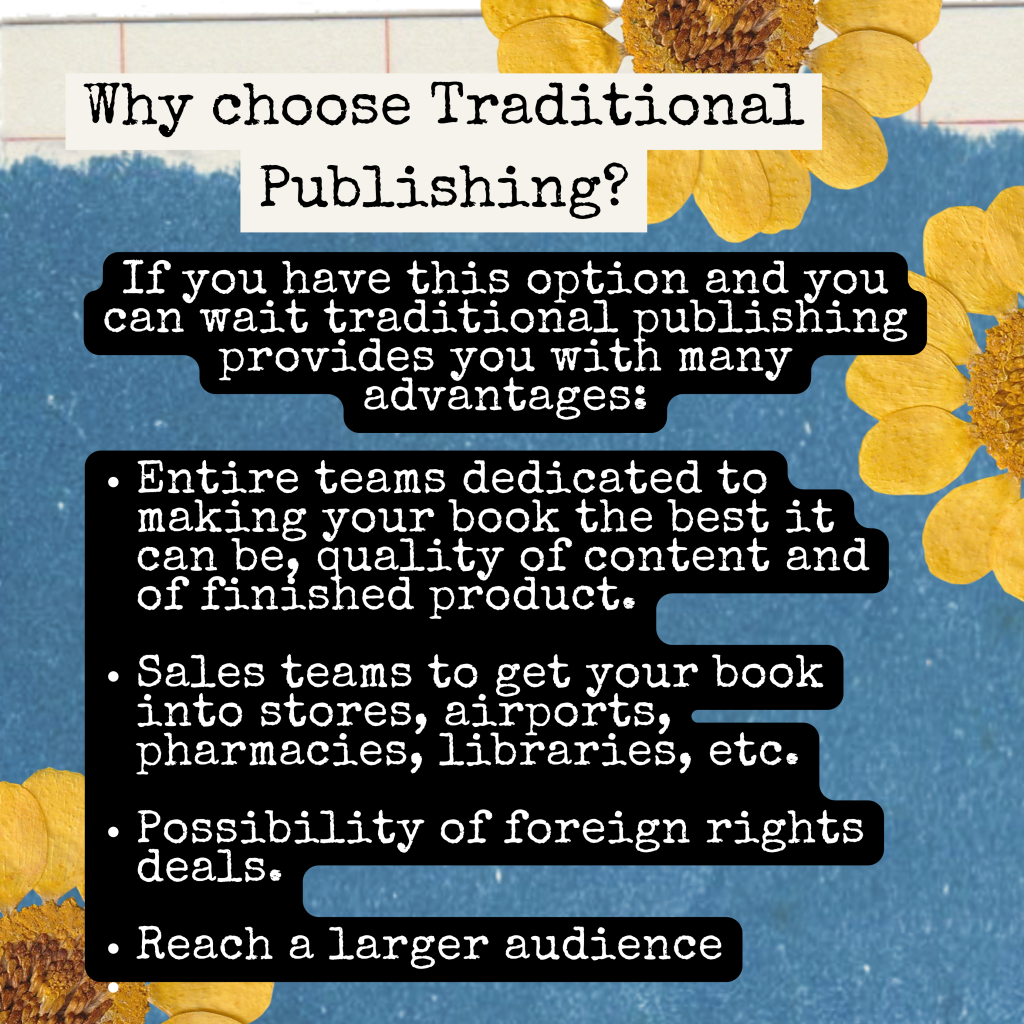
Traditional publishing is full of gatekeepers, and if you don’t have personal connections with those gatekeepers it’s a huge hurdle. Getting in is almost impossible, and even if you spend years submitting to publishers and agents you just might not get through. There are thousands of submissions every year to each publisher, only a handful of manuscripts are chosen from each to be published.

There are lots of reasons for why this avenue might be closed to you so simplifying it down to whether or not you can choose to traditionally publish is reductive. However if we are simply comparing the relative benefits, the fact is that traditional publishing offers writers who have the time and resiliency to rejection to wait for an offer more of a real career long term.

If you are sitting here wondering where to go and you haven’t begun the journey of submitting your work to publishers and agents yet, you need to ask yourself what your goals are and how much you’re willing to undergo for it.

If you want to set yourself on the traditional publishing track you need to ask yourself if you are going to be ok with the following three inevitable realities:

First, there will be a lot of rejection. It will be constant and you’re going to be expected to take it with grace and say “thank you may I have another.” There’s a certain amount of masochism inherent in writing for the traditional market, sorry.

Second, it’s going to take for bloody ever. It’s going to be years. If you’ve ever built an addition on your home or done some construction project that took over your life, it’s like that. Finding out information about what’s happening? Meeting timeline goals, nope. Forget about it. Get ready to hurry up and wait.

Third, traditionally published books are a product of teamwork. This is a beautiful thing because each member of the team specializes in whatever element they’re bringing to your book. However this will mean accepting criticism, and compromising on the book you’ve written. Your final book is probably not going to look or be what you imagined initially, it’s not just your baby. You’re co-parenting that baby with a whole team now. Are you okay with that? It’s okay to say “no, I’m not” and make decisions knowing that about yourself. Personally? I’m a complete sell out, seriously the price isn’t even that high. I will add aliens, I will delete entire characters at the drop of a hat if it means I take home that advance. Artistic integrity be damned I may be an artist but I do not have any desire to starve for it.

If you’re at the beginning stages here and you’re still nodding your head saying yes I want this, I want to be a traditional author, I accept all of this but you’re not sure where to start? I have three avenues for you to consider, and some information available to you here on this blog to begin.

Next Steps for Pursuing Traditional Publishing

  1. Peer Review/Edits/Beta Readers

First have you taken your manuscript to be peer reviewed or edited professionally? You can do this in different ways, there are organizations like SCBWI that have writing groups, or local organizations like your community library or community college. You can also enlist the help of a professional editor (I personally offer manuscript review and feedback for picturebook texts.)

2. Querying a Literary Agent

Second, approaching an agent. Do you want an agent? Not every author has an agent and you don’t strictly require one to become an author. I personally have one and I can’t live without them. You can see my blog article on literary agents for more information one what they do, and how to approach them.

3. Submissions

Third, open submissions to a publisher. Do you want to skip getting an agent, or are being continually rejected by agents and would like to go straight to a publisher? Not all publishers accept unsolicited submissions. You can check out my blog post on open submissions (that means they consider manuscripts from un-agented writers). There’s a spreadsheet with a list of traditional publishers who accept open submissions for your convenience that includes how and where to submit to them.

Hope that helps!

Subscribe and follow @readwithriver for more ‘De-mystifying Publishing’

If you found this helpful you can support my work here by buying my book “The Boy Who Cried Poop!” Or requesting it at your local library. If you already have a copy (thank you) leaving a review on Goodreads or Amazon would be such a fantastic help. I appreciate you all!
Posted in Demystifying publishing

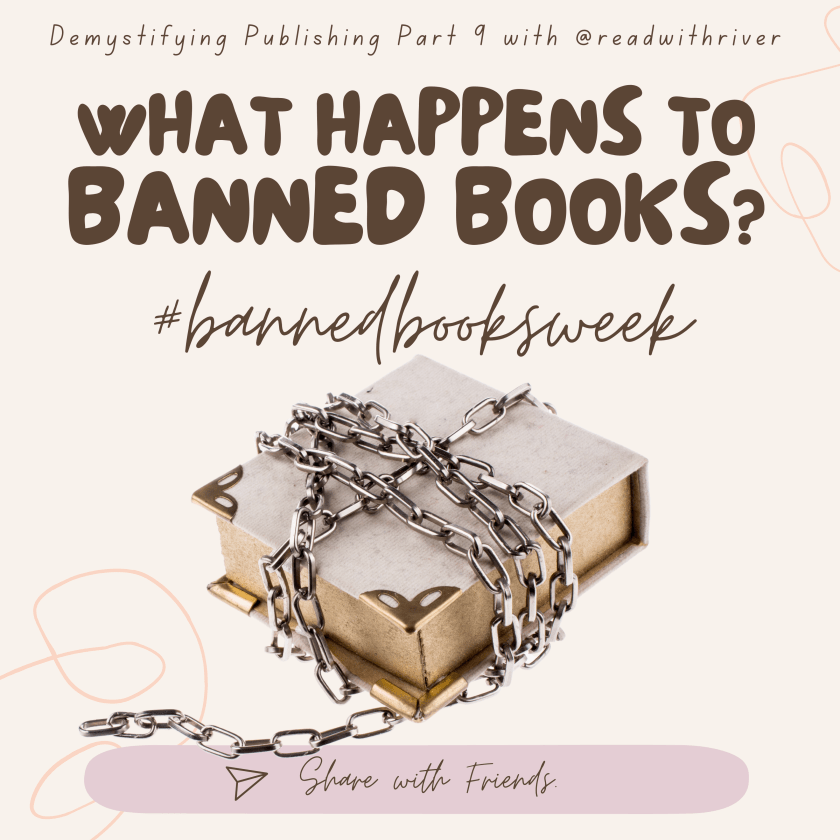
What Happens to Banned Books?: Demystifying Publishing Part 9 with @readwithriver

What's the deal with banning books? What happens to the books? Who is most affected? Let's discuss!
Demystifying Publishing Part 9 with @readwithriver: What happens to Banned Books? #Bannedbooksweek
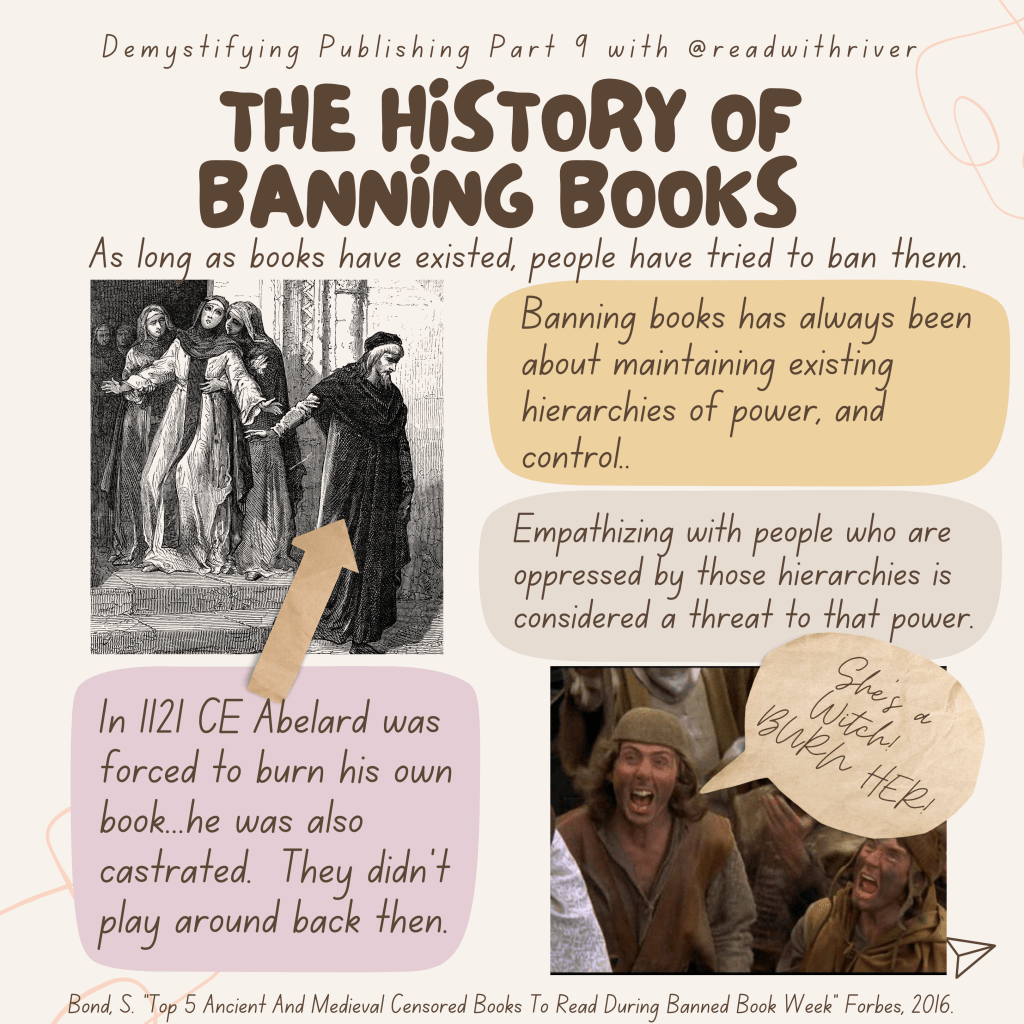
The History of Banning Books. As long as books have existed, people have tried to ban them. Banning books has always been about maintaining existing hierarchies of power, and control. Empathizing with people who are oppressed by those hierarchies is considered a threat to that power. In 1121 CE Abelard was forced to burn is hown book…he was also castrated. They didn’t play around back then. (Source Bond, S. ” Top 5 Ancient and Medieval Censored Books TO Read During Banned Book Week” Forbes, 2016.
Banned Books Today. Are banned books illegal tools of the devil? …No…Books are banned by individual school boards, libraries, schools, etc. You can still buy them, they are often harder to find.
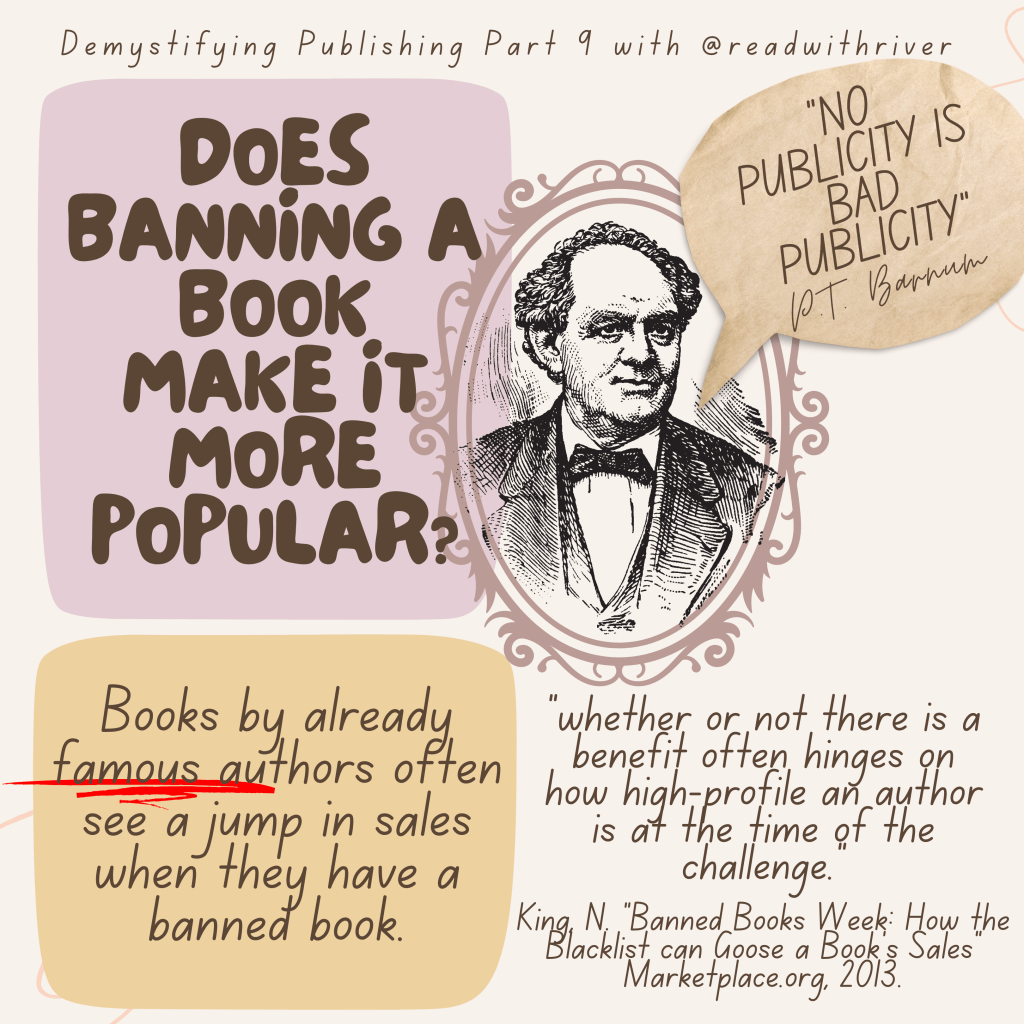
Does banning a book make it more popular? “No Publicity is Bad Publicity”-P.T. Barnum. Books by already famous authors often see a jump in sales when they have a banned book. “Whether or not there is a benefit often hinges on how high profile an author is at the time of the challenge.” (Source King,N. “Banned Books Week: How the Blacklist can Goose a Book’s Sales” Marketplace.org, 2013.)
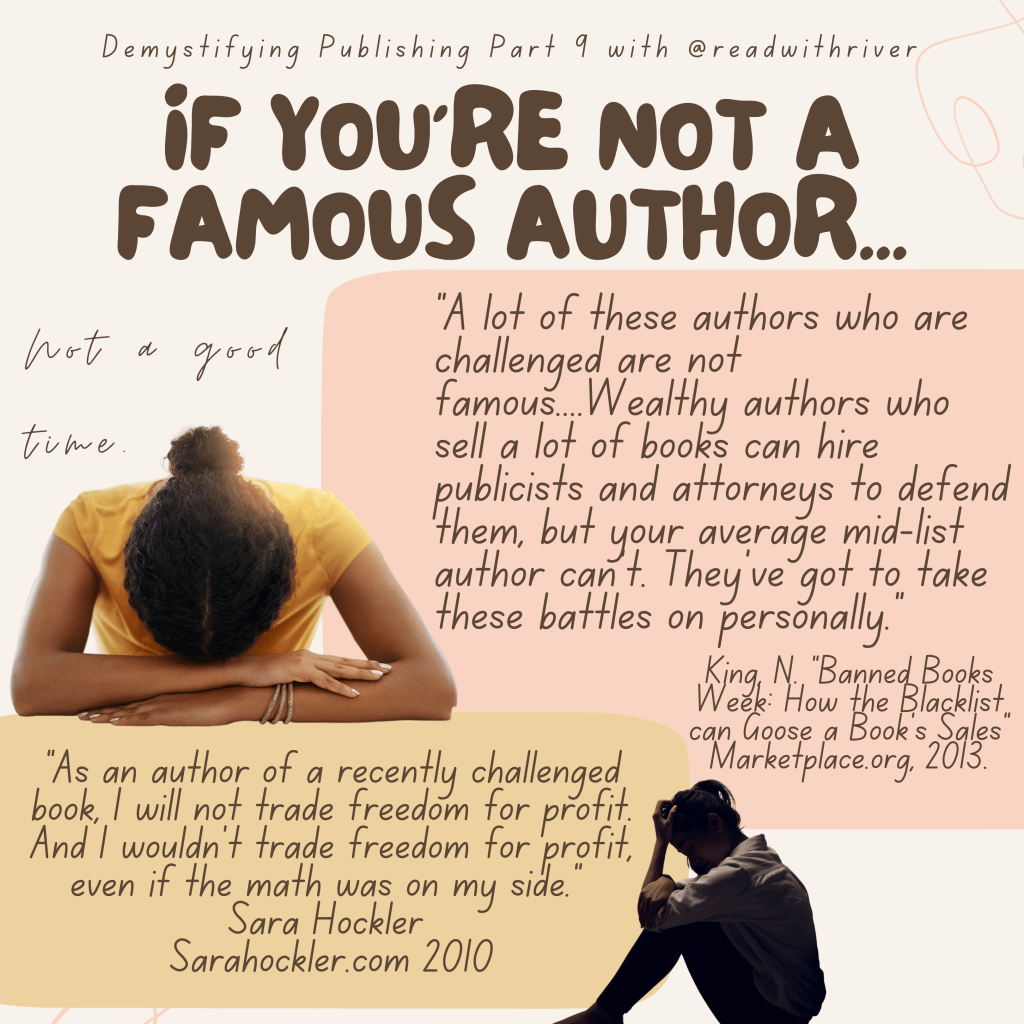
IF You’re Not A Famous Author… not a good time. “A lot of these authors who are challenged are not famous….Wealthy authors who sell a lot of books can hire publicists and attorneys to defend them, but your average mid-list author can’t. They’ve got to take these battles on personally.” (Source. King,N. “Banned Books Week: How the Blacklist can Goose a Book’s Sales” Marketplace.org, 2013.) “As an author of a recently challenged book, I will not trade freedom for profit. And I wouldn’t trade freedom for profit, even if the math was on my side.” (Sara Hockler, Sarahockler.com, 2010)
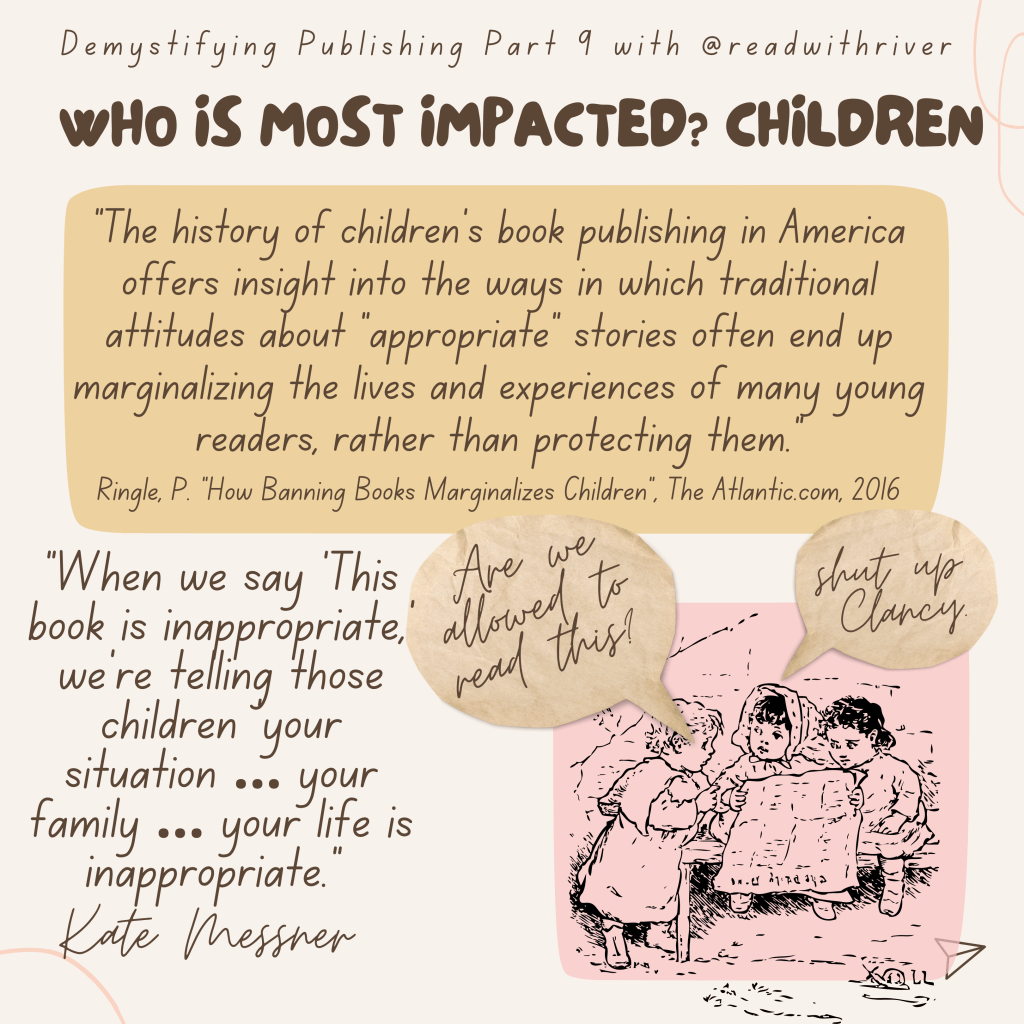
Who is most Impacted? Children. “THe history of children’s book publishing in America offers insight into the ways in which traditional attitudes about “appropriate” stories often end up marginalizing the lives and experiences of many young readers, rather than protecting them.” (Source, Ringle, P. “How Banning Books Marginalizes Children,” TheAtlantic.com, 2016.) “When we say ‘this book is inappropriate’ we’re telling those childrne your situation…your family…your life is inappropriate.”-Kate Messner
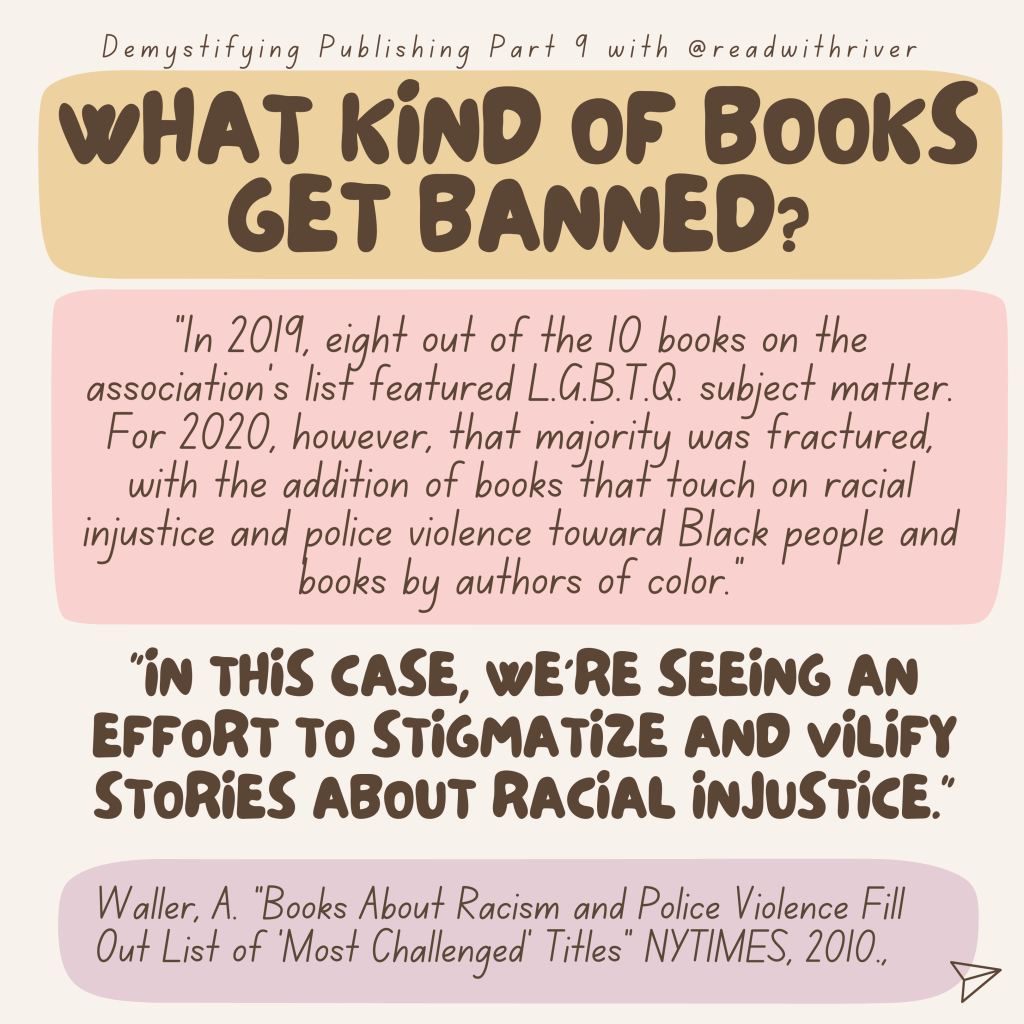
What kind of books get banned? “In 2019, eight out of the 10 books on the association’s list featured L.G.B.T.Q. subject matter. For 2020, however, that majority was fractured, with the addition of books that touch on racial injustice and police violence toward Black people and books by authors of color.” “In this case, we’re seeing an effort to stigmatize and vilify stories about racial injustice.”(Source, Waller, A. “Books About Racism and Police Violence Fill Out List of ‘Most Challenged Titles.” NYTIMES, 2020.)
Banned Books Week Since 1982 every year in September Banned Books Week is celebrated to fight against challenges, and support books that have been banned. A Coalition of Organizations works together for banned Books Week. Check it out to learn more.

Sources

Source 1: Bond, S. ” Top 5 Ancient and Medieval Censored Books TO Read During Banned Book Week” Forbes, 2016.

Source 2: King, N. “Banned Books Week: How the Blacklist can Goose a Book’s Sales” Marketplace.org, 2013.

Source 3: SaraH Ockler, SarahOckler.com, 2010

Source 4: Ringle, P. “How Banning Books Marginalizes Children,” TheAtlantic.com, 2016.

Source 5: Waller, A. “Books About Racism and Police Violence Fill Out List of ‘Most Challenged Titles.” NYTIMES, 2020.

Posted in Demystifying publishing

Literary Agents: The Fairy Godparents of Publishing

Demystifying Publishing Part 4 with @readwithriver

Demystifying Publishing Part 4 with @readwithriver  
Literary Agents:The Fairy Godparents of Publishing
A very practical Cinderella story.
What does an agent do?  Why do you want one? How do you choose one?
Saves and Shares are appreciated!
Fairy Literary Agents 
A very practical Cinderella story.
Once upon a time there was a writer who could not get to the publisher’s ball to have her manuscript read. “Oh how I wish I could go to the ball.” Then one night after many years of wishing one of her queries* was answered! An agent appeared.  
*See part three on How to Query.
Fairy Literary Agents
Pumpkins and Glass Slippers
Her Fairy Literary Agent used her editing magic to dress up her manuscript and get the writer past the gates into the publisher’s ball to dance with the editor.  Most editors especially at big houses will only look at manuscripts brought to them by agents.  These editor-agent relationships are cultivated over many years.  Even for publishers that accept open submissions (see part 3) manuscripts submitted by agents are seen faster and are given a response even if it is a reject.  Instead of six months, you can expect half of that time frame or less for a response.
Fairy Literary Agents At the Ball
Once the writer’s work was past the gates, it was up to the writer to make the editor fall in love with her work.  A Fairy Literary Agent can help you streamline your work, they can get you an audience with the best editors but, they can’t force an editor to love it or to like you.  That’s your job.  Editors call a meeting with the author before an offer is made to see if they will be easy to work with.  You CAN talk yourself out of a book deal. 
Fairy Literary Agents Finding you the right prince!
Not every publisher is one you want to work with.  Agents look for skeletons in editors’ & publishers’ closets and steer their clients away from sketchy partnerships.  They have a history of working with various editors and teams and they will know who will be the best fit for you and your work.  Traditional publishing is a team sport.
Fairy Literary Agents Contracts
Standard contracts are NEVER in the author’s best interests. Your agent negotiates for you until it is. Beforehand: financial matters like royalty percentage &, production matters like cover approval. During: intervening in decisions that negatively affect the integrity of your work.  After: making sure your work continues to be in print and if it is not, fighting to revert rights back to you to resell.  This is just a fraction of what they negotiate.
Fairy Literary Agents, agents succeed if you succeed. 
Agents usually make 15% of the author’s cut, from advance and royalties.  They only get paid if you do.
This is NOT lucrative. Agents sometimes have second jobs, or take on more clients than they can reasonably handle to make a living wage.  This is a career people choose because they love doing it, not because they’re trying to make a mint.  A good question to ask an agent before working with them is how many clients they have and how much time they will have to work with you personally.  No one is more personally invested in your success than your agent, their livelihood depends on it.
Fairy Literary Agents: Finding the right agent for you
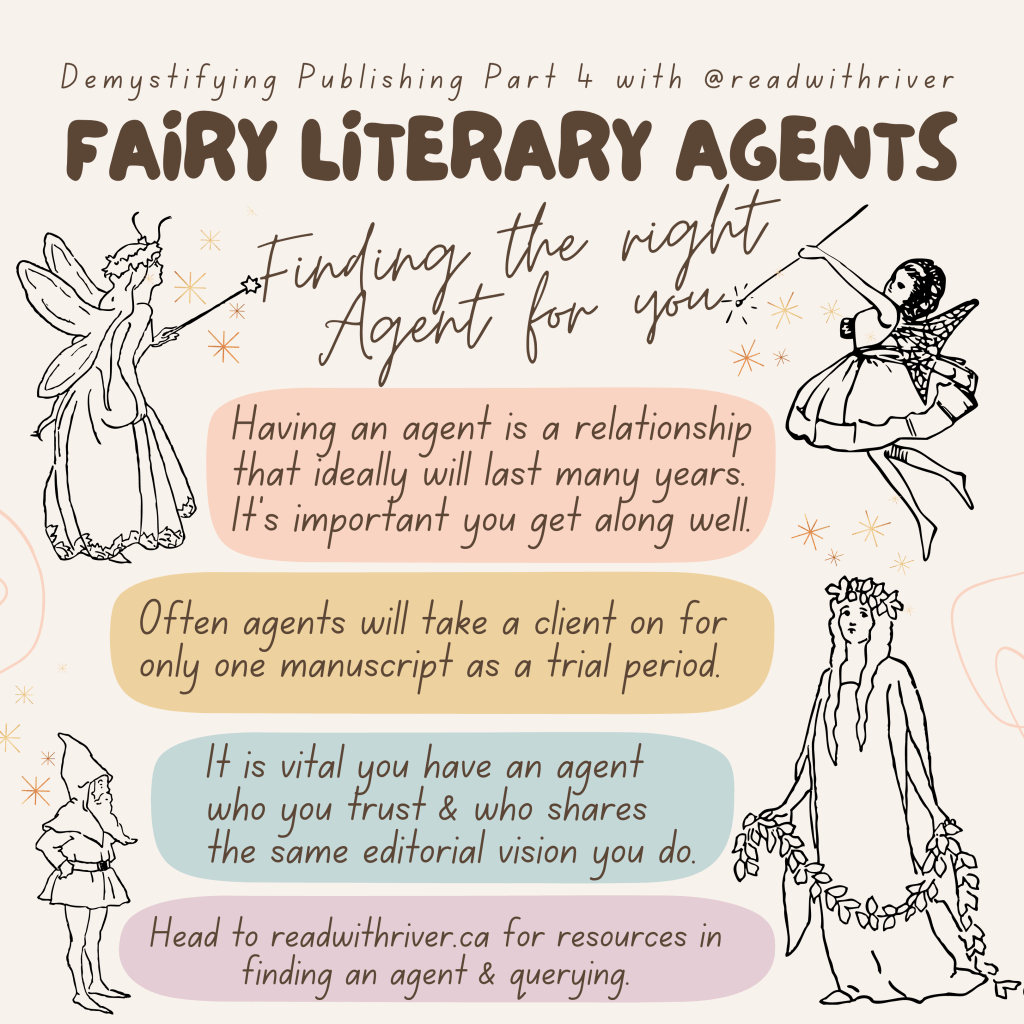
Having an agent is a relationship that ideally will last many years.  It’s important you get along well.  Often agents will take a client on for only one manuscript as a trial period.  It is vital you have an agent who you trust & who shares the same editorial vision you do. Head to readwithriver.ca for resources in finding an agent & querying.

Resources to help you find Literary Agents:

US Literary Agent Listings

https://www.writersunion.ca/literary-agents

http://www.ardorlitmag.com/literary-agents.html

https://literaryagencies.com/literary-agents-childrens-books/

https://www.pw.org/literary_agents

Posted in Uncategorized

Early STEM Learning and the OZOBOT

This week we will be hosting a fantastic STEM Learning Giveaway on our Instagram @Readwithriver Giveaway runs from Dec. 3- Dec. 10, 2020.

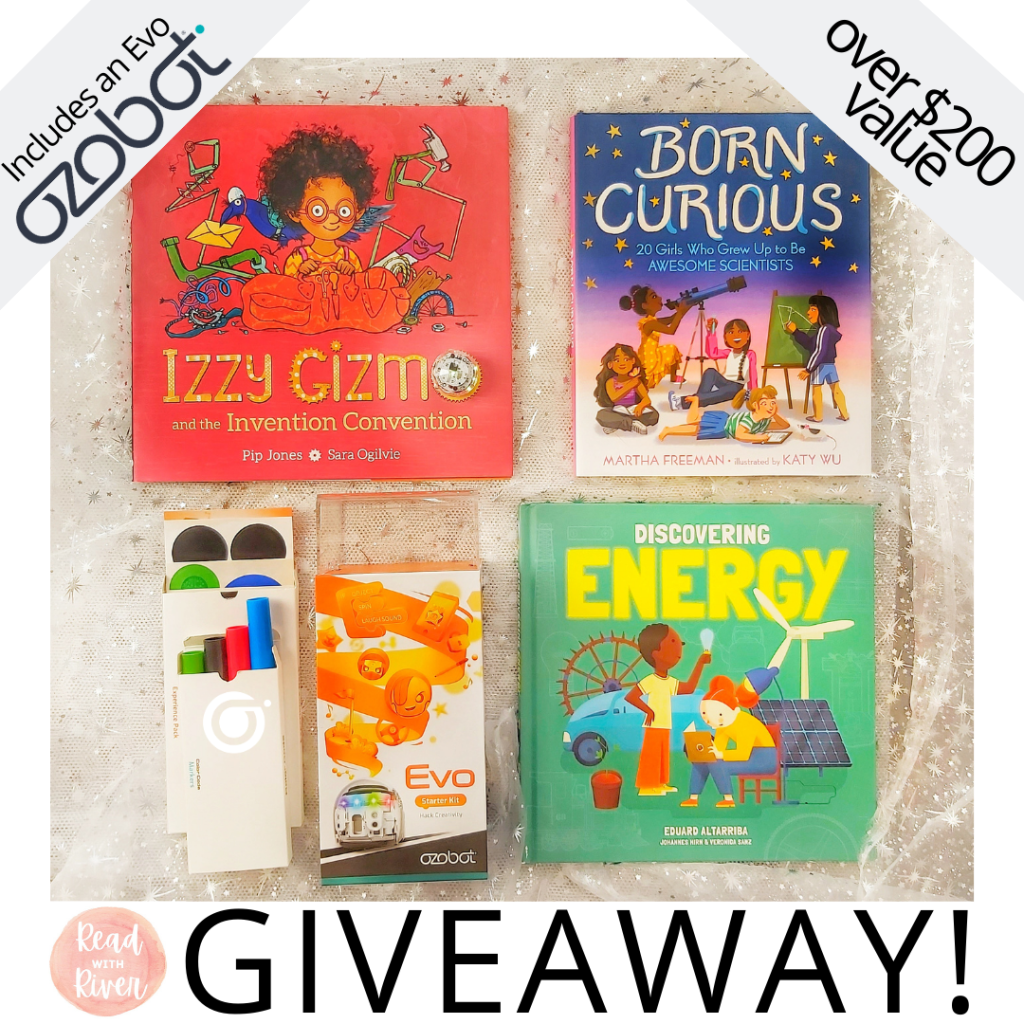
We are so excited to be doing an incredible STEM (Science Technology Engineering Math) Giveaway this year for our North American Followers. We will be giving away three wonderful books, two of which were winners in the #Bookstagang_Bestof2020 List! And in partnership with @ozobot we will also be giving away

  • “Evo for Home & Homeschool“
  • In the box:
  • 1 Evo robot
  • Quick Start Guide
  • Evo Experience Pack
  • 4 Color Code markers
  • USB charging cable

To Enter, head over to Instagram! And Enter yourself in the Giveaway Post!

Watch River Show you how to use Evo the Ozobot!

We’re still learning about all of the features, because really the possibilities are enormous with coding your own programs, but here we show some of the basic ways you can use it.

You absolutely do not need to know how to code to be able to use this. It is incredibly accessible.

The Evo is a tiny robot that your child can code to perform certain actions by giving it instructions (code) in a few different ways. Using coloured markers, or stickers, tracks can be created and the Evo will follow along, this includes understanding instructions such as turn left, skip over or finished!

By downloading the app the Evo can also be driven by remote and given other instructions including doing tricks, playing games, or even trying your hand at programming your own game! Both River (4) and Willow (2) have had so much fun, designing tracks especially! They have enjoyed rolling out long sheets of paper to make extra long obstacle courses! It definitely levels up our homeschooling program.

US Customers Can purchase here. I do NOT make a commission from any sales, and I do highly recommend this toy we were gifted one. Additionally if you wish to order an Ozobot, during the holidays, they are also giving away a free Racer Wearable Skin  

Canadians can purchase Evo here.

  • “Evo for Home & Homeschool“
  • In the box:
  • 1 Evo robot
  • Quick Start Guide
  • Evo Experience Pack
  • 4 Color Code markers
  • USB charging cable
  • $99 in the US, $124.99 CAD

About the books in this Giveaway!

“Born Curious: 20 Girls Who Grew Up to Be Awesome Scientists”

This is an anthology of biographies explores the lives of Female Scientists! Inspire your little ones!

“Izzy Gizmo and the Invention Convention”

Izzy and Fixer have returned in the next book in this fabulous series. They’re on a quest to build a naturally fueled recycling machine and hopefully win the Genius Guild badge as well! Relatable characters, fun read aloud, growth mind set!

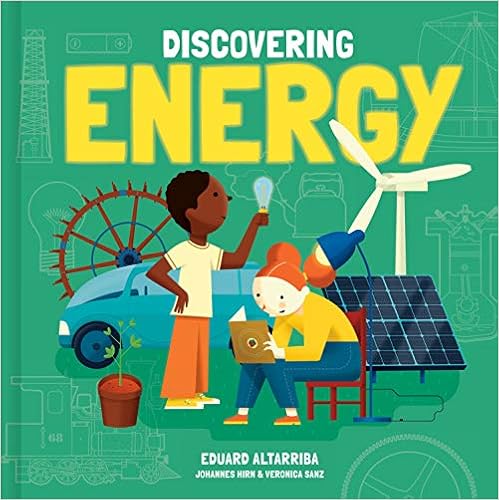
“Discovering Energy”

What is energy? How do humans harness it, how do we use it, what do we use it for? This book explores all of the ins and outs of understanding this complex topic for kids! With wonderful illustrations. This book was one of the nominations for the #Bookstagang’s Best Books of 2020.

Posted in Uncategorized

Twice Recycled Eric Carle Art

Eric Carle inspired Art

20200514_113714_0000

Do you have piles and piles of ambiguous blobby paintings?  We sure do.  River is a prolific abstract artist and it is just impractical to keep every single one.
So how do I mitigate the paper use?  First I give her paper that I have already used, I am a compulsive list maker.
Second, I find ways to then use her paintings again.  This activity is perfect for recycling paintings and gives you a style that looks something like Eric Carle’s works! I saw something like this on a library display board years ago.
I made one here as an example based on Eric Carle’s  “The Very Hungry Caterpillar.”

How to:

Materials

Scissors

Glue

Tempera paint

Paper

Canvas or firm background paper (Bristol board will do)

Utensils for painting with (think outside the box, forks, old tooth brush, sponge, cardboard, cotton balls, you can use your fingers or feet!)


Procedure

1. Have your  child make a bunch of abstract process paintings on a fairly thick paper, we did this over several days. (Abstract process paintings are paintings that aren’t supposed to look like anything and are all about the experience of painting.)

2. Each painting should use different colours, you may wish to limit their colour palatte by only giving them a couple of colours at a time.  Otherwise everything will  be muddy.

3. Let them experiment making marks on these paintings give them different tools for each one.

4. Once it is all dry cut shapes out of the paintings.  Make a variety of sizes and types and throw in some organic shapes for good measure.  You can let your child help with safety scissors.

5. Using regular glue make pictures with the shapes.  To get the Eric Carle feel emphasize layering the picture.  So add plenty of layers and details.

5.  This can be a great opportunity to bring in math discussion and exploration,  talking about shapes, patterning, and symmetry.

6. Show us your work! Tag @readwithriver


#bookishplay #kidsartactivities #kindergartenart


Posted in Uncategorized

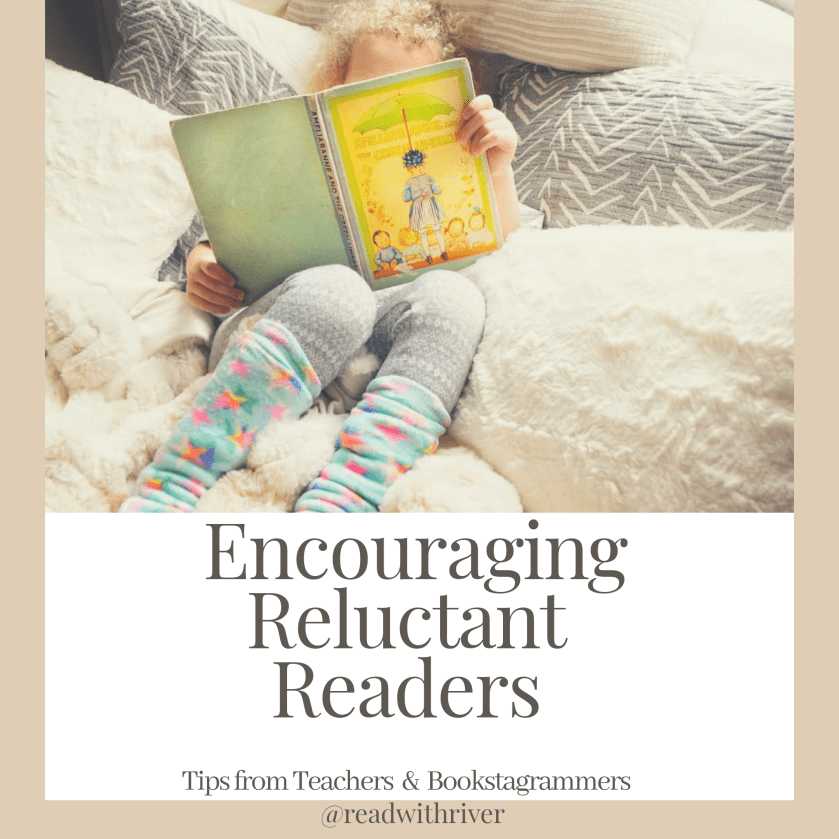
Encouraging Reluctant Readers : Top Advice from Teachers & Bookstagrammers

Not all children instantly love books. A reluctant reader will often struggle down the line with literacy skills and it can affect their feelings about learning in general and their own self esteem.  This can be frustrating for both you and your child. So what can you do?

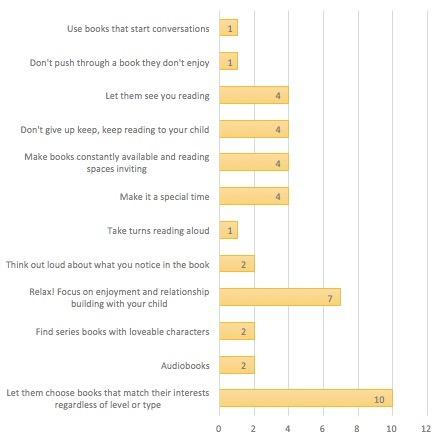
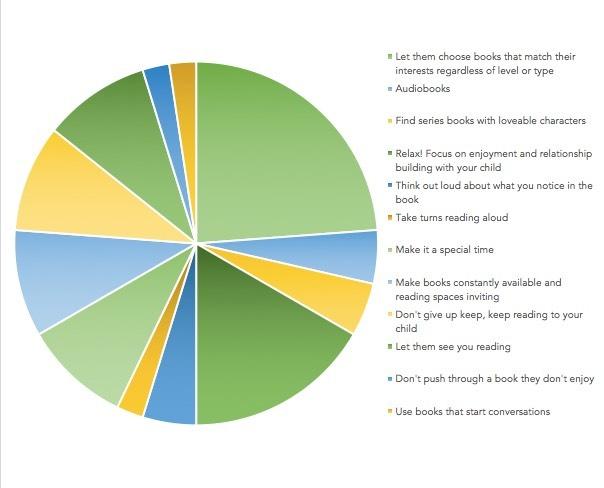
  I have collected advice from 20 of my favourite bookstagrammers and teachers here on Instagram!  Tips that you can implement at home without spending any money.

How to Encourage A Reluctant Reader

  1. Let them choose books that match their interests, regardless of level or type. 
  2. Relax! Focus on enjoyment and relationship building with your child. 
  3. Make it a special time.
  4. Make books constantly available and reading spaces inviting 
  5. Don’t give up, keep reading to your child. 
  6. Let them see you reading 
  7. Consider Audiobooks 
  8. Find series books with loveable characters 
  9. Think out loud about what you notice in the book.  
  10. Don’t push through a book they don’t enjoy 
  11. Use books that start conversations.
  12. Take turns reading aloud.
based on advice submitted from participating teacher influencers and bookstagrammers.

@ReadwithRiver

My tips to make reading inviting! Create spaces that a child would want to read in and have a selection of excellent books for them to choose from.  Rotate the selection regularly. Focus on creating a special time every day where you can also read together and focus on keeping it fun.

@hereweeread

My best tip for reluctant readers is to find a series of books that match their interests.  When kids get to know the characters in a series, they feel connected, invested and want to know more about them. So find a few great series of books to keep them reading.

@kidsmakemess

My advice for parents of reluctant readers would be to relax! I know it’s tough, but try to stop worrying so much about what your child is or is not able to do. 

Find some books on a topic they’re interested in and read it to them. 

Enjoy books together without testing them or making them perform for you. If you can make reading a positive experience, a time for connection, your child is more likely to be motivated to learn. 

Another tip would be to “think out loud” – casually point something out as you read (a letter you notice, a sight word you know they’re practicing at school) or work out a tricky word aloud and then move on. But be careful! If you do this too often or too obviously, your child will likely catch on and get annoyed.

@thereadingninja

Tough to narrow it down because each reluctant reader is different. But probably my number one tip is to find a way to get into the fun of it with your child. Whether your thing is voices, or reading during bath time, or seeking out book events. If you as the caregiver can make it fun and set an example of reading being awesome then the kids will likely follow.

@litcentric

To help kids build stamina for longer texts parents can try an “I read, You read” strategy. Take turns reading a page (or paragraph) at a time. It’s a relief for reluctant readers because they don’t have to carry the full load by themselves and comprehension is better maintained because they can listen to understand when it’s the parent’s turn.

@thetinyactivists

Pick books with engaging illustrations to have conversations about, in addition to reading the text. Ideally, a series or a book that would lend itself well to being a jumping off point for extra interest in a topic.

@inclusivestorytime

“Allow them to choose the books, and set aside the time to read one to one every day. Keep books in every part of the house… even the bathroom! That way a book is never more than an arms length away.”

@aundreatsmith

 I would say allow them to choose the book. Even if we are the one reading to them, giving reluctant readers a choice is helpful. So I would show the child three-four books with topics they are interested in and then have them choose.

@kids.books.we.love

Togetherness and specialness.  Togetherness, making a set time each day and make it special, an afternoon tea after school, a special drink and a bite to eat while sharing a book to read. Whatever you do, make it special and be together

@creativekindergartenblogontpt

Find books that interest them with characters they want to read about. Foster a love of reading!

@mrskobysbookclub

All reading is good reading!

Don’t worry about reading level, or size, or genre, or if it’s a book they’ve read before. Reading is reading.

If someone only wants to read dinosaur books or graphic novels- let them. Building book joy and love is the foundation for lifelong literacy.

Oh and audiobooks are reading too!

Give your kid both- the book and the listenable format and let them follow along.

Hearing fluency modeled is a great way to encourage them to read along on their own!

@the.organized.bookshelf

My number one tip is to let kids see their parents enjoying books. 

@beckys_bookshelf

Find something they are really interested in and tie it to books. My youngest didn’t enjoy reading until I found him some simple biographies about famous runners. Also, audiobooks are a great option for some kids!

@teachasam

Make reading fun! Use silly voices and actions.

@mrswalkerreads

I think family members modelling positive reading behaviours is the most important. Since children learn so much by seeing (not telling), if they see others gaining enjoyment of reading, they might be inspired to give it a try. We tell parents/guardians to pull out a book themselves, read aloud picture books/chapter books, make reference to how reading helps them read driving directions (kids will internalize, “I need to read to drive a car”) or when a parent is cooking they can say, “can you help me read this recipe”… without pressure, parents can model positive ways in which reading is intertwined into daily life

Another tip we share in my role is  not to use timers to enforce 20mins of reading a night (even though we know it’s good practice)… timers make it seem like a chore and when the timer goes off, even if the child was enjoying the book, they will stop and move onto something else

With reluctant readers, we also tell parents not to worry about WHAT they are reading (comics, graphic novels, magazines)… let them gravitate to anything and praise!

Bring them to places where they will also see people reading… bookstores, library… they will start to see that reading is for enjoyment.

@Picturebookplaydate

Let them pick books they’re interested in reading – even if it means they’re reading something you’re not super excited about. Graphic Novels are books! They’re awesome for encouraging a love of reading!

(By “not super excited about” I mean like character books – not books that are inappropriate or anything.)

@bookbairn

It’s ok to give up on a book that’s not working. Forcing something that no one is enjoying is never fun. Put the book away and head to your library for something else. And if in doubt ask a librarian for their recommendations for books on a theme, topic or genre your kid enjoys.

@librarymombooks 

When it comes to reluctant readers, I always think of that J.K. Rowling quote, “If you don’t like to read, you haven’t found the right book.” My biggest tip for parents or teachers looking to help reluctant readers is to first explore the child’s interests and then find a book that fits their personality. I used to give my students a self-evaluation sheet asking them to circle various activities they were interested in and then used that to help guide them to a book I thought they might like that was near their reading level. 

Another tip I have is to be open minded. Many parents don’t love graphic novels, but reluctant readers do! There are a ton of graphic novels out there that not only have tons of kid appeal, but they also help children built important skills like reading with expression and better understanding punctuation. Because these books are highly illustrated, readers can use the pictures to help identify new words and better comprehend the story. Children may finish these stories quickly, but that isn’t necessarily a bad thing. It is a huge boost to their ego to be able to read the entire book and they will usually return for rereadings, which will help books their reading skills.

Many parents also worry when their child chooses a book that they believe is lower than their typical reading level or if they reread a book over and over. There are actually benefits for children rereading books or choosing books on a lower level. Rereading allows them to develop a deeper understanding of some of the nuances in the plot they may have missed the first time and it can be an opportunity to practice their fluency. Sometimes they need a break from all the difficult reading they may be doing in school. Many adults are able to read War and Peace, but very few do because they want something more entertaining. Kids are the same way. 

Kids are figuring out their own reading identities and they have to have the freedom to explore and choose their own books.

Scholastic has two new groups of books aimed specifically for new/ reluctant readers that are fantastic! 

Acorn Books are intended for children ages four to seven and contain an excellent combination of easy-to-read text, color illustrations, and engaging storylines featuring friendship stories, humor, and magic. They also include tips for drawing the characters to inspire budding writers to create their own stories. 

The Branches Books are an ideal choice for those newly independent readers who are in between the easy reader stage and traditional chapter books. They have high-interest stories with simple plotlines that include easy-to-read text and illustrations that provide context clues and aid in reading comprehension. 

@mrsrussellsroom

Read TO your kids. That’s my tip!

@the.crafty.teacher

 let them read whatever they want. Blog, comic, graphic novel, book below grade level, I don’t care, as long as they are reading.

@teachingmykiddos

Honestly, I read this tip from Shannon over at @ohcreativeday about just continuing to read, read, read even when they don’t seem to be listening or don’t seem to care. So I probably read to my now toddler’s bum for months because she would just crawl away. So I think continuing to expose, even when they don’t seem interested, and creating a literacy rich environment would be my only tips!

Posted in #Bookstagraminthe6ix, River Reads, RwR Book Club

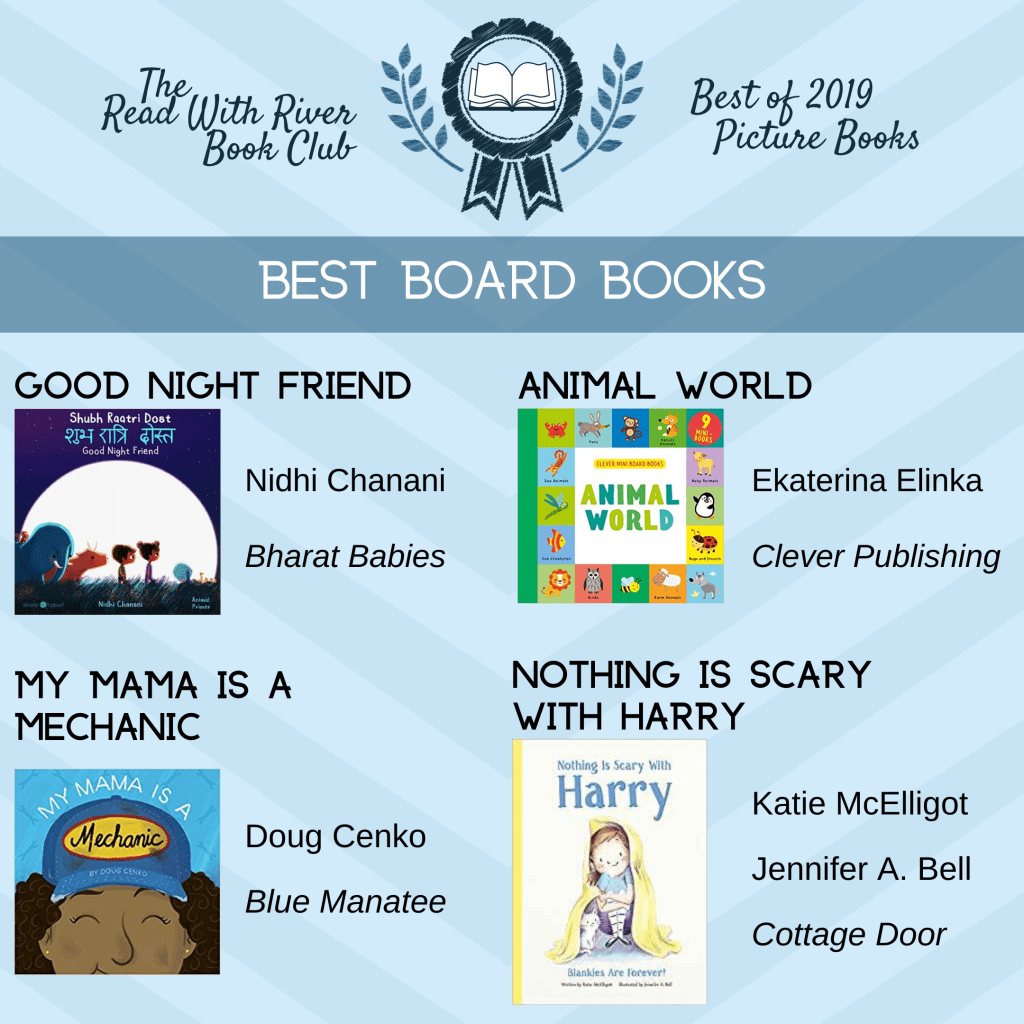
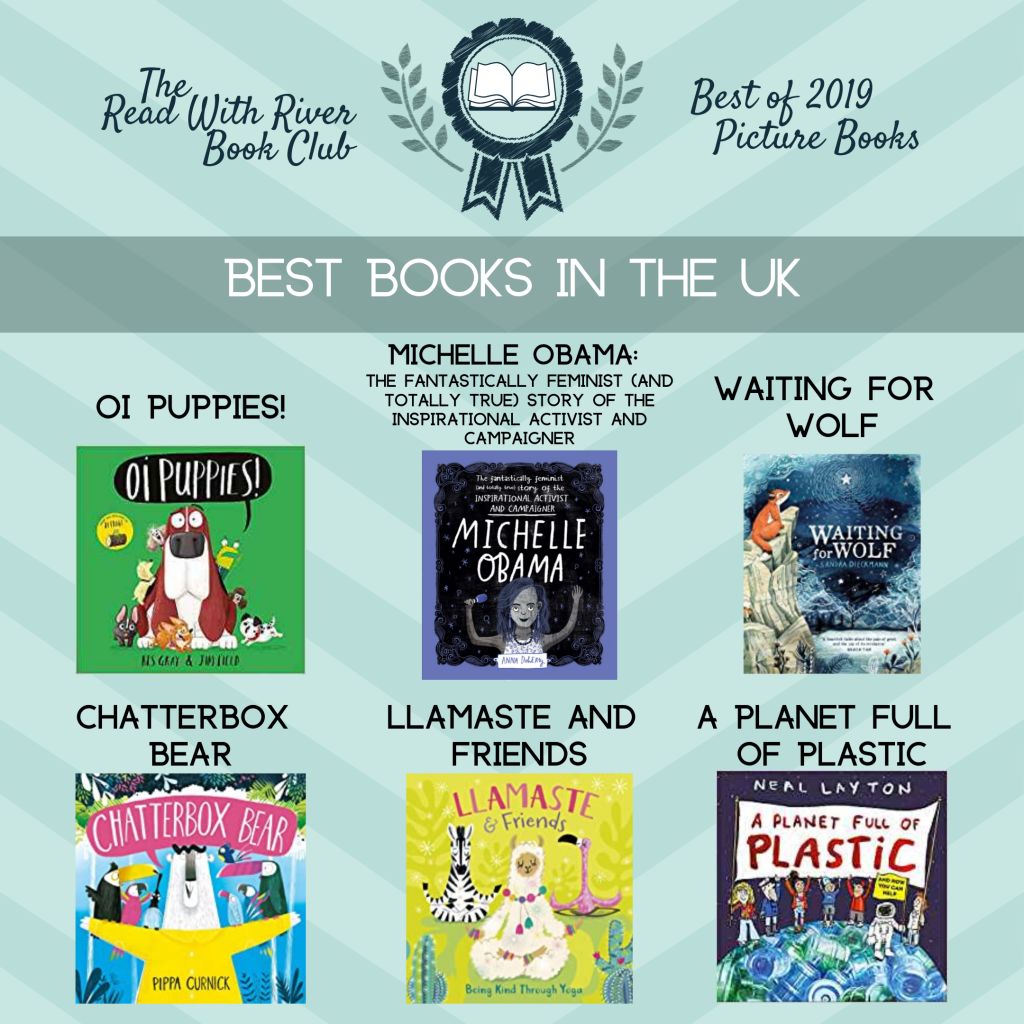
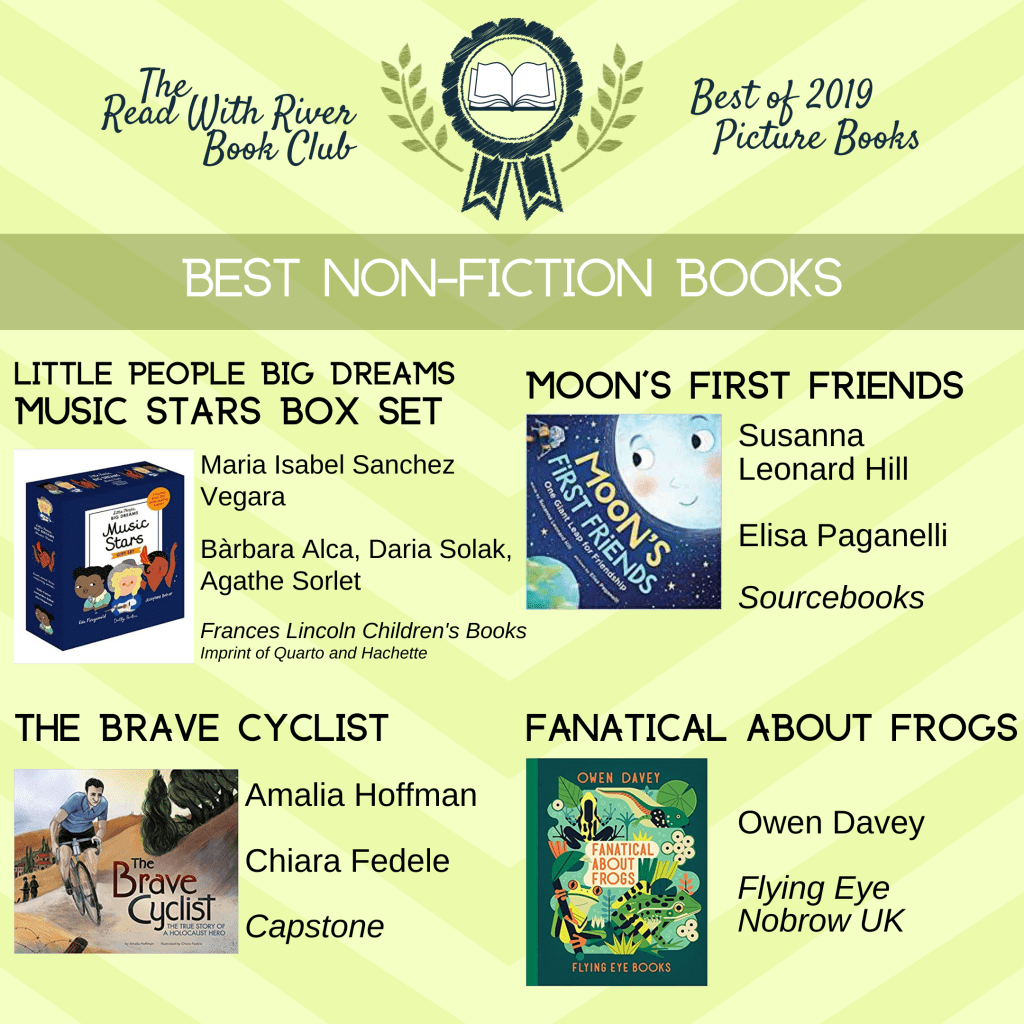
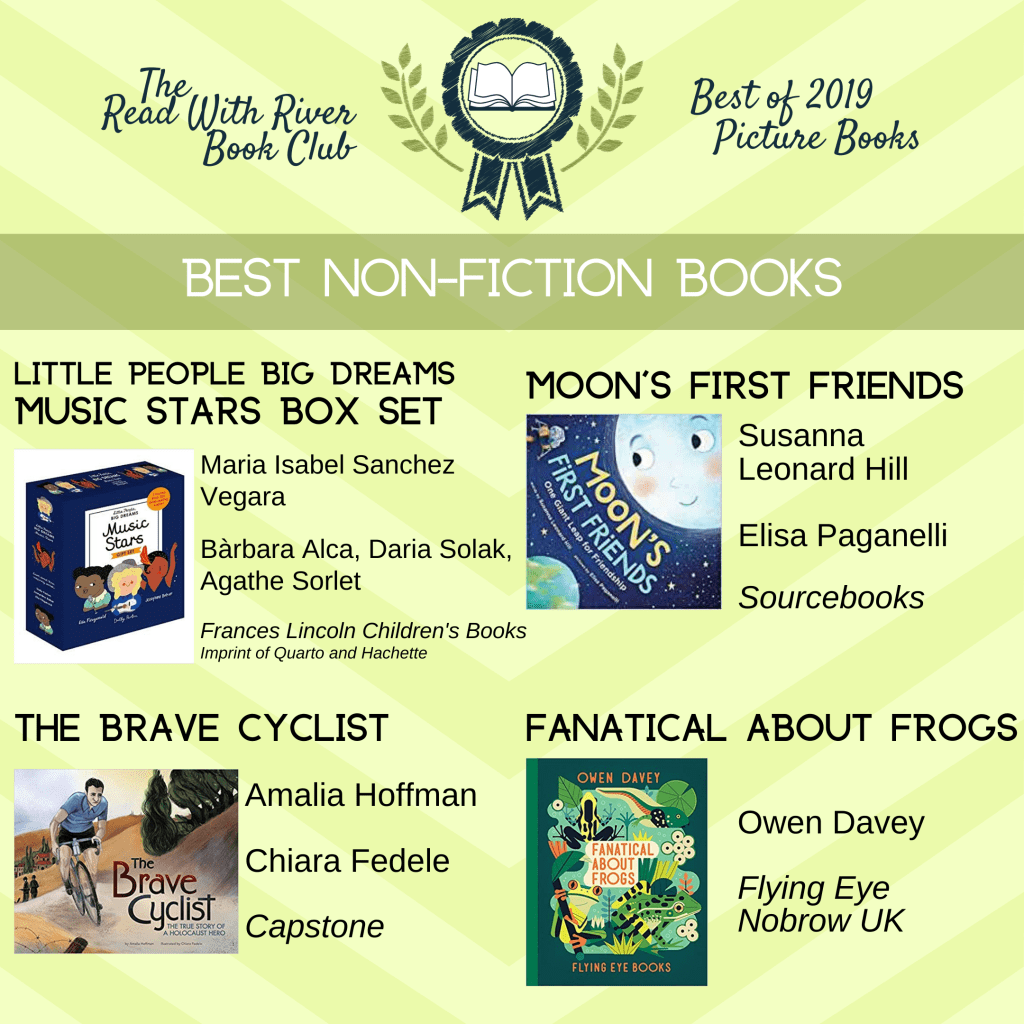
RWR Best Books of 2019

Our Participating Judges

The Read with River Book Club is proud to present the books selected as the best new releases of 2019. The juries for this selection were made up of our 16 regular bookstagram members, and three guest judges worldwide.

How did we come to the decisions we made? The process was admittedly difficult with mountains of books and pdf.’s piling up at our doors and in our inboxes. In the end each book was judged on a scale of one to ten in it’s category, and the scores were added up to give us the most impartial results possible.

There were definitely some stand outs for each of us, and not everyone always agreed on everything. However in the end we were all happy to see books that we could all agree on.

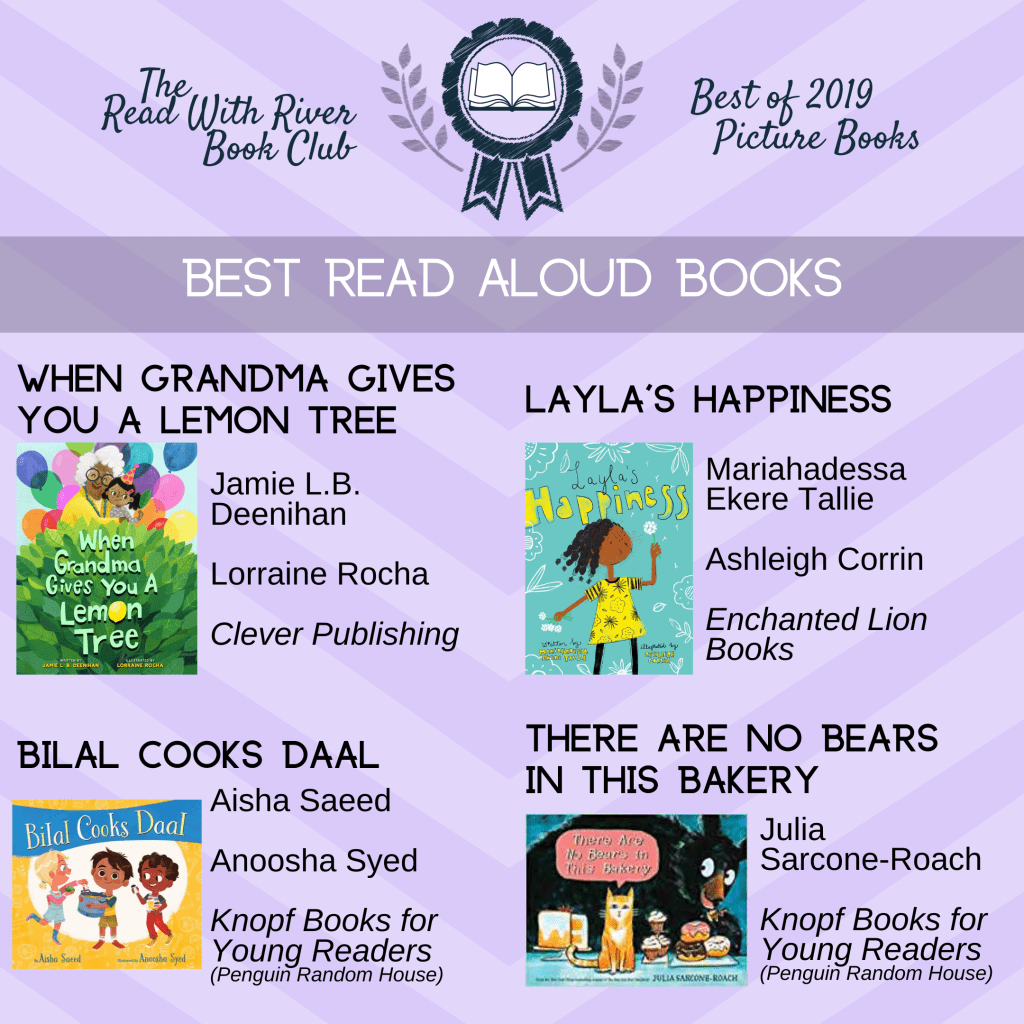
My own personal favourites from the year were “Pokko and the Drum” by Matthew Forsythe, an absolutely gorgeous experiment in effusive and dramatic illustration.

“There are No Bears in this Bakery” by Julia Sarcone-Roach, a cat who monologues like a 1930’s private eye and an awful lot of baked goods in this one for the win. I laugh every time we read it.

“When Grandma Gives You a Lemon Tree” by Jamie L.B. Deenihan and Lorraine Roccha, was an overall win for me too. Excellent story, very relatable, inspiring, and the art was on point. A definite must add for your bookshelf.

Who were the participating judges?

Canadian Judges

@readwithriver

@inclusivestorytime

@Noodlenuts_Classics

@mrswalkerreads

American Judges

@thetinyactivists

@hereweeread

@happilyeverelephants

@comunication.blooms

@toddlers.who.read

@_mybookaddiction_

@bookoholicmom

@houstonlibraryfinds

@astoryaday

@little.librarians

British Judges

@ivyslibrary

@sharing.the.shelf

@bodkinandroo

Australian Judges

@bookskidslove